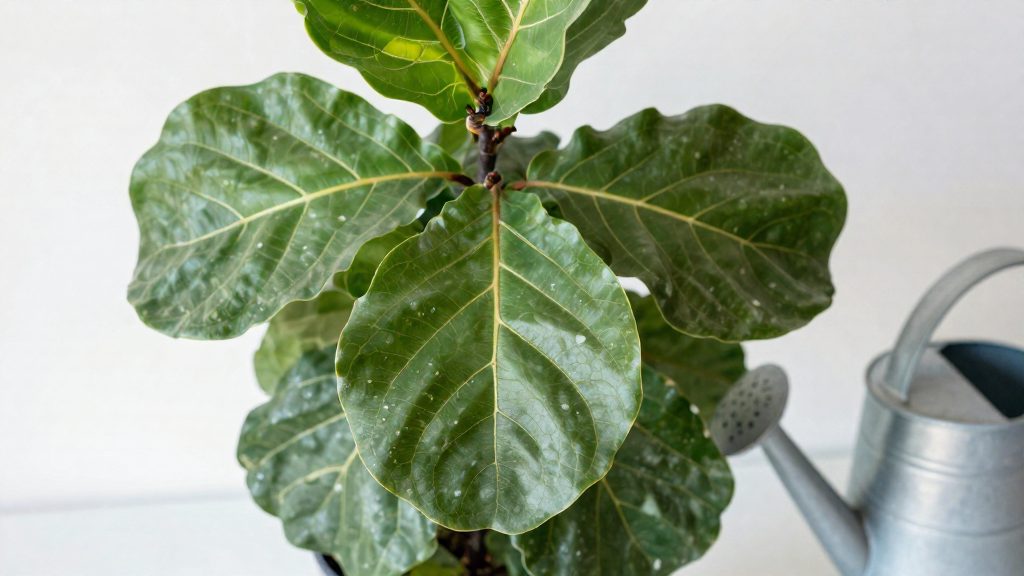
Fiddle leaf figs grow best in bright, indirect indoor light, according to the University of Florida IFAS Extension. Direct sunlight can scorch the leaves, so a sheer curtain is a practical way to soften a sunny window. Sources do not agree on how many hours of direct sun are acceptable, so watch how the leaves respond after you change a position.
Bright Indirect Light as the Baseline
A fiddle leaf fig needs bright indirect light as its standard indoor condition. This means the room receives plenty of daylight, but the sun’s rays do not fall directly on the foliage. Place the plant where the window provides strong ambient light, and keep it out of the direct beam.
Guidance on direct sun varies between sources:
- The University of Florida IFAS Extension recommends indoor light without direct rays.
- UC ANR describes morning sun favorably.
- No universal safe duration of direct sun is established, so check the plant’s leaves and adjust placement if they show stress.
Filtering Direct Sun with a Sheer Curtain
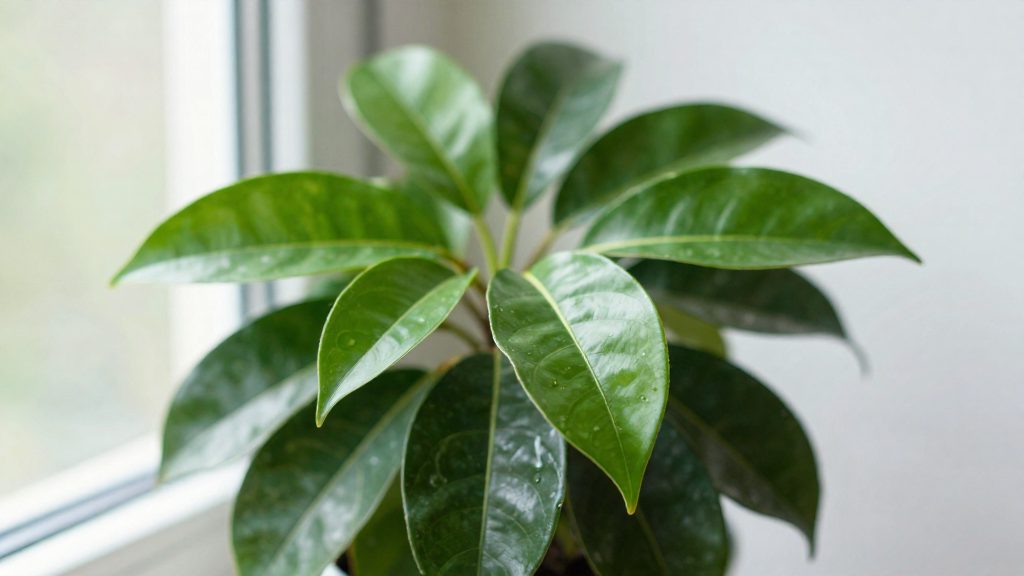
When a window receives strong direct sun, a sheer curtain can filter the light before it reaches the plant. The University of Florida IFAS Extension identifies this as a simple way to reduce direct sunlight. North Carolina State University Cooperative Extension notes that excessive direct sunlight can scorch leaves, which makes filtering a useful precaution in bright rooms.
| Light condition | Guidance | Practical action |
|---|---|---|
| Bright indirect light | Preferred indoor condition (University of Florida IFAS Extension) | Place the plant in a bright room, away from direct rays |
| Direct sunlight | Excess can scorch leaves (North Carolina State University Cooperative Extension) | Limit exposure in intense sun |
| Sheer curtain | Filters direct sunlight (University of Florida IFAS Extension) | Hang it between the plant and the window |
Rotating the Plant for Even Exposure
Rotation balances light across the canopy. The University of Florida IFAS Extension recommends rotating the plant when you water so its leaves receive light more evenly. Doing this at a fixed point in your routine makes it easy to remember. Rotation matters most when the plant sits near a single window, because one side of the canopy otherwise receives most of the light.
When Should You Water It?
Water a fiddle leaf fig when the soil is dry at depth, then water thoroughly until water drains from the pot. Checking moisture before each watering helps reduce the risk of drought stress and overwatering, so base watering on soil conditions rather than a fixed calendar and ensure excess water can drain away.
Testing Soil Moisture
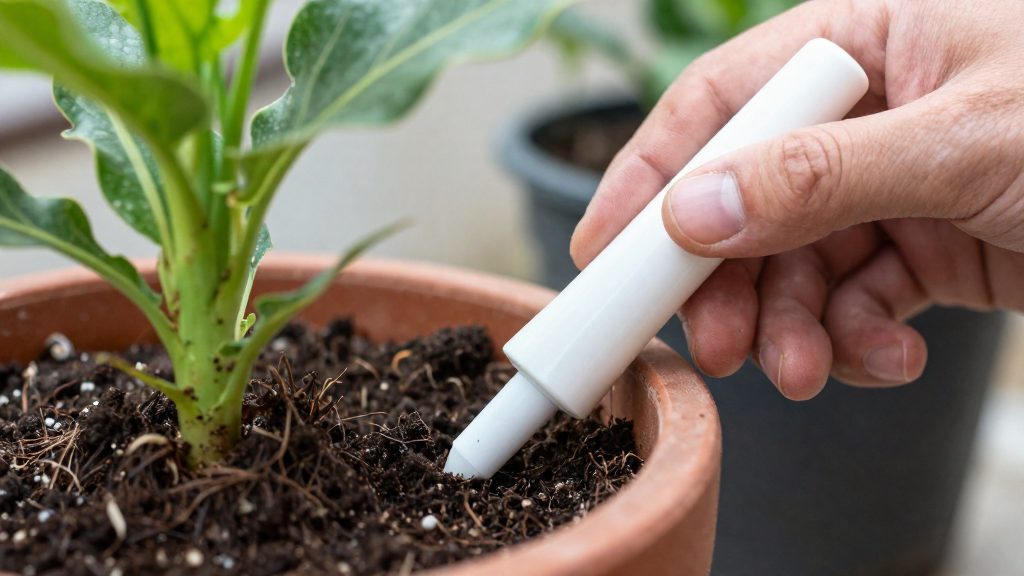
Push a finger or a wooden skewer into the soil to check the top two inches. UC ANR and New York Botanical Garden recommend watering when the top two inches are dry; UF/IFAS instead recommends letting the top inch dry. If it is still damp, wait and check again later.
University of California Agriculture and Natural Resources (2021) uses the two-inch check. The University of Florida IFAS Extension recommends letting the top inch dry, so the recommended depth differs by source.
| Source | Watering trigger |
|---|---|
| University of California Agriculture and Natural Resources (2021) | Top two inches of soil dry |
| New York Botanical Garden | Top two inches of soil dry |
| University of Florida IFAS Extension | Top inch of soil dry |
Watering Until It Drains
Water thoroughly until water runs out of the drainage hole, then empty the saucer after about 15 minutes, according to the New York Botanical Garden. Emptying the saucer removes standing water that would otherwise keep the base of the pot wet.
Adjusting for Winter
The New York Botanical Garden notes that water uptake slows during winter’s lower light. Adjust watering to the plant’s drying rate instead of following a fixed schedule. Check the soil more often than the calendar suggests, and water only when the trigger depth is dry. In winter, this usually means watering less often than in spring and summer.
Choosing Soil and a Pot
Fiddle leaf figs (Ficus lyrata) need a container and a growing medium that let excess water leave the root zone. According to the New York Botanical Garden, the two choices that support this are a pot with a drainage hole and a potting mix that drains well.
Pot with a drainage hole
- Choose a pot with a hole in the base so excess water can exit.
- Use a decorative pot without a hole only as an outer cover, and keep the plant in a nursery pot that has drainage.
Well-draining potting mix
- Use a potting mix that drains well rather than a dense garden soil, which holds water and compacts in containers.
- Check the product label for houseplant or drainage claims, and follow the manufacturer’s instructions for use.
Adding perlite
- Mix perlite into the potting mix to improve drainage, as the New York Botanical Garden notes.
- Follow the mixing ratio printed on the perlite or potting mix label.
Managing Temperature and Humidity
According to University of Florida IFAS Extension, fiddle leaf figs prefer stable temperatures between 65°F and 75°F and indoor humidity above 40%. The stability matters as much as the numbers: a spot that stays in this range through the day and across seasons is better than one that swings from cold to warm. According to New York Botanical Garden, the plant should also be protected from drafts and temperature changes caused by heating vents, air conditioning, doors, and windows.
| Factor | Condition to aim for | Source |
|---|---|---|
| Temperature | Stable, between 65°F and 75°F | University of Florida IFAS Extension |
| Indoor humidity | Above 40% | University of Florida IFAS Extension |
| Drafts and temperature changes | Shielded from heating vents, air conditioning, doors, and windows | New York Botanical Garden |
Keeping the temperature stable
Choose a spot away from the paths of cold or hot air, and avoid moving the plant between rooms with different temperatures. Check the spot at different times of day, since a location that is comfortable in the afternoon may become drafty overnight near a window or door.
Shielding from drafts and heat sources
- Place the plant away from heating vents and air conditioning outlets.
- Keep it clear of doors that open often.
- Avoid positions where cold air or heat enters through a window.
Monitoring indoor humidity
Measure room humidity with a digital hygrometer, which is inexpensive and available at most hardware and home stores. If readings stay below 40%, a room humidifier is one practical option. Position it so that its output does not blow directly onto the foliage, and check the readings again after a few days to confirm the change.
Fertilizing Your Fiddle Leaf Fig
Use a general houseplant fertilizer during spring and summer, and follow the directions on its label. According to the University of California Agriculture and Natural Resources (2021), feeding outside this period is not part of the recommended routine, and the main risk is overfeeding, which can burn the leaf margins. Sources differ on how often to feed, and no universal dose or schedule is established, so the product label is the reference for amount and interval.
Choosing and timing the fertilizer
| Season | Guidance |
|---|---|
| Spring | Start feeding with a general houseplant fertilizer |
| Summer | Continue feeding within the same period |
| Fall and winter | Outside the recommended feeding period |
Feeding frequency varies by source
| Source | Suggested frequency |
|---|---|
| University of California Agriculture and Natural Resources (2021) | Once or twice a year, during spring and summer |
| New York Botanical Garden | Every other week, at half strength |
These schedules differ substantially. Because no universal dose or frequency is established without a specific product, check the label of your fertilizer before choosing an interval.
Following label directions
- Measure the dose exactly as the label states.
- Do not increase the amount or frequency to speed up growth.
- If the label and a general guide disagree, the label takes priority for that product.
Repotting, Pruning, and Cleaning Leaves
Fiddle leaf figs (Ficus lyrata) are repotted in spring, when the roots have filled the container. According to the New York Botanical Garden, the signals are roots emerging above the soil or through the drainage holes, or a root ball that substantially fills the pot. Routine maintenance covers cleaning the leaves, pruning for shape, and checking for pests.
Repotting Signals
| Signal | Action |
|---|---|
| Roots emerge above the soil | Repot in spring |
| Roots grow through drainage holes | Repot in spring |
| Root ball substantially fills the pot | Repot in spring |
Pot-Size Increments
When repotting, increase the container by one pot size. The New York Botanical Garden advises against larger jumps in size, so the plant’s root system is not left in excess soil.
Cleaning Leaves
Clean the leaves gently with a damp cloth. Support each leaf with your other hand while wiping, so the stem is not strained. Dust is removed this way, and the foliage stays clean.
Cleaning is also a good time to inspect the plant. North Carolina State University Cooperative Extension lists scale insects, aphids, mealybugs, thrips, and spider mites as common indoor pests.
Pruning and Removing Dead Leaves
- Shape pruning: Prune in spring by cutting leggy branches back to a node, according to the New York Botanical Garden.
- Dead leaves: Remove them at any time of year.
Troubleshooting Brown Spots and Leaf Drop
Brown spots and leaf drop on a fiddle leaf fig (Ficus lyrata) have several possible causes, and these symptoms alone cannot identify which cause is responsible. Overlapping problems with light, watering, humidity and temperature can produce similar symptoms, so the location of the damage and any recent changes to the plant’s environment both help narrow the cause. Leaf drop can result from either excessive or insufficient watering, and excessive direct sunlight can scorch leaves, according to North Carolina State University Cooperative Extension.
Diagnosing Edge Versus Center Brown Spots
Note whether the browning appears along the leaf margins or in the center, and whether those leaves face a window or receive direct sun. Scorched tissue on sun-exposed leaves is the damage pattern linked to direct sunlight, according to North Carolina State University Cooperative Extension.
Light guidance differs between sources:
| Source | Recommended light |
|---|---|
| University of Florida IFAS Extension | Bright, indirect indoor light; a sheer curtain can filter direct sunlight |
| University of California ANR (2021-03-04) | Describes morning sun favorably |
No universal safe duration of direct sun is established. After changing exposure, watch the leaves over the following weeks instead of relying on a fixed number of hours.
Brown spots can also appear alongside pest activity. Inspect the plant for scale insects, aphids, mealybugs, thrips and spider mites, checking both leaf surfaces and stems, as recommended by North Carolina State University Cooperative Extension.
Leaf Drop After Moving or Relocation
A move changes light intensity, temperature and air movement at once, so leaf drop after relocation often reflects several changes together. Consider these factors:
- Light: Place the plant in bright, indirect light.
- Temperature and humidity: Fiddle leaf figs prefer stable temperatures between 65°F and 75°F and indoor humidity above 40% (University of Florida IFAS Extension). Choose a new spot where these conditions stay consistent.
- Seasonal relocation: Container plants that spent summer on a sheltered patio should return indoors as fall temperatures decline, in temperate U.S. climates (North Carolina State University Cooperative Extension). Plan the move before nights become cold.
Dead leaves can be removed at any time (New York Botanical Garden). Remove them once they are fully brown or dried, rather than trying to save them.
When Symptoms Persist
If browning or leaf drop continues after you have checked light exposure, placement and pests, contact your local cooperative extension office. Extension services, such as University of Florida IFAS Extension, North Carolina State University Cooperative Extension and University of California ANR, provide regional guidance on houseplants. When you call, describe where the damage appears on the leaves, the plant’s placement and any recent move, and send clear photos of the affected leaves.
Keeping Children and Pets Safe
Ficus lyrata is toxic to people, cats, and dogs if ingested, according to North Carolina State University Cooperative Extension. Its sap can irritate skin. Households with young children or pets should treat the whole plant as something to keep out of reach.
Sap Irritation on Skin and Eyes
- Wear gloves when pruning or propagating, since the sap can irritate skin (North Carolina State University Cooperative Extension).
- Wash hands after handling the plant, before touching your face, eyes, or food.
- If sap reaches the eyes, immediately begin rinsing with plenty of room-temperature running water, remove contact lenses, and continue rinsing while obtaining poison control advice about the required duration and further care. Seek emergency care after rinsing if eye symptoms are severe.
Ingestion Risks for Cats and Dogs
Ingestion is the main toxicity risk named for cats and dogs. Cats and dogs may chew leaves or stems, especially young plants or trailing growth.
- If a pet has chewed any part of the plant, contact a veterinarian or an animal poison control service promptly.
- Bring a leaf or stem sample to the appointment so the plant can be identified.
- Symptoms of ingestion are not described here, so do not wait for signs before seeking advice.
Placing the Plant Out of Reach
Choose a position that meets the plant’s light needs, which are bright, indirect light (University of Florida IFAS Extension), while also keeping it away from pets and children.
- Use a sturdy plant stand or a high shelf that is stable and away from frequent foot traffic.
- Keep the plant away from drafts and heating vents, as recommended by New York Botanical Garden.
- Check that a climbing cat cannot reach the plant from nearby furniture, since a stand alone may not prevent access.