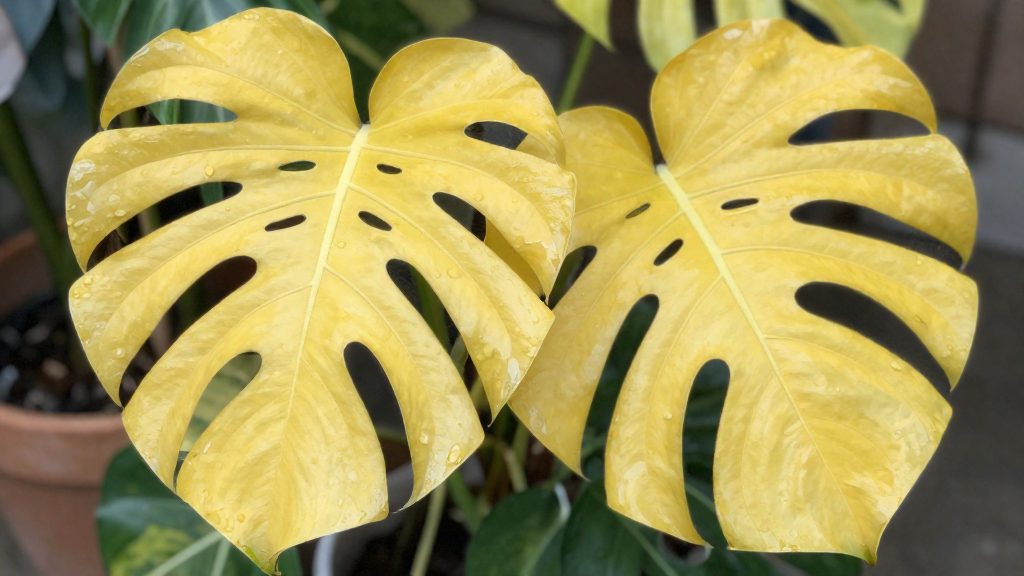
Symptom, not a diagnosis. Several stress factors produce the same yellow color, including moisture imbalance, low temperature, light problems, fertilizer excess, pests, repotting and natural aging. Identifying the cause starts with observing which leaves are affected and what else appears on them.
Why do Monstera leaves turn yellow?
Yellowing reflects stress in the leaf tissue, but the colour alone does not identify the trigger. A Monstera that is too wet, too cold, under-lit or recently repotted can show the same yellow tones, so the cause has to be inferred from context. According to Bloomscape (2026), moisture, especially overwatering, is the most common cause, which is why moisture is often the first suspect. Other stresses can produce similar colours, so checking the wider picture avoids treating the wrong problem.
Why diagnosis starts with the pattern, not the colour
Before changing any care routine, record the following:
- Which leaves are yellow: older lower leaves, or leaves across the whole plant.
- Accompanying marks: spots, crispy edges, light-brown dry patches, holes, white webbing or sticky residue.
- Soil surface: a white crust on the soil, which Epic Gardening (2025-01-29) links to excess fertiliser.
- Timing: whether the yellowing followed repotting, arrived in winter, or appeared alongside new growth.
Diagnosing the pattern early protects the remaining foliage, because a correct cause allows the plant to recover while the unaffected leaves are still healthy.
Map of cause categories covered in this guide
| Cause category | Typical pattern | Source |
|---|---|---|
| Moisture imbalance | Named as the most common cause; detailed separately in this guide | Bloomscape (2026) |
| Low temperature | Growth stops below 50°F (10°C) and leaves can yellow; ideal range 65-85°F (18-29°C) | Easyplant (2026) |
| Light problems | Too little light causes yellowing and slow growth; direct sun can scorch leaves | Bloomscape (2026) |
| Fertiliser excess | White crust on soil, slow growth and crispy brown edges | Epic Gardening (2025-01-29) |
| Sap-sucking pests | Spider mites, scale and mealybugs, especially on a weakened plant | Bloomscape (2026) |
| Repotting stress | Transplant-shock yellowing shortly after repotting | Epic Gardening (2025-01-29) |
| Natural ageing | Older lower leaves shed while new growth appears | Bloomscape (2026) |
Matching the pattern to one of these categories narrows the likely cause before any treatment. Light, pest and fertiliser causes are covered in their own dedicated parts of this guide.
Overwatering and underwatering
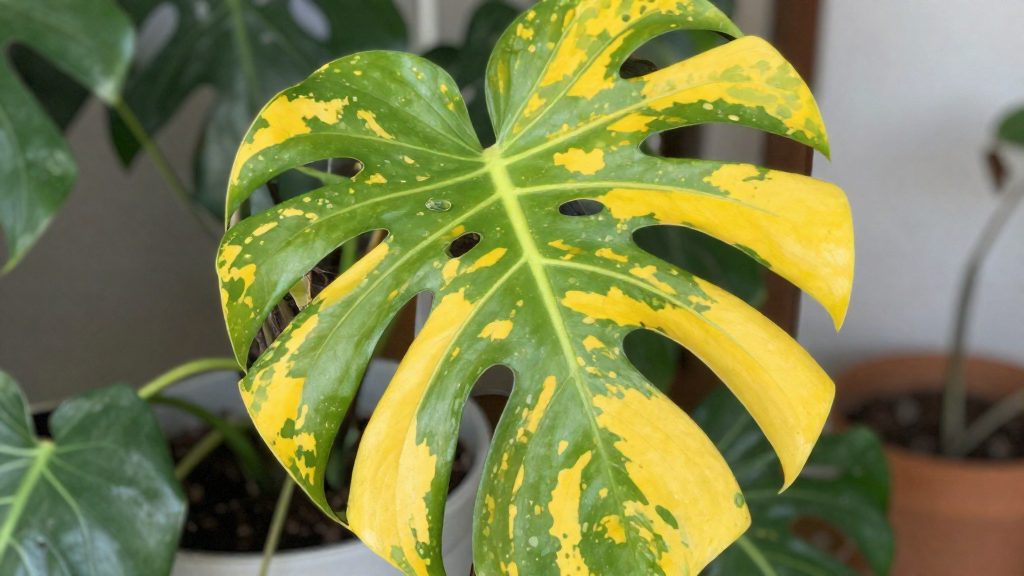
Watering errors are a leading cause of yellow Monstera leaves. Too much and too little water both produce yellowing, but they leave different patterns on the plant, so the symptoms can help you tell which error is occurring.
Overwatering symptoms
Excess water is the more frequent problem. According to Easyplant (2026), overwatering yellows the lower leaves first, and the affected leaves often develop black or brown spots. Because the damage starts at the base of the plant, check the oldest foliage first when you suspect a watering problem.
Underwatering symptoms
Underwatering yellows leaves throughout the plant instead of starting at the bottom. Easyplant (2026) notes that these leaves often show light-brown dry spots. The distinction matters: yellowing spread across the whole plant points toward too little water, while yellowing concentrated on the lower leaves with dark spots points toward too much.
| Symptom | Overwatering | Underwatering |
|---|---|---|
| Where yellowing starts | Lower leaves first | Leaves throughout the plant |
| Spot type | Black or brown spots | Light-brown dry spots |
Watering routine
Bloomscape (2026) advises watering only when the top 2-3 inches of soil are dry, and watering less in winter. Epic Gardening (2025-01-29) gives a similar check, recommending that the top 2 inches or so dry out before watering again. To test, push a finger into the soil to that depth before each watering.
Is low light or too much sun the problem?
Low light and direct sun both affect Monstera leaves, but they cause different damage. Too little light causes yellowing and slow growth, while direct sun scorches leaves. According to Bloomscape (2026), bright, indirect light is the recommended fix for both problems. Identifying which problem is present shows whether the plant needs to move closer to a window or farther from one.
Low light: slow growth and gradual yellowing
When a Monstera receives too little light, it tends to grow slowly and its leaves yellow gradually rather than in sudden patches. Bloomscape (2026) lists insufficient light as a cause of yellowing and slow growth. Because the decline is slow, it can be mistaken for normal ageing. Yellowing combined with slow growth is the pattern to watch for.
Direct sun: bleached, scorched patches
Direct sun damages leaves in a different way. Exposed leaves can show bleached, scorched patches, so the damage is localised to the leaves receiving the strongest light. Bloomscape (2026) notes that direct sun can scorch leaves.
| Problem | Main symptom | Typical location |
|---|---|---|
| Low light | Slow growth and gradual yellowing | Across the plant as growth slows |
| Direct sun | Bleached, scorched patches | Exposed leaves facing the light |
Placement: bright, indirect light and window orientation
Placing the plant where it receives strong ambient daylight, without direct rays falling on the foliage, addresses both problems. The orientation of the window determines how much direct sun reaches the plant, so check which window it sits in before making changes. If scorch marks appear, move the plant away from a sunny window. If growth is slow and leaves are yellowing gradually, move it nearer to a bright spot without direct rays. The official sources consulted do not specify exact distances or hours of light, so adjust the position in small steps and observe new growth.
Temperature, drafts and humidity
Temperature is one of the environmental factors most directly linked to Monstera leaf yellowing. According to Easyplant (2026), the ideal range is 65-85°F (18-29°C). Below 50°F (10°C), growth stops and leaves can yellow. Epic Gardening (2025-01-29) adds that Monsteras do best when temperatures stay above 60°F (16°C).
| Temperature | Effect on the plant |
|---|---|
| 65-85°F (18-29°C) | Ideal range (Easyplant, 2026) |
| Above 60°F (16°C) | Level at which Monsteras do best (Epic Gardening, 2025-01-29) |
| Below 50°F (10°C) | Growth stops and leaves can yellow (Easyplant, 2026) |
Cold drafts
Cold air is one temperature stress to avoid for indoor Monsteras. Epic Gardening (2025-01-29) recommends keeping the plant away from cold windows in winter. The same principle applies to other sources of cold air, such as doors that open to the outdoors and air conditioning outlets, which can send cold air over nearby leaves.
The consulted sources do not specify how close a draft must be to cause damage, or how long exposure must last. Check the leaves after cold periods. If yellowing appears on the side of the plant facing a draft, move the pot to a more stable spot.
Low humidity and heating vents
Heating systems can dry indoor air, but the consulted sources do not describe low humidity or heating vents as a cause of Monstera yellowing, and they give no humidity percentage or threshold.
To limit exposure to heated, dry air:
- Keep the plant away from heating vents, radiators and baseboard heaters.
- Avoid placing it in the direct flow of warm air from a vent.
- Observe the plant over several weeks. Yellowing on the upper leaves, rather than only the lower ones, may point to a stress factor other than watering, but the sources do not confirm this pattern.
Pests and nutrient problems
Sap-sucking pests and overfertilizing are two causes of yellowing on a Monstera that are less common than moisture problems but still significant. Bloomscape (2026) lists sap-sucking pests, including spider mites, scale and mealybugs, as a cause of yellowing, especially on a plant that is already weakened. Because these pests feed on plant sap, the damage appears as yellowed areas, so a diagnosis depends on inspecting the leaves and stems directly.
Spider mites, mealybugs and scale
Easyplant (2026) lists three pest signs: holes in the leaves, white webbing and sticky residue. Check both sides of the leaves and the stems for these signs before assuming a nutrient or water problem. To treat an infestation, spray the plant with water first, then apply insecticidal soap or neem oil, as Easyplant (2026) recommends. The official sources consulted do not specify how often these treatments should be repeated.
Nitrogen and magnesium deficiency
The official sources consulted do not describe yellowing patterns for nitrogen or magnesium deficiency in Monstera, so this article cannot confirm the pattern for either nutrient. Before attributing yellow leaves to a nutrient shortage, rule out the causes that the sources do document: moisture, temperature and light. If a deficiency is still suspected, confirm it with a soil test before adding any fertilizer.
Overfertilizing
Epic Gardening (2025-01-29) identifies overfertilizing as a cause of yellowing. The signs are a white crust on the soil, slow growth and crispy brown edges on the leaves. The recommended response is to flush the soil, reduce fertilizer to half strength or less, and skip fertilizer for several months after overfeeding.
| Symptom | Documented cause | Source |
|---|---|---|
| White crust on soil, slow growth, crispy brown edges | Overfertilizing | Epic Gardening (2025-01-29) |
| Holes, white webbing, sticky residue | Pest damage | Easyplant (2026) |
| Yellowing on an already weakened plant | Sap-sucking pests | Bloomscape (2026) |
Repotting stress and soil
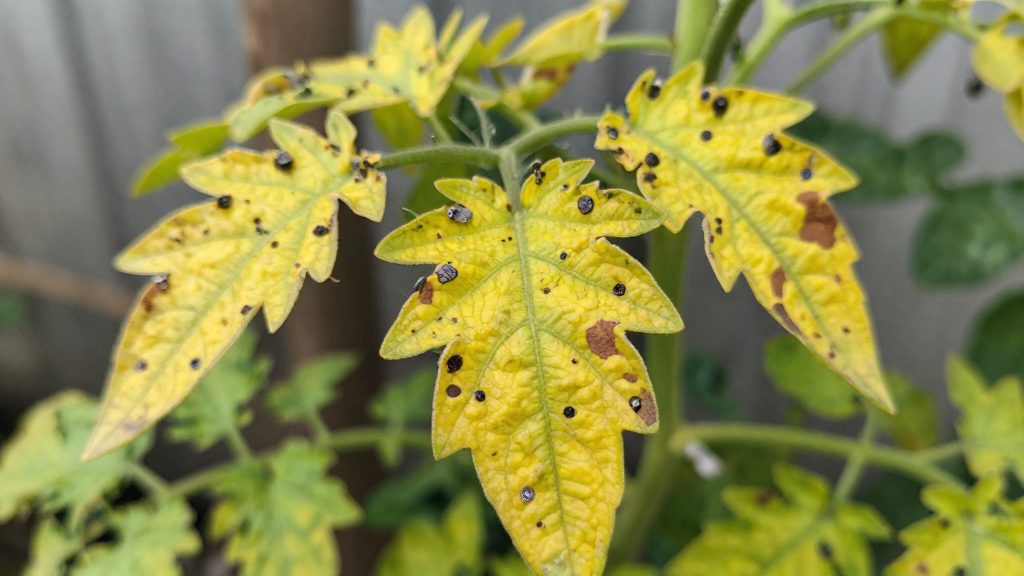
Repotting can make a Monstera yellow even when watering and light are correct. According to Epic Gardening (2025-01-29), repotting can cause transplant-shock yellowing. Epic Gardening recommends repotting every 1-2 years, handling the roots as little as possible, and watering right after the move. Timing, root handling, soil structure and pot choice all affect whether the plant recovers without losing leaves.
Transplant shock
Removing a plant from its pot damages some roots, and a disturbed root system takes time to take up water and nutrients. Yellowing that appears after repotting is usually a stress response to this disturbance. To limit it, ease the root ball out gently, avoid pulling on the stems, and set the plant back at the same depth it was growing at before.
Root-bound plants and circling roots
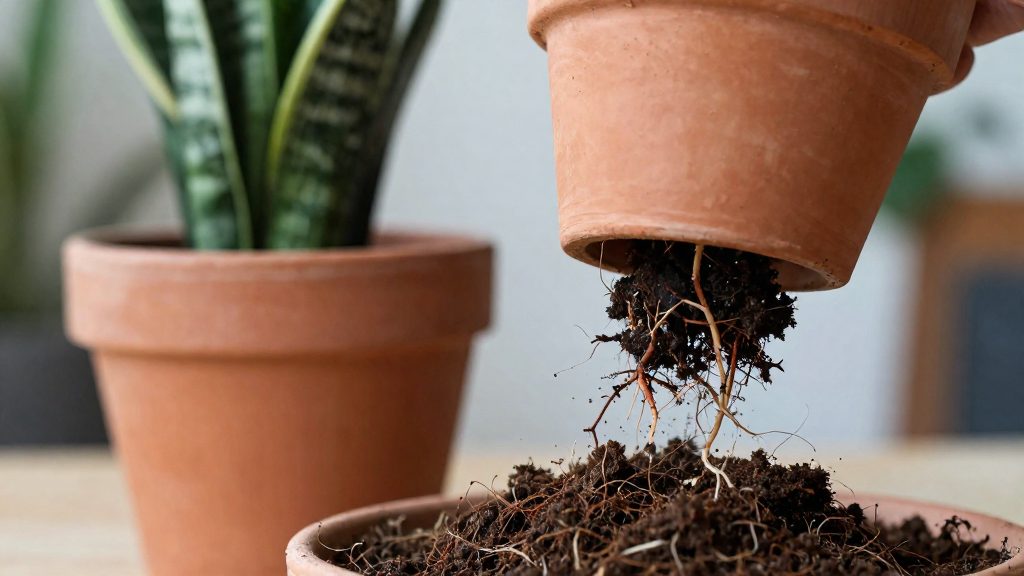
A root-bound plant has filled its container with roots. Typical signs are roots circling the inside of the pot or growing out through the drainage holes. When the root ball is loosened, separate circling roots gently with your fingers and trim only roots that are damaged or dead. Avoid removing large sections of healthy root, since this adds to the stress of the move.
Soil compaction and aeration
Compacted soil holds less air around the roots. The mix Epic Gardening suggests is designed to stay loose and well aerated:
| Component | Parts |
|---|---|
| Potting soil | 2 |
| Perlite | 1 |
| Coconut coir | 1 |
Dense garden soil or heavy mixes packed tightly into the pot are poor choices for this plant, since they hold water around the roots and restrict air.
Pot size and drainage
Choose a container with plenty of drainage holes, as Epic Gardening (2025-01-29) recommends. The official sources consulted do not specify an exact size increase for repotting, so move the plant only into a pot modestly larger than its current root ball. A much larger pot holds more soil moisture than the roots can use, which slows drying and prolongs the stress of the transition.
Is yellowing ever normal?
Some yellowing is part of a Monstera’s normal growth. According to Bloomscape (2026), older lower leaves are shed when new growth is appearing, so a yellow leaf at the base of the plant during a period of new growth is not necessarily a sign of illness. What matters is which leaves are yellowing, how many are affected, and whether the newer leaves stay green.
Natural aging of the oldest lower leaves
The oldest lower leaves are the ones closest to the soil and the first to form on the plant. As the plant produces new leaves at the top, these lower leaves can lose color and drop. Bloomscape (2026) links this shedding to periods of new growth, so yellowing that appears alongside fresh leaves opening fits this pattern.
Yellowed leaves do not turn green again
Easyplant (2026) states that yellowed leaves do not turn green again and typically fall off. A leaf that has fully yellowed will not recover its color, so checking the plant means looking at the newest leaves rather than the ones already lost.
Telling natural aging from a problem
Aging usually affects only the oldest leaves, while a problem tends to spread. Use this comparison:
| Feature | Natural aging | Possible problem |
|---|---|---|
| Leaves affected | Oldest lower leaves | Newer leaves, or yellowing that moves upward over time |
| New growth | Healthy new leaves emerge as older ones drop | New leaves also turn yellow |
| Spots or pests | Not linked to aging | Black or brown spots (Easyplant, 2026); holes, white webbing or sticky residue (Easyplant, 2026) |
To check the plant, follow these steps:
- Count the yellow leaves and note their position on the stem.
- Observe whether yellowing stays on the oldest leaves or moves toward newer growth over successive weeks.
- Inspect leaf undersides and stems for holes, white webbing or sticky residue.
- Look for black or brown spots on the leaves.
Lower-leaf yellowing alone does not separate aging from a cause such as overwatering, so the spread pattern and any accompanying signs are the deciding factors.
What to do with yellow leaves
Treat yellow leaves as a symptom to diagnose before you touch the care routine. Light, temperature, feeding, pests, and repotting can produce similar yellowing. Changing several things at once makes it impossible to tell which change helped, so work through a short checklist, correct one cause, and then, if you wish, remove fully yellow leaves.
Step 1: Diagnose before changing care
Start by looking at where the yellowing is and what it looks like:
| Symptom | Likely cause | Source |
|---|---|---|
| Lower leaves yellow first, often with black or brown spots | Overwatering | Easyplant (2026) |
| Yellowing across the whole plant, often with light-brown dry spots | Underwatering | Easyplant (2026) |
| White crust on the soil, slow growth, crispy brown leaf edges | Overfertilizing | Epic Gardening (2025-01-29) |
| Holes, white webbing, or sticky residue | Sap-sucking pests | Easyplant (2026); Bloomscape (2026) |
| Older lower leaves yellowing while new growth emerges | Natural shedding | Bloomscape (2026) |
| Yellowing after repotting | Transplant shock | Epic Gardening (2025-01-29) |
Then run through these checks:
- Pattern: Note whether the yellow is on old lower leaves, new leaves, or the whole plant.
- Soil moisture: Check the soil with your finger before deciding anything about watering.
- Soil surface: Look for a white crust, which points to fertilizer buildup.
- Leaf undersides and stems: Look for pests, holes, webbing, or sticky residue.
- Recent changes: Check whether the plant was repotted recently.
If pests are present, Easyplant (2026) recommends spraying with water first, then with insecticidal soap or neem oil.
Step 2: Correct the cause
Make one adjustment at a time, based on what the checklist showed. Move the plant away from cold windows in winter, and adjust its position if it is getting direct sun or too little light.
Step 3: Remove yellow leaves
Once the cause is addressed, remove leaves that are fully yellow or damaged:
- Use clean, sharp shears so the cut is smooth and the plant is not torn.
- Cut the leaf stalk close to the main stem or at its base, without cutting into the stem itself.
- Clean the blades between plants, especially if pests were present.
- Remove only leaves that are clearly yellow or damaged. Leaves that are still green should stay on the plant.
Cutting them is a tidiness step rather than a required one.
Step 4: Monitor the new growth
After the change, watch new leaves as they unfurl. Healthy new growth is the clearest sign that the correction is working. The official sources consulted do not specify a set timeframe for this, so observe the plant over the following weeks and avoid judging the result after a single day. If yellowing continues on new leaves, return to Step 1 and check a different variable.
Frequently asked questions
Does overwatering always cause yellow Monstera leaves?
Not always, but it is the usual suspect. According to Bloomscape (2026), overwatering is the most common cause, and it typically yellows the lower leaves first, often with black or brown spots. Underwatering can look different, with yellowing across the whole plant and light-brown dry patches (Easyplant, 2026).
Will a yellow Monstera leaf turn green again?
No. Easyplant (2026) notes that yellowed leaves do not regain their green colour and typically fall off. Your priority is protecting the healthy foliage and new growth that remain.
Is some yellowing on the lower leaves normal?
Yes, when it affects older leaves and new growth is emerging. Bloomscape (2026) explains that this is natural aging, as the plant sheds its oldest lower leaves. Yellowing with holes, white webbing or sticky residue points to pests rather than normal shedding.