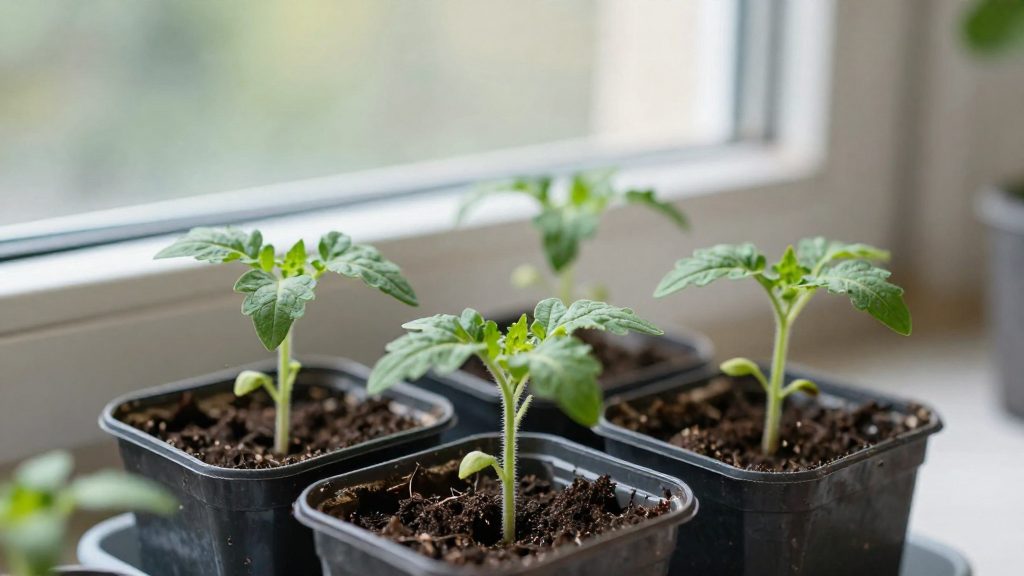
When to start tomato seeds indoors
Tomato seeds are usually sown indoors 5 to 6 weeks before the intended outdoor planting date, according to Iowa State University Extension and Outreach (2024). Epic Gardening (2026) gives a wider range of 6 to 10 weeks before the last frost. Old Farmer’s Almanac (2026) suggests about 6 weeks before the last expected spring frost. The sources count back from two different anchors, the transplant date and the last spring frost, so the exact sowing date depends on which one you use.
Standard window: 5 to 6 weeks before outdoor planting
Iowa State University Extension and Outreach (2024-04-30) advises sowing tomato seeds indoors 5 to 6 weeks before the intended outdoor planting date. To find your sowing date, count back 5 to 6 weeks from the day you plan to transplant.
Extended window: 6 to 10 weeks before the last frost
Epic Gardening (2026) gives a wider window of 6 to 10 weeks before the last frost date. Sowing early in this range produces older seedlings at transplant time. Sowing late in it produces younger seedlings, which need less time indoors before planting out.
Old Farmer’s Almanac (2026) uses a single reference point: about 6 weeks before the last expected spring frost.
| Reference point | Sowing window | Source |
|---|---|---|
| Outdoor planting date | 5 to 6 weeks before | Iowa State University Extension and Outreach (2024-04-30) |
| Last frost date | 6 to 10 weeks before | Epic Gardening (2026) |
| Last expected spring frost | About 6 weeks before | Old Farmer’s Almanac (2026) |
Sowing depth
Sow each tomato seed 1/2 inch deep (Old Farmer’s Almanac, 2026). Fill the container with seed-starting mix, make a shallow hole with a fingertip or pencil, drop in one seed, and cover it with mix. Water gently so the seed is not washed to the surface.
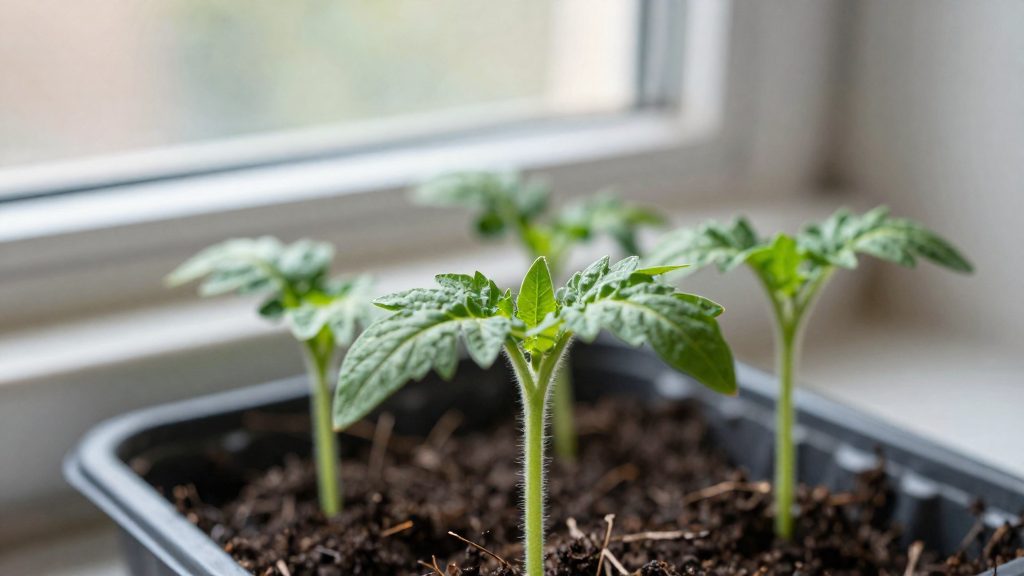
How do I find my last frost date?
The average last spring frost date is the anchor for every tomato seed-starting calculation, because the indoor sowing date is counted backward from it. It is a statistical average for your location, not a day on which frost is guaranteed to be over. The Iowa State University Extension and Outreach (2024) guidance shows how much this date varies even within one state: frost danger is treated as past around late April in southern Iowa and mid-May in northern counties. The same principle applies wherever you garden.
Step 1: Check local weather records
- Find the weather station closest to your garden and look up its historical spring temperature records.
- For each year on record, note the last day in spring when the temperature fell to freezing or below.
- Use the typical date across those years, not the earliest or latest single year. Unusual years can shift the result in either direction.
- Record the result as your local average date.
Step 2: Consult your regional extension office
- Contact your extension office or check its website. Extension services publish frost-date tables for their own areas, based on local data.
- Find the entry for the town nearest to you and compare it with your own records.
- If the two dates differ, note both. Local conditions such as elevation, slope, and low ground where cold air settles can make your garden colder than the regional figure.
Step 3: Separate the average from a guaranteed safe date
| Date type | What it represents | How to use it |
|---|---|---|
| Average last spring frost date | The date after which frost has usually ended at your location | Starting point for counting back to indoor sowing |
| Guaranteed safe date | A date when frost cannot return | Not available from any weather record |
Late frosts can occur after the average date. Treat the average as a planning anchor, not a safety guarantee, and check the forecast before making any outdoor move.
Start dates by hardiness zone
Calendar start dates for three groups of USDA hardiness zones are listed below. Because the dates follow the last frost, they shift with local conditions, so treat them as a starting point and confirm your own last frost date.
| USDA hardiness zone | Indoor start window for tomato seeds |
|---|---|
| Zones 8 and 9 | Mid-January to mid-February |
| Zone 7 | February 15 to early March |
| Zones 5 and 6 | Early to mid-March |
Warmer zones start earlier. A longer frost-free season allows an earlier indoor start, so zones 8 and 9 begin in January or February, while zones 5 and 6 wait until March.
After sowing, follow the guidance on sowing depth in the first section of this article, and on germination temperature, light, and removing heat and humidity in the section on seedling conditions below.
What temperature and light do seedlings need?
Tomato seeds germinate best in a warm range of 65 to 85°F (18 to 29°C), according to Epic Gardening (2026). Within that range, germination is fastest near 70°F. The Old Farmer’s Almanac (2026) gives the same optimum, noting that soil around 70°F produces the best germination, usually within about 5 days. Once the seeds have sprouted, the conditions change: the warmth and moisture that helped germination are no longer what the seedling needs.
Conditions from sowing to emergence
| Stage | Condition | Source |
|---|---|---|
| Germination | Temperature 65 to 85°F | Epic Gardening (2026) |
| Fastest germination | Soil around 70°F, usually within about 5 days | Old Farmer’s Almanac (2026) |
| After sprouting | Heat mat and humidity dome removed | Epic Gardening (2026) |
| First light | Within a few hours of germination | Epic Gardening (2026) |
| Light placement | LEDs a few inches above the seedlings | Epic Gardening (2026) |
Removing heat and humidity
Heat mats and humidity domes help seeds germinate, but they are no longer needed once the seeds have sprouted. Epic Gardening (2026) advises removing both as soon as the seeds sprout. Remove the dome first, since it traps humidity. Then turn off the heat mat, or move the trays off it, so the seedlings are no longer kept at germination temperature.
Providing light right after germination
Seedlings need light within a few hours of germination. Without it, they stretch toward whatever light is available and grow thin, weak stems. This stretched growth is called legginess, and Epic Gardening (2026) links it to light that is too far away. A strong light source placed close to the seedlings prevents it.
Positioning LEDs
According to Epic Gardening (2026), LEDs should sit a few inches above the seedlings. As the plants grow, raise the light to keep this distance. Keeping the light close and adjusting it upward as the seedlings grow helps them develop compact, sturdy stems.
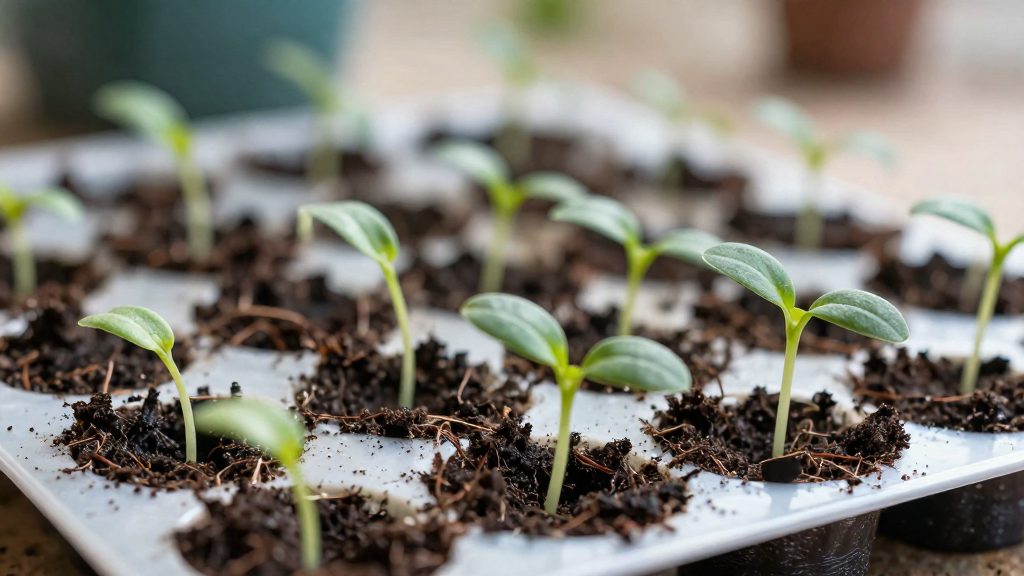
Can I start tomato seeds too early?
Sowing much earlier than the recommended window keeps seedlings in containers for longer. The sources give 5 to 6 weeks before transplanting, or about 6 to 10 weeks before the last frost, and the problems below tend to start when seedlings stay indoors past that point.
Root-bound seedlings in undersized containers
A seedling is root-bound when its roots fill the container and start to circle the inside of the pot. Seeds sown early in small cells or small pots run out of root space while they are still indoors. To check, look for roots growing out of drainage holes, or lift the seedling and see whether the soil holds together as one solid block. Roots that have grown in a tight circle take longer to spread into open ground after transplanting, which slows establishment.
Overgrown transplants stressed by indoor conditions
A seedling kept indoors past its ready stage tends to grow large relative to its root system and its container. Indoor air is usually still, and the plant has no outdoor conditions to adjust to, so a large, crowded transplant handles the move outside less well than a younger one. Keep seedlings on a schedule that matches the sowing window above, rather than letting them wait for a planting date that is still weeks away.
Repotting before outdoor planting
Move a seedling into a larger container once its roots fill the current one, rather than letting it stay root-bound. Choose a pot one size up, fill it with fresh potting mix, and water the plant in so the soil settles around the roots. Use containers with drainage holes. The official sources consulted do not specify exact pot dimensions for tomatoes, so match the container to the root mass you can see.
How to harden off tomato seedlings
Hardening off is the process of moving tomato seedlings from the stable conditions indoors to the sun, wind, and temperature swings outdoors. According to the Old Farmer’s Almanac (2026), this takes about a week, beginning with a few hours of shade and gradually increasing both the time outside and the amount of direct sun. Seedlings grown indoors have not developed the thicker tissues needed to handle full outdoor light, so exposing them all at once can scorch leaves or stunt growth.
The process works best when the schedule is adjusted to the weather, not just the calendar. The sources consulted do not specify exact daily increments in hours, so the stages below describe the progression rather than a fixed timetable.
| Stage | Location | Light | Protection |
|---|---|---|---|
| First days | Sheltered spot, such as a porch or shaded patio | A few hours of shade only, no direct midday sun | Bring seedlings in before wind picks up or temperatures drop |
| Middle days | Same spot, kept outside for longer periods | Longer stays, with more direct sun gradually added | Keep out of strong wind; bring inside on cold nights |
| Final days | Planned planting site | Extended direct sun, close to the conditions of the planting bed | Still shelter from wind; bring in on cold nights if frost is possible |
Shelter from wind is one of the main risks during this period. Strong gusts dry out young leaves and can snap thin stems, so place seedlings against a wall or fence, or in a spot protected by other plants. Cold nights are the other risk: seedlings that have spent the day outside should return indoors when temperatures fall, and stay there until the outdoor nights are no longer cold.
Keep soil evenly moist during hardening off. Check the containers daily, since small pots dry out faster in sun and wind. Water the soil directly rather than the foliage, and avoid soggy soil.
When to transplant tomatoes outdoors
Tomato seedlings should go outdoors only when two conditions are met: frost danger has passed, and the soil has reached at least 60°F. Iowa State University Extension and Outreach (2024) places the outdoor transplant window around late April in southern Iowa and mid-May in northern counties. The soil requirement is separate from the frost requirement, so both must be checked before planting.
Condition 1: frost danger has passed
Tomatoes are tender, so transplanting is tied to the last spring frost rather than to the calendar. Iowa State University Extension and Outreach (2024) states that transplants go out only after frost danger has passed. A single warm week in early spring does not establish that the danger is over.
Condition 2: soil at least 60°F
The Old Farmer’s Almanac (2026) gives a minimum soil temperature of 60°F before seedlings are set out. Air temperature does not reliably indicate soil temperature, so measure the soil directly with a soil thermometer at planting depth, ideally in the morning, before setting plants in the ground.
Regional timing
| Region | Typical outdoor transplant timing | Condition |
|---|---|---|
| Southern Iowa | Around late April | Frost danger has passed |
| Northern Iowa counties | Mid-May | Frost danger has passed |
These dates come from Iowa State University Extension and Outreach (2024) and apply to Iowa. The official sources consulted do not specify transplant timing for other regions, so gardeners elsewhere should base the date on their own last expected spring frost and the soil temperature.