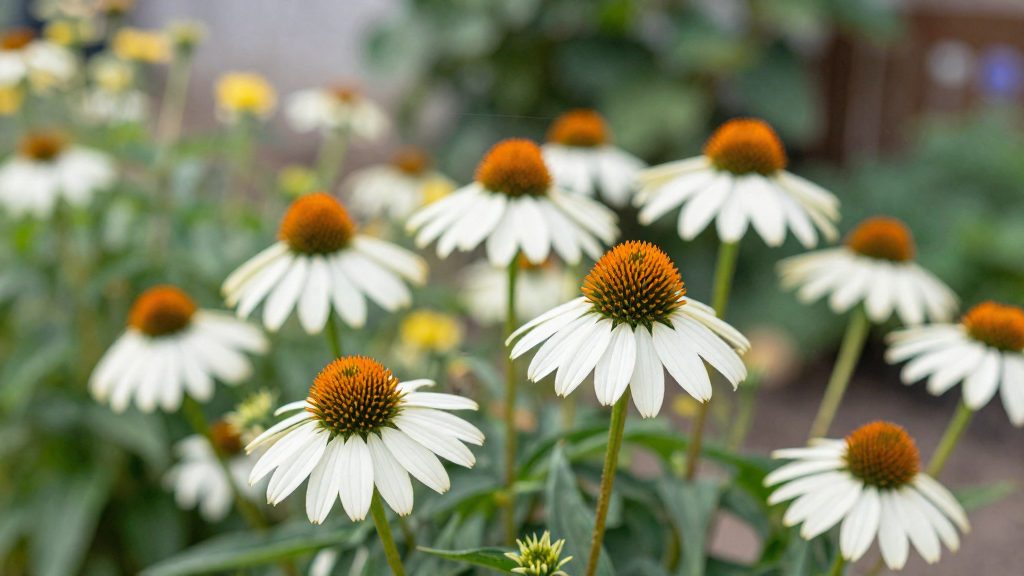
Six or more hours of direct sunshine between 10 a.m. and 6 p.m. is the threshold The Old Farmer’s Almanac uses to define full sun. Only light that reaches the spot inside that window counts. A site that gets strong morning light but falls into shade by mid-afternoon does not meet the definition, even if it looks bright. Verifying exposure before planting means measuring that window on the actual planting spot rather than estimating it.
What counts as full sun?
Full sun is measured in direct light hours, not by how bright a spot appears. The Old Farmer’s Almanac sets the benchmark at six or more hours of direct sunshine between 10 a.m. and 6 p.m. Diffuse light, such as an open sky on an overcast day, does not satisfy this definition because it lacks direct rays.
Iowa State University Extension’s publication Perennials for Sun (PM 1914) begins from the same premise: hundreds of perennials prefer the bright light and heat of sunny sites. Confirming adequate direct light is therefore the first step for any bed planted with sun-loving perennials.
Tracking sunlight from May through July
The Almanac suggests tracking a site’s sunlight from May through July to confirm its conditions. The sun’s path and the shadows around a site shift over those months, so a single observation on one day is unreliable. Record the spot at several points in the period and note which parts of the 10 a.m. to 6 p.m. window it sits in direct sun.
| Check | What to record |
|---|---|
| Morning | Whether direct sun reaches the spot after 10 a.m. |
| Midday | Whether the spot is in direct light at midday |
| Late afternoon | Whether direct sun still reaches the spot before 6 p.m. |
| Repeated May to July | Whether the same pattern holds through the season |
Shade from walls, trees, and buildings
Walls, fences, trees, and buildings are the most common reasons a spot falls short of full sun. Each one blocks direct rays for part of the day, and the blocked period changes as the sun moves. A wall facing the afternoon sun may shade a bed in late day, while a nearby tree may shade the same bed in the morning. Walk the site at different times of day and note every obstruction, including neighboring structures that cast shadows across the boundary.
Once the direct hours are recorded, assess them against the six-hour threshold within the 10 a.m. to 6 p.m. window. A spot should be classed as full sun only if it meets that threshold. Otherwise, its planting plan should be based on the measured hours rather than on an assumption that the site qualifies.
Which perennials thrive in full sun?
Full-sun perennials are species that perform well in six or more hours of direct sunshine. Before choosing plants, confirm that the site meets this threshold. The sources below give a reference point for building a shortlist of sun-tolerant species.
Iowa State’s sun-tolerant catalog
Iowa State University Extension’s publication Perennials for Sun (PM 1914) covers more than 100 sun-tolerant perennials for zones 3 to 5. Its introduction says that hundreds of perennials in general prefer the bright light and heat of sunny sites, so the catalog is a useful starting point for gardeners in those zones. The official sources consulted do not specify the individual species in the catalog.
The Almanac’s full-sun list
The Old Farmer’s Almanac lists 20 full-sun perennials. Examples include:
- Purple coneflower (Echinacea purpurea)
- Black-eyed Susan (Rudbeckia hirta)
- Blanket flower (Gaillardia aristata)
- Blazing star (Liatris spicata)
- Butterfly weed (Asclepias tuberosa)
- Daylily (Hemerocallis)
- Russian sage
- Yarrow (Achillea millefolium)
- Sedum
- Coreopsis
Daylilies: reliable, low-maintenance bloomers
Daylilies (Hemerocallis) are on the Almanac’s full-sun list and suit beds where sun is consistent. They appear on the Almanac’s full-sun list, so planting them in a site that meets the six-hour standard is the main requirement. The official sources consulted do not specify bloom periods, division intervals, or spacing, so check local extension guidance for those details.
Coreopsis: a versatile sun-loving perennial
Coreopsis is included on the Almanac’s full-sun list, so it is a candidate wherever direct sun is reliable. Confirm that the planting site receives full sun before placing it in a permanent position.
Care notes from the Almanac
| Plant | Almanac care note |
|---|---|
| Black-eyed Susan | Deadhead to prolong bloom and limit self-seeding |
| Blanket flower | Deadhead to prolong bloom and limit self-seeding |
| Butterfly weed | Mark its location, since its long taproot makes it slow to emerge in spring |
Full-sun perennials from the Almanac’s list to consider
The official sources consulted do not rank these species by pollinator value or nectar output, so the selection below reflects their inclusion in published full-sun lists, not measured visitor data.
Pollinator-focused examples from the Almanac’s list
The Old Farmer’s Almanac lists 20 full-sun perennials. Four of them are listed here as examples, without any claim about their pollinator value:
- Purple coneflower (Echinacea purpurea): included in the Almanac’s full-sun list.
- Black-eyed Susan (Rudbeckia hirta): included in the same list.
- Blazing star (Liatris spicata): included in the same list.
- Butterfly weed (Asclepias tuberosa): included in the same list. The official sources consulted do not specify its role for monarch butterflies.
The same list also includes blanket flower (Gaillardia aristata), daylily (Hemerocallis), yarrow (Achillea millefolium) and coreopsis, which widen the choice for a sunny bed.
Matching species to your region
Check a species’ hardiness zone against your own before buying plants, since a species listed for one range may not suit a colder or warmer region.
Checking full-sun sites that dry out quickly: what the sources do and don’t say
For exposed beds where the soil dries quickly, the most useful starting point is a plant list already matched to full sun. The Old Farmer’s Almanac lists 20 full-sun perennials, and four of them are Russian sage, sedum, yarrow (Achillea millefolium) and blanket flower (Gaillardia aristata). The sources do not say whether any of them tolerates heat or drought. The official sources consulted do not specify heat, drought or soil-moisture tolerance for these four, so their suitability for a specific site has to be checked against local conditions before planting.
Confirming the site before choosing plants
- Observe the bed through the growing season rather than relying on a single look, since shade from buildings or trees can change the count.
- Only plant species from the sun list on sites that meet the six-hour threshold.
- Note which areas stay warm and dry in summer, since those spots are the best candidates for the heat-tolerant selection.
Selecting and grouping the species
- Russian sage is on the Almanac’s full-sun list. The sources consulted do not describe its heat or drought behaviour, so confirm it with regional extension advice.
- Sedum is also on that list. The sources consulted do not specify its groundcover habit or tolerance of poor soils, so check plant labels or local nursery guidance for those points.
- Yarrow and blanket flower are included as full-sun species. The sources consulted do not specify their soil drainage preferences.
Watering established versus new plantings
Newly planted perennials need consistent moisture while their roots establish, and the official sources consulted do not give a watering schedule for these species. A practical method is to check the soil by hand an inch or two down before each watering, keeping it evenly moist (not waterlogged) while roots establish, rather than following a fixed calendar. Grouping plants with similar moisture needs in the same bed makes this check easier to apply across the whole border.
How do you plant and space sun perennials?
Planting then involves three steps: marking slow-emerging species, preparing the soil, and setting plants at the right depth and spacing.
Mark slow-emerging species before spring growth
Butterfly weed (Asclepias tuberosa) has a long taproot, which makes it slow to emerge in spring, according to The Old Farmer’s Almanac. Mark its location before spring growth starts, using a plant label, a stake, or a note on a garden map. Without a marker, the bed can be dug or weeded where the plant sits while no shoots are visible yet.
Prepare the soil
The official sources consulted do not specify soil type, texture, or amendment rates for these species. General practice still applies:
- Loosen the bed to the depth of the root system so roots can spread.
- Remove weeds and debris before planting.
- Avoid planting into waterlogged ground.
Plant depth and spacing
Set each perennial at the same depth it grew in its container, with the crown (the point where stems meet roots) level with the soil surface. The official sources consulted do not specify numeric spacing or planting depth figures. Use the spacing on the plant label or the mature width given by the supplier, and leave enough room for each plant to fill out without touching its neighbours.
Transplanting timing
The official sources consulted do not specify a planting calendar for these species. Transplant during cool, moist weather when possible, water each plant in well after setting it, and keep the root ball moist until the plant is established. Examples from the Almanac’s full-sun list, such as purple coneflower (Echinacea purpurea), black-eyed Susan (Rudbeckia hirta), blazing star (Liatris spicata), and daylily (Hemerocallis), follow the same basic steps.
How do you keep full-sun perennials blooming?
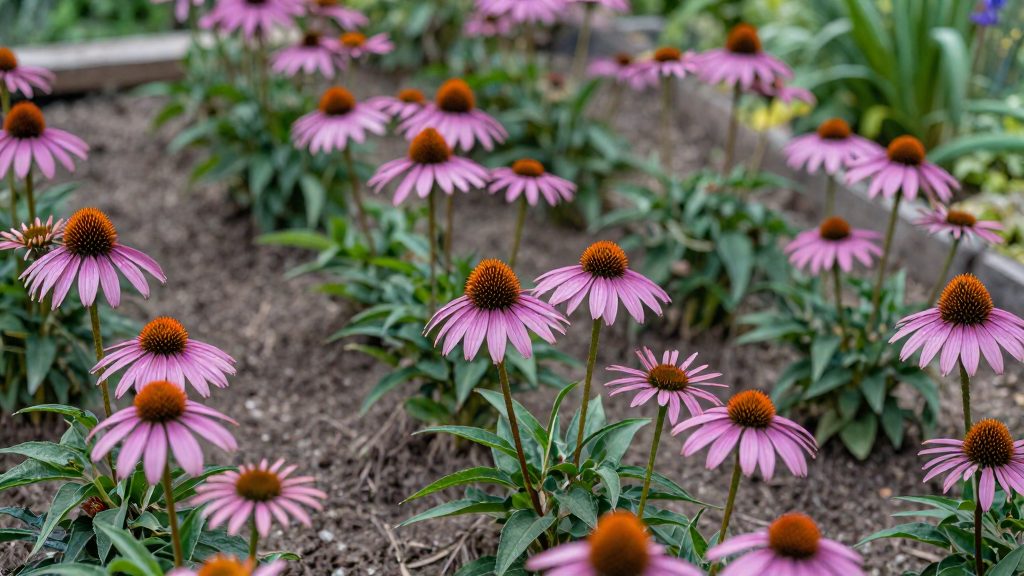
Keeping sun-loving perennials in flower through summer depends mainly on removing spent blooms and, for some species, cutting the plant back partway through the season. According to The Old Farmer’s Almanac, deadheading black-eyed Susan (Rudbeckia hirta), blanket flower (Gaillardia aristata) and globe thistle prolongs bloom and limits self-seeding. The same source advises cutting catmint back by about half in summer to encourage rebloom.
Deadheading to extend flowering
Deadheading means cutting off faded flower heads before they go to seed. Removing spent blooms keeps the plant producing new flowers rather than seed heads. Cut the stem just below the faded head with clean, sharp pruners, and repeat as blooms fade throughout the flowering period.
Limiting self-seeding
Self-seeding is a common issue with sun-grown perennials, because seed heads that drop onto the soil produce new plants. Timely flower removal is the most direct way to control this. Cut heads before they ripen and dry. If you want a plant to spread, leave a few heads intact late in the season instead.
Cutting catmint back in summer
For catmint, the Almanac recommends cutting the plant back by about half in summer. This removes finished flowering stems and is aimed at encouraging a second flush of bloom. Make the cut after the first flowering has faded, not while the plant is in full bloom.
| Plant | Action | Stated purpose |
|---|---|---|
| Black-eyed Susan | Deadhead spent flowers | Prolong bloom, limit self-seeding |
| Blanket flower | Deadhead spent flowers | Prolong bloom, limit self-seeding |
| Globe thistle | Deadhead spent flowers | Prolong bloom, limit self-seeding |
| Catmint | Cut back by about half in summer | Encourage rebloom |
Common problems and fixes
Powdery mildew is a disease the Almanac addresses for garden phlox and bee balm. According to The Old Farmer’s Almanac, the two main levers are air circulation and variety choice. Both are preventive, so they work best before the disease appears. Garden phlox and bee balm are the two plants the Almanac names specifically for this problem.
Recognizing powdery mildew
Powdery mildew shows up as a whitish, powdery coating on leaves and stems. The official sources consulted do not describe symptom progression or timing in detail, so check plants regularly during the growing season and treat any patch of white powder as a reason to act. Inspect the lower and inner leaves first, since they dry more slowly after rain or watering and are often where the coating starts.
Improving air circulation around phlox and bee balm
The Almanac advises improving air circulation around garden phlox and bee balm to reduce powdery mildew. In practice:
- Space plants so that foliage does not touch neighboring clumps when they reach full size.
- Thin dense stems inside the clump so air can move through the center.
- Avoid planting these perennials against walls or in tight groups where humidity stays trapped around the leaves.
- Water the soil at the base of the plant rather than wetting the foliage.
Choosing mildew-resistant varieties
The Almanac also offers a second option: choosing mildew-resistant varieties. This is often the simpler route when a site is shaded by neighboring plants or has limited airflow, because it does not depend on re-spacing an established clump. When buying, look for plant labels or nursery descriptions that explicitly mention mildew resistance, and ask the supplier which cultivars have performed well in your region. The official sources consulted do not name specific resistant cultivars, so this information should come from local nurseries or extension offices.
Choosing plants for your USDA zone
Your USDA hardiness zone is the first filter when selecting sun-loving perennials, because it sets the winter conditions a plant must survive. Locate your zone on the USDA hardiness zone map, then compare it with the zone range listed for each candidate on a nursery label, in a catalog, or in an extension guide. Only plants whose range includes your zone should move to the next step.
If you garden outside zones 3 to 5, use each plant’s own zone range as the deciding check rather than assuming a guide’s list fits your site.
Zone is one condition among several. Narrow your choices in this order:
- Confirm the zone: note your USDA zone and the coldest zone each candidate tolerates.
- Match the light: keep only plants suited to the sun your site actually receives.
- Test the drainage: a plant that tolerates your winters can still decline in drainage-poor soil that stays wet.
- Shortlist regionally: build a list from a regional extension guide, then verify each name against its listed zone range.
The Old Farmer’s Almanac names 20 full-sun perennials, including purple coneflower (Echinacea purpurea), black-eyed Susan (Rudbeckia hirta), blanket flower (Gaillardia aristata), blazing star (Liatris spicata), butterfly weed (Asclepias tuberosa), daylily (Hemerocallis), yarrow (Achillea millefolium), sedum, coreopsis and Russian sage. The official sources consulted do not specify zone ranges for these species, so confirm hardiness for your zone separately before buying.
Frequently asked questions
How much sun does a perennial bed need to count as full sun?
The Old Farmer’s Almanac defines full sun as six or more hours of direct sunshine between 10 a.m. and 6 p.m. Bright light without direct rays, such as an open sky on an overcast day, does not meet this definition.
Is one sunny day enough to confirm a planting site?
No. The Almanac suggests tracking a site’s sunlight from May through July, because the sun’s path and nearby shadows shift over those months. Check the spot at several points in that period and note which part of the 10 a.m. to 6 p.m. window it receives direct light.
Can I choose perennials from a full-sun list without further checks?
Not entirely. The official sources consulted do not specify spacing, drought tolerance or planting dates for the species on the Almanac’s list, so those details need to be checked separately. Iowa State University Extension’s Perennials for Sun (PM 1914) covers zones 3 to 5, so confirm your hardiness zone before using its selections.