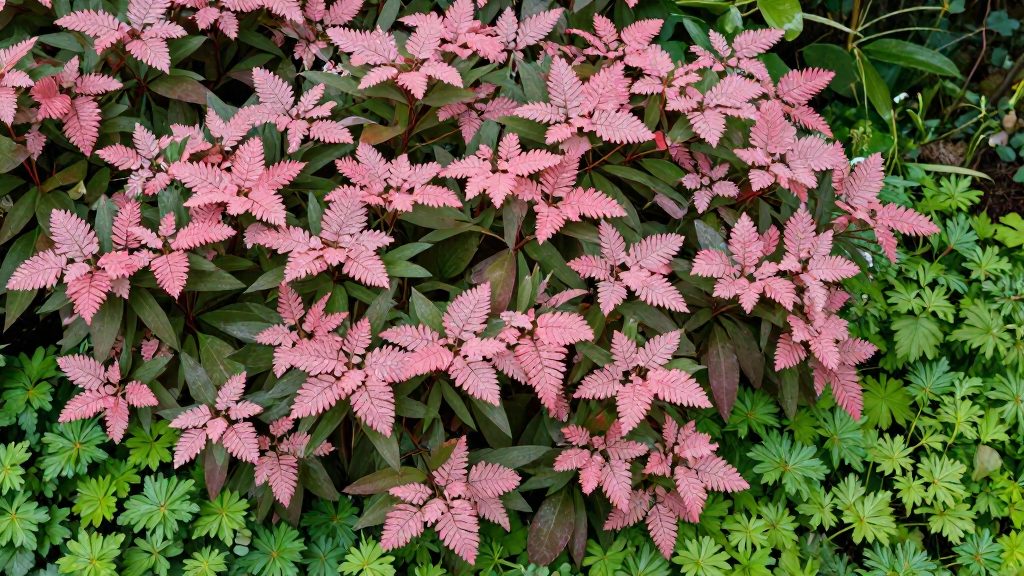
Establishment care on a shady slope focuses on keeping the soil covered and moist while the groundcover roots in. According to Melinda Myers, LLC (2026), the following establishment steps apply to plantings on a shady slope under trees.
What makes a groundcover good for shady slopes?
A suitable groundcover for a shady slope needs three things: dense, low growth that covers bare soil, tolerance of the specific shade and moisture on the site, and a spread rate that holds soil without becoming invasive. Iowa State University Extension and Outreach lists common shade groundcovers with size ranges from 2 to 18 inches. The official sources consulted do not give numeric light thresholds or root density measurements, so selection depends on observing the site’s light, moisture, and slope.
Soil-holding and root density
The official sources consulted do not specify root density or a measured soil-holding capacity for these plants. On a slope, the practical test is whether the plant forms a continuous mat at ground level. A closed cover leaves less bare soil for water to move, which is the main reason to choose a groundcover over loose mulch alone.
Shade tolerance categories
Shade on a slope varies by depth, moisture, and drainage. Iowa State University Extension and Outreach describes the following conditions and their effects on plant choice:
| Site condition | Selection consequence | Example from the source |
|---|---|---|
| Deep shade | Coverage may thin over time | Bugleweed thins out in deep shade |
| Dry shade | Choose plants adapted to low moisture | Yellow archangel is adaptable to dry shade |
| Wet soil | Avoid species that cannot tolerate saturation | Periwinkle does not tolerate wet sites |
To judge light level, count the hours of direct sun that reach the slope at different times of the year. Canopy density under trees changes with the season, so a site may be shadier in summer than in spring.
Mature size and spread for full cover
The Iowa State University Extension and Outreach size ranges are listed below. The source does not specify whether each figure refers to height or spread.
| Groundcover | Listed size range |
|---|---|
| Bugleweed | 2–8 in |
| Canadian wild ginger | 4–8 in |
| Periwinkle | about 6 in |
| Sweet woodruff | 6–8 in |
| Barrenwort | 8–12 in |
| Foam flower | 6–18 in |
| Creeping lily-turf | 8–12 in |
The sources give spread behaviour only for Bishop’s goutweed, lily-of-the-valley and Allegany spurge, covered in the invasive section below.
Which perennials handle dry shade on a slope?
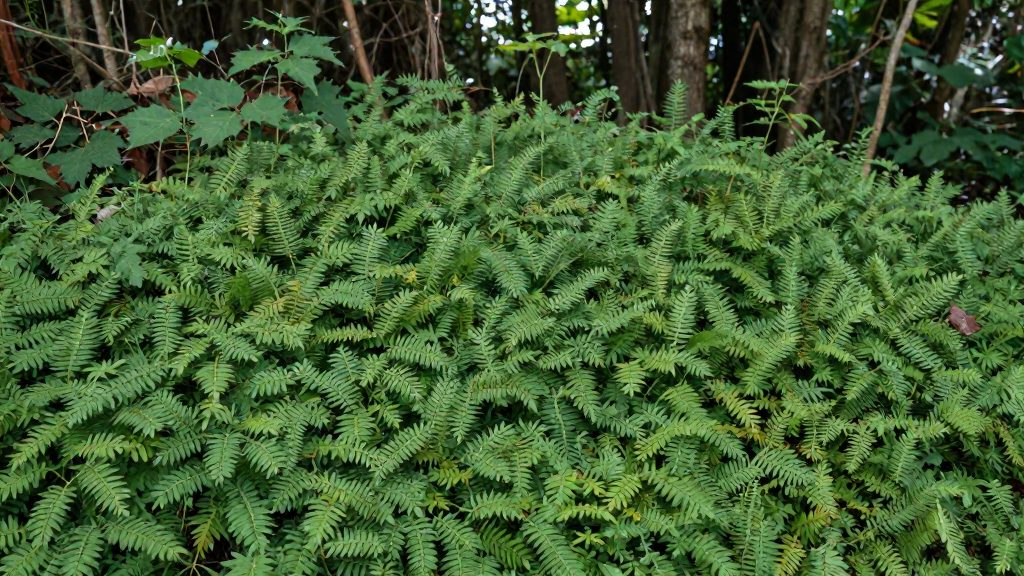
Yellow archangel is described by Iowa State University Extension and Outreach as adaptable to dry shade. Melinda Myers, LLC (2026) recommends moneywort and deadnettle for a shady slope under trees because they tolerate drought and shade. According to Iowa State University Extension and Outreach, yellow archangel is adaptable to dry shade. Plant choice depends on how deep the shade is and how water moves across the slope, so the options below are grouped by their documented fit and limits.
Dry shade under trees
The sources consulted describe dry shade under trees as a distinct site condition, but they do not quantify root competition or the loss of soil moisture beneath a given canopy. Treat the planting area as dry shade and select plants documented for those conditions.
- Dig small test holes at several points along the slope and check how moist the soil is at each one.
- Plant the drier, more shaded positions with the species documented for drought and shade.
- Reserve the lower, wetter positions for plants that tolerate moisture, and keep the two groups separate.
| Plant | Documented fit | Documented limit |
|---|---|---|
| Yellow archangel | Adaptable to dry shade (Iowa State University Extension and Outreach) | Not stated in the consulted sources |
| Moneywort | Tolerates drought and shade on a shady slope under trees (Melinda Myers, LLC, 2026) | Not stated in the consulted sources |
| Deadnettle | Tolerates drought and shade on a shady slope under trees (Melinda Myers, LLC, 2026) | Not stated in the consulted sources |
Limits in wet or deep shade
Not every shade groundcover suits every shaded slope. Periwinkle, listed at about 6 in tall, does not tolerate wet sites. Bugleweed, listed at 2–8 in tall, thins out in deep shade. Both are weaker choices for the conditions described above.
Native groundcovers for shade
Iowa State University Extension and Outreach names six native groundcover options for shade: Pennsylvania sedge, bristle-leaved sedge, Meehan’s mint, goldenstar, golden ragwort and wild geranium. Its listing also includes Canadian wild ginger, which has a listed height of 4–8 in. The consulted sources do not give habitat value or native-range performance data for these species, so the information below covers only what they state about each plant.
| Plant | What the consulted sources state |
|---|---|
| Pennsylvania sedge | Named as a native shade groundcover by Iowa State |
| Bristle-leaved sedge | Named as a native shade groundcover by Iowa State |
| Meehan’s mint | Named as a native shade groundcover by Iowa State |
| Goldenstar | Named as a native shade groundcover by Iowa State |
| Golden ragwort | Named as a native shade groundcover by Iowa State |
| Wild geranium | Named as a native shade groundcover by Iowa State |
| Canadian wild ginger | Listed at 4–8 in by Iowa State; recommended for shady slopes under trees by Melinda Myers, LLC (2026) |
Native sedges
Pennsylvania sedge and bristle-leaved sedge are the two native sedges named by Iowa State. Melinda Myers, LLC (2026) recommends native sedges for a shady slope under trees and notes that they tolerate both drought and shade. On a slope, where soil tends to dry faster than in a flat bed, that drought tolerance is the most relevant trait.
Meehan’s mint, goldenstar and golden ragwort
These three species appear in Iowa State’s list of native shade options. The consulted sources do not specify their height, spread or light requirements, so no sizing or spacing figures are given here. Check those details against a regional native plant reference before planting.
Wild geranium and Canadian wild ginger
Wild geranium is listed by Iowa State as a native option for shade. Canadian wild ginger has a listed height of 4–8 in.
Which shade groundcovers are invasive?
Bishop’s goutweed and lily-of-the-valley are the shade groundcovers that spread aggressively and often become invasive. According to Iowa State University Extension and Outreach, both should be planted only where their spread can be confined or where they can be left to spread freely. Neither is suited to mixed plantings. Allegany spurge is native, spreads less aggressively and is hardier than Japanese spurge.
Bishop’s goutweed and lily-of-the-valley
The two species share the same behaviour and the same restriction. Plant them in a defined bed or zone that you can manage, and keep them out of shared plantings with other groundcovers. Because they spread aggressively, a planting that stays compact in its first season can expand into neighbouring areas over time. Check the edges of the bed regularly so that spread stays within the boundary you set.
Allegany spurge as a less aggressive alternative
Allegany spurge is native, hardier than Japanese spurge, and spreads less aggressively. It is a more practical choice where you want groundcover in shade without the invasive risk of the two species above.
| Plant | Spread behaviour | Planting guidance |
|---|---|---|
| Bishop’s goutweed | Spreads aggressively, often invasive | Plant only where spread can be confined or left free; not for mixed plantings |
| Lily-of-the-valley | Spreads aggressively, often invasive | Plant only where spread can be confined or left free; not for mixed plantings |
| Allegany spurge | Spreads less aggressively | Native and hardier than Japanese spurge; a less invasive alternative |
How do you plant on a slope?
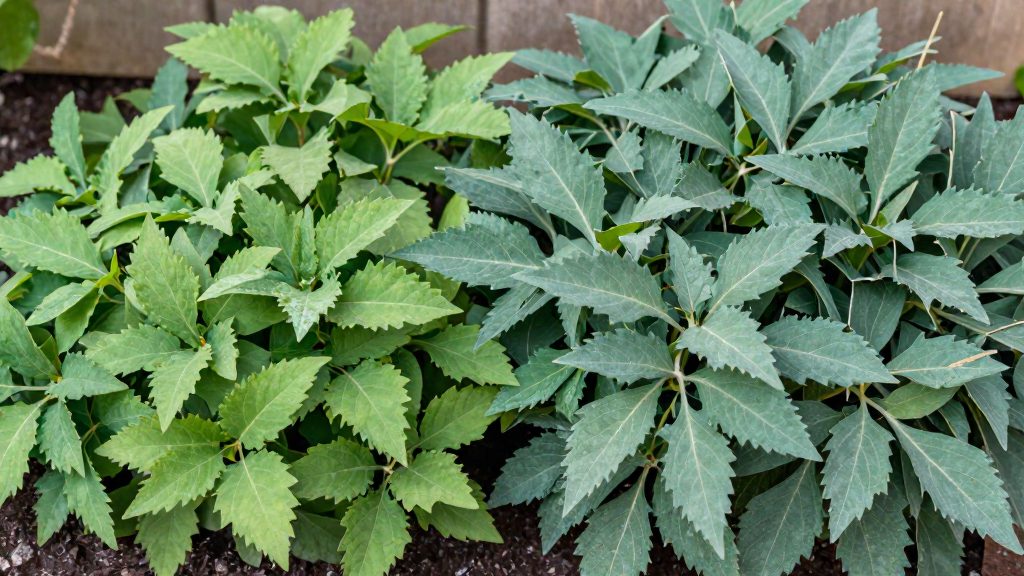
On a slope, the planting method matters as much as the plant choice, because bare soil between young plants can wash out during rain. Set plants across the slope rather than straight up and down it, and loosen the soil in each planting spot so roots can establish. The Iowa State University Extension and Outreach guidance on shade groundcovers does not give a planting density per square foot for slopes, so spacing should be set from each plant’s reported size range.
Planting across the contour
Mark a level line across the slope and plant along it. Then offset the next row so each plant sits between two plants in the row above. This contour planting pattern, with plants in staggered rows, breaks up the channels that water follows downhill and keeps loose soil from moving between plants.
Spacing and density
Iowa State University Extension and Outreach lists these size ranges for shade groundcovers, which can serve as a starting point:
| Plant | Reported size range | Site note from the same source |
|---|---|---|
| Bugleweed | 2–8 in | Thins out in deep shade |
| Periwinkle | About 6 in | Does not tolerate wet sites |
| Canadian wild ginger | 4–8 in | No site limitation listed |
The source does not specify whether these figures refer to height or spread, so check the plant label before converting them into a spacing. Closer spacing covers the ground faster and requires more plants. Wider spacing costs less but leaves exposed soil for longer.
Bishop’s goutweed and lily-of-the-valley spread aggressively. On a slope, plant them in their own block rather than interplanted with other groundcovers.
Root ball placement and soil loosening
- Loosen the soil in each planting spot with a hand fork before setting the plant, so roots can push outward into the surrounding soil.
- Set the root ball at the same depth it grew in its container. Avoid planting deeper than the container depth, since the crown should not be buried.
- Center the root ball in the hole, then firm the soil gently around it. Avoid pressing hard on loosened soil, which can compact it unevenly.
Care in the first seasons
Establishment care on a shady slope focuses on keeping the soil covered and moist while the groundcover roots in. According to Melinda Myers, LLC (2026), the following establishment steps apply to plantings on a shady slope under trees.
Leave the dead grass in place. Dead grass left on the slope acts as temporary mulch while the new plants establish, protecting the soil surface.
Apply shredded bark mulch. Melinda Myers, LLC (2026) advises mulching with shredded bark during establishment. Spread a layer over bare soil between plants, keeping it off the crowns and stems. Bark mulch helps retain soil moisture, which matters on a slope where water runs off quickly.
Water through the first few seasons. The same source recommends supplemental watering for the first few seasons, since young plants have not yet built a root system that can reach deeper moisture. Keep the root zone moist without letting it become waterlogged.
Which groundcover should you choose?
Choosing a groundcover for a shady slope depends on three site conditions: shade depth, soil moisture, and invasiveness risk. Iowa State University Extension and Outreach lists many shade species, but each tolerates a different mix of these conditions, so the match to your site matters more than a plant’s general reputation.
Matching species to shade depth and soil moisture
Assess the shade before choosing plants. Note how many hours direct light reaches the ground, and whether the shade comes from a tree canopy, a structure, or the slope’s orientation. Then check the soil after rain. A bed that stays wet for long periods needs different species from one that dries out between waterings.
The documented limits for several common options are below.
| Species | Documented condition | Source |
|---|---|---|
| Bugleweed | Thins out in deep shade | Iowa State University Extension and Outreach |
| Periwinkle | Does not tolerate wet sites | Iowa State University Extension and Outreach |
| Yellow archangel | Adaptable to dry shade (Iowa State); variegated yellow archangel is listed by Myers as tolerating drought and shade | Iowa State University Extension and Outreach; Melinda Myers (2026) |
| Allegany spurge | Native, hardier than Japanese spurge, spreads less aggressively | Iowa State University Extension and Outreach |
| Japanese spurge | Needs protection from winter wind and sun | Iowa State University Extension and Outreach |
For deep shade, bugleweed is a weaker choice because it thins out. For dry shade, yellow archangel is the option the consulted sources describe most consistently.
Weighing native options against non-native spreaders
Among the species discussed, Iowa State describes Allegany spurge as native and less aggressive in spread.
Bishop’s goutweed and lily-of-the-valley are the non-native spreaders to weigh most carefully. They should be planted only where they can be confined or where unrestricted spread is acceptable. On a slope, where edging is harder to maintain, confirm containment is realistic before choosing either one.
Iowa State also lists native alternatives for shade: Pennsylvania sedge, bristle-leaved sedge, Meehan’s mint, goldenstar, golden ragwort, and wild geranium.
Final shortlist for a shady slope under trees
For a shady slope under trees, Melinda Myers (2026) recommends moneywort, deadnettle, wild ginger, native sedges, and variegated yellow archangel. She notes these plants tolerate drought and shade. Use this list as the starting point, then screen each candidate against your shade and soil checks.
The consulted sources do not specify moisture ranges for moneywort, deadnettle, or wild ginger, so confirm those against your own soil before committing to them.
Frequently asked questions
Which groundcovers handle dry shade on a slope?
Yellow archangel is adaptable to dry shade, according to Iowa State University Extension and Outreach. Melinda Myers, LLC (2026) also lists moneywort, deadnettle, wild ginger, native sedges, and variegated yellow archangel as options that tolerate both drought and shade under trees.
Which shade groundcovers should I avoid because they spread too far?
Bishop’s goutweed and lily-of-the-valley are aggressive spreaders that often become invasive, per Iowa State University Extension and Outreach. Plant them only where you can confine them, and keep them out of mixed plantings. For a less aggressive native option, Allegany spurge is hardier than Japanese spurge and spreads more slowly.
How should I care for a new groundcover planting on a shady slope?
Melinda Myers, LLC (2026) advises leaving the dead grass in place as natural mulch while the plants establish. Adding shredded bark mulch and watering through the first few seasons help the roots take hold. The official sources consulted do not specify exact watering volumes or frequency.