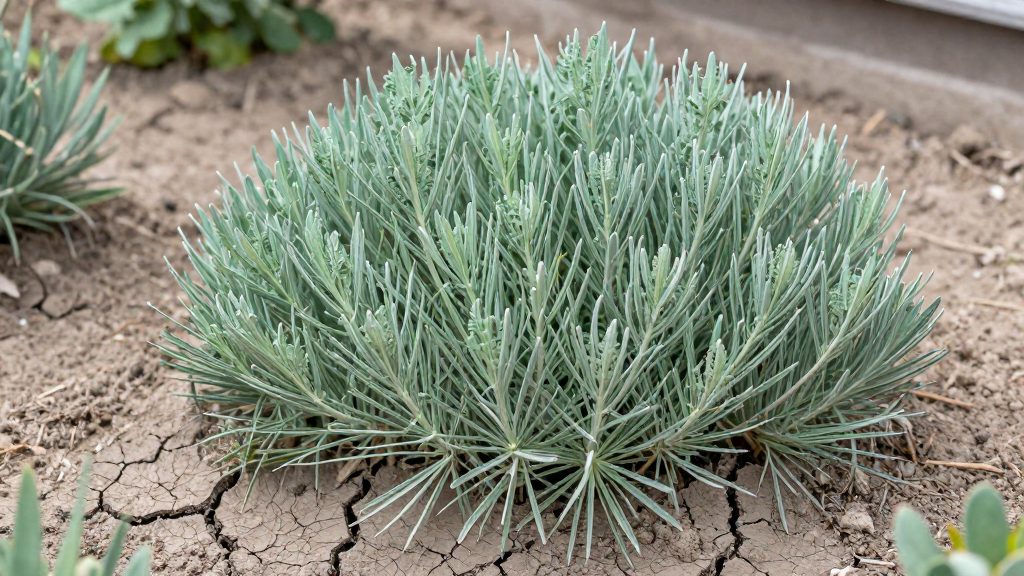
Clay soil is difficult for drought-tolerant perennials because it holds moisture and stays cool for longer, so the roots can remain wet for extended periods. According to Proven Winners (2026), this retained moisture can lead to root rot. Drought tolerance describes how a plant copes with dry spells, not with saturated roots, so a plant adapted to dry conditions can still decline in a poorly drained clay bed.
Why is clay soil tricky for drought-tolerant perennials?
How clay holds water and stays cool
Clay retains water after rain and irrigation, and it drains slowly. The result is a root zone that stays wet and cold after the surface appears dry, which is the reverse of the conditions most drought-tolerant perennials are selected for.
Cool, wet soil also slows the warming of the root zone in spring, when many perennials begin active growth. Roots in cold, saturated clay can have less oxygen available, which adds stress to plants chosen for dry conditions.
Root rot risk in waterlogged clay
When roots stay in standing water, they can rot. Proven Winners (2026) notes that clay’s moisture retention can lead to root rot. Waterlogged roots can cause wilting or yellowing above ground, which can be mistaken for drought. Checking soil moisture a few inches below the surface, near the root zone, before watering helps prevent this confusion.
Why drought tolerance does not cancel waterlogging damage
Drought-tolerant plants are adapted to dry spells, but that adaptation does not make them resistant to saturated soil.
Which drought tolerant perennials grow best in clay soil?
The plants best suited to it are those listed as clay-tolerant. Fine Gardening (2026) names three clay-tolerant perennials, with their hardiness zones:
| Plant | Genus | Hardiness zones |
|---|---|---|
| Coneflower | Echinacea | 3–9 |
| Black-eyed Susan | Rudbeckia | 3–11 |
| Yarrow | Achillea | 3–9 |
The sources consulted do not specify the individual drought tolerance of these three plants, so check their suitability for dry spells with a local nursery before planting.
Proven Winners (2026) gives a clearer drought profile for the Decadence series false indigo (Baptisia). It is described as highly drought tolerant and very long-lived, and it is suggested for clay soil. Of the plants named here, it is the only one whose drought tolerance is explicitly stated in the sources.
Selecting plants by hardiness zone before purchase
Hardiness zones indicate whether a perennial is rated to tolerate winter cold in your area, so check them before buying:
- Find your own hardiness zone for your region.
- Read the zone range printed on the plant label.
- Confirm that your zone falls within that range.
- Compare ranges across species. Black-eyed Susan is rated up to zone 11, while coneflower and yarrow are rated up to zone 9, so black-eyed Susan’s range reaches warmer zones.
Sun-loving perennials for heavy clay
Full-sun perennials can work in heavy clay when their summer water needs suit the site. Three options from the sources consulted are described for full sun or drought tolerance, though only the yucca is explicitly linked to heavier soils: Hot Rod switchgrass, Bright Star yucca and Blue Jean Baby Russian sage. Their water needs differ, so each should be planned separately rather than placed on a single watering routine.
Hot Rod switchgrass
Hot Rod switchgrass (Zones 4–10) is described as drought tolerant and fast to establish, according to Fine Gardening (2026). The source does not say whether it tolerates clay, so check drainage before using it in a clay bed, though the source does not specify how many weeks or months this takes.
Bright Star yucca
Bright Star yucca (Zones 7–10) is drought tolerant and, according to Fine Gardening (2026), surprisingly tolerant of heavier soils, the closest link to clay conditions in this group. Its zone range is narrower than that of switchgrass, so confirm your hardiness zone before buying.
Blue Jean Baby Russian sage
Blue Jean Baby Russian sage (Zones 4–9) suits full sun but needs light, regular summer water in hot weather, according to Fine Gardening (2026). It is the only plant in this group that the source describes as needing regular water rather than tolerating dry conditions, so it needs closer attention in clay.
Summary of water needs
| Plant | Zones | Summer water need (per Fine Gardening, 2026) |
|---|---|---|
| Hot Rod switchgrass | 4–10 | Drought tolerant |
| Bright Star yucca | 7–10 | Drought tolerant, tolerates heavier soils |
| Blue Jean Baby Russian sage | 4–9 | Light, regular water in hot summers |
Site preparation for these perennials
Part-shade perennials for clay: goatsbeard and brunnera
Part-shade perennials suit clay beds that receive direct sun for only part of the day. Two plants in the consulted data fit this condition. According to Proven Winners (2026), Chantilly Lace goatsbeard (Aruncus) grows in part shade and tolerates drought better than astilbe, so it is a useful alternative where astilbe would otherwise be the default choice for a shaded clay bed. According to Fine Gardening (2026), Jack Frost brunnera prefers afternoon shade, so it suits a site that is shaded during the hottest hours.
Plant profiles
- Chantilly Lace goatsbeard (Aruncus): grows in part shade. Proven Winners (2026) describes it as more drought tolerant than astilbe.
- Jack Frost brunnera: prefers afternoon shade.
Both plants are described for shaded conditions, but the sources differ in emphasis. Goatsbeard is noted as more drought tolerant than astilbe, while brunnera needs regular watering in dry months, so it is not a drought-tolerant choice. The consulted sources do not give a number of hours of sun or shade for either plant.
Light requirements for part-shade clay sites
Light is the main factor in choosing between these plants. Before planting, observe the bed across a full day to identify:
- Which areas receive direct morning sun.
- Which areas fall into shade during the afternoon.
- Which areas remain shaded most of the day.
Brunnera fits a bed that is shaded in the afternoon. Goatsbeard fits a bed in part shade without a specific afternoon requirement noted in the sources.
Watering in dry months
Jack Frost brunnera still requires regular watering in dry months according to Fine Gardening (2026), so check soil moisture in shaded clay beds during dry periods and water as needed rather than relying on the soil’s retention alone.
How do you improve clay drainage before planting?
According to Fine Gardening (2026), the recommended fix is to add organic matter before planting: dig 6 to 8 inches of compost or well-aged manure into the soil to a depth of at least 1 foot, then keep adding compost through the year. The source also expects the bed to settle after amending, so the process is a repeated routine rather than a single operation.
Digging in the amendment
Mix the organic amendment into the clay rather than leaving it as a surface layer. The goal is to improve the soil where perennial roots will grow, which means working the material down to at least 1 foot. Compost and well-aged manure are the materials named for this step.
| Step | Action | Detail |
|---|---|---|
| 1 | Spread compost or well-aged manure over the bed | 6 to 8 inches |
| 2 | Work the amendment into the clay | To a depth of at least 1 foot |
| 3 | Add compost during the growing year | Repeat every year |
| 4 | Check the bed surface after planting | Expect settling |
Annual top-ups and bed settling
Compost is not a one-time addition. Fine Gardening (2026) advises adding compost through the year to maintain the improved structure.
Expect the bed to sink after the first amending. The official sources consulted do not specify how much settling to expect, so check the bed height after the first season and add compost to any low areas.
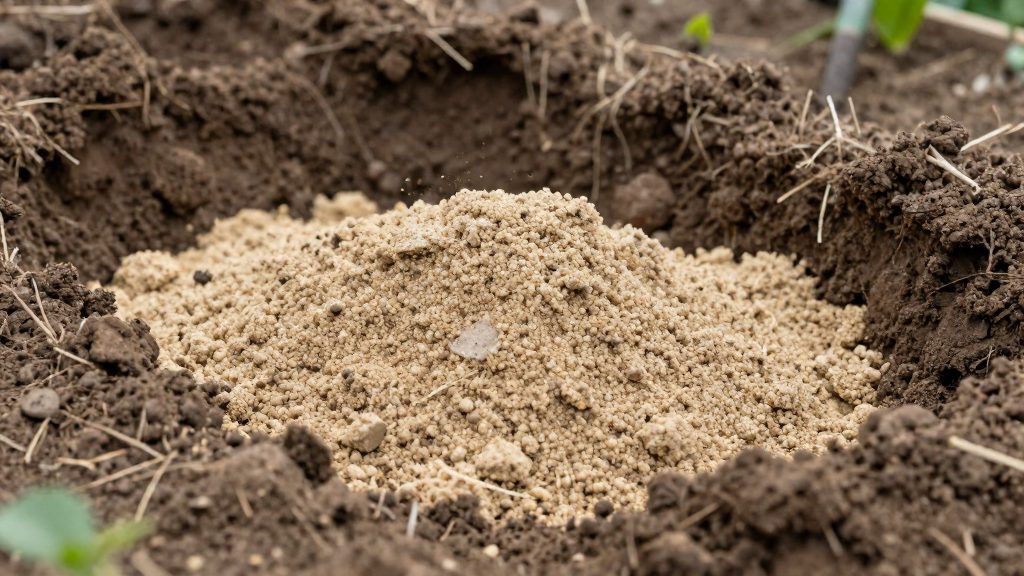
Should you plant in raised beds or berms?
Raised beds, berms and mounds all lift the root zone above heavy clay, and the deciding factor is height. According to Fine Gardening (2026), drought-tolerant plants in clay need berms, mounds or raised beds tall enough that their lowest roots are never in standing water, even in the wettest winters. The shape you choose matters less than whether the finished height clears the water that collects on your site in its worst season.
Construction options
- Berm: a long, gently raised strip of soil shaped along a planting line. It suits a border or a row of plants.
- Mound: a smaller, rounded raised area for one plant or a small group.
- Raised bed: a planting area with defined edges, built on top of the existing clay.
Each option works if it meets the height requirement. Choose the form that fits the space and the number of plants.
Height above standing water
The sources consulted do not give a fixed height in inches or centimetres, so the height has to be judged on site. Observe the area after heavy rain during the wettest months and note where water pools and how long it stays. Build the surface high enough that the lowest roots sit clearly above that level. Fine Gardening (2026) notes that beds settle over time, so add height above the target to allow for this.
Placement relative to drainage flow
Before building, watch where water runs across the ground after rain. A raised structure placed in a natural low point will sit in the water it was meant to escape. Position berms and beds on higher or sloping ground where water drains away from the planting area, and keep the raised mass out of the path where water collects.
How do you water new perennials in clay?
Watering new perennials in clay means supplying enough water for roots to establish without keeping the root zone saturated.
How often to water during the first season
The official sources consulted do not specify a fixed watering interval for new perennials in clay, so the schedule should follow the soil rather than the calendar. Water when the soil at root depth has begun to dry, and skip the session when it is still moist. As general guidance, deep, infrequent watering is usually preferable to frequent light sprinkling, especially in clay. Reduce watering after heavy rain and in cool weather, when plants use less water.
Checking soil moisture at depth
Surface dampness is a poor guide in clay. Before each watering, push a trowel, probe or finger into the soil near the root ball, below the top layer, and check the moisture there. If the deeper soil feels wet or sticky, wait. Check the same spot each time, using the same method, so you compare like with like.
Choosing plants that suit clay
Selecting clay-tolerant plants reduces the watering risk from the start. Fine Gardening (2026) names coneflower (Echinacea, Zones 3–9), black-eyed Susan (Rudbeckia, Zones 3–11) and yarrow (Achillea, Zones 3–9) as clay-tolerant perennials. Decadence series false indigo (Baptisia) is suggested for clay soil by Proven Winners (2026).
Signs of overwatering in clay beds
| Sign | What to check |
|---|---|
| Standing water after rain | Puddles that do not drain away within the bed |
| Cold, wet soil | Soil that stays wet and cool well after the weather has dried |
| Rotted roots | Dark, soft roots when you dig a test hole, a sign of root rot |
| Decline despite restraint | Plants weakening even though you have not added water recently |
If you see these signs, stop watering, avoid compacting the bed by walking on it, and let the top layer dry before checking the deeper soil again.
Common mistakes to avoid
Common errors with drought tolerant perennials in clay soil include ignoring standing water, skipping soil amendment, and mismatching plants to their light and water needs. The fixes focus on standing water, soil amendment, and matching each plant to its light needs.
Mixing sand into clay soil
The sources consulted do not discuss adding sand. The documented approach is to add compost or well-aged manure to the clay.
Planting crowns too deep in heavy soil
The sources consulted do not give a crown depth for clay beds. As general guidance, check crown level over the first seasons. If a crown is sinking into the soil, lift the plant or top up the mound around it.
Placing shade-loving plants in full-sun clay
Light needs vary within this group, and the documented ones are specific. According to Fine Gardening (2026), Blue Jean Baby Russian sage suits full sun but needs light, regular water in hot summers, while Jack Frost brunnera prefers afternoon shade. Chantilly Lace goatsbeard grows in part shade and is said to tolerate drought better than astilbe, according to Proven Winners (2026).
| Plant | Documented light | Documented water need | Source |
|---|---|---|---|
| Blue Jean Baby Russian sage | Full sun | Light, regular water in hot summers | Fine Gardening (2026) |
| Jack Frost brunnera | Afternoon shade | Regular watering in dry months | Fine Gardening (2026) |
| Chantilly Lace goatsbeard (Aruncus) | Part shade | Tolerates drought better than astilbe | Proven Winners (2026) |
Frequently asked questions
Which drought-tolerant perennials handle clay soil best?
Proven Winners (2026) suggests the Decadence series false indigo (Baptisia), which is highly drought tolerant and very long-lived. Fine Gardening (2026) lists coneflower (Echinacea, Zones 3–9), black-eyed Susan (Rudbeckia, Zones 3–11) and yarrow (Achillea, Zones 3–9) as clay-tolerant perennials.
Why does my drought-tolerant perennial look wilted in clay?
Waterlogged roots can cause wilting or yellowing above ground, which is easily mistaken for drought. Check the moisture a few inches below the surface, near the root zone, before watering, since root rot is a common cause of these symptoms in clay.
Do I need to raise the bed or amend the soil before planting?
Fine Gardening (2026) recommends berms, mounds or raised beds tall enough that the lowest roots never sit in standing water, even in the wettest winters. To amend the soil, dig 6 to 8 inches of compost or well-aged manure into a depth of at least 1 foot, then expect the bed to settle over time.