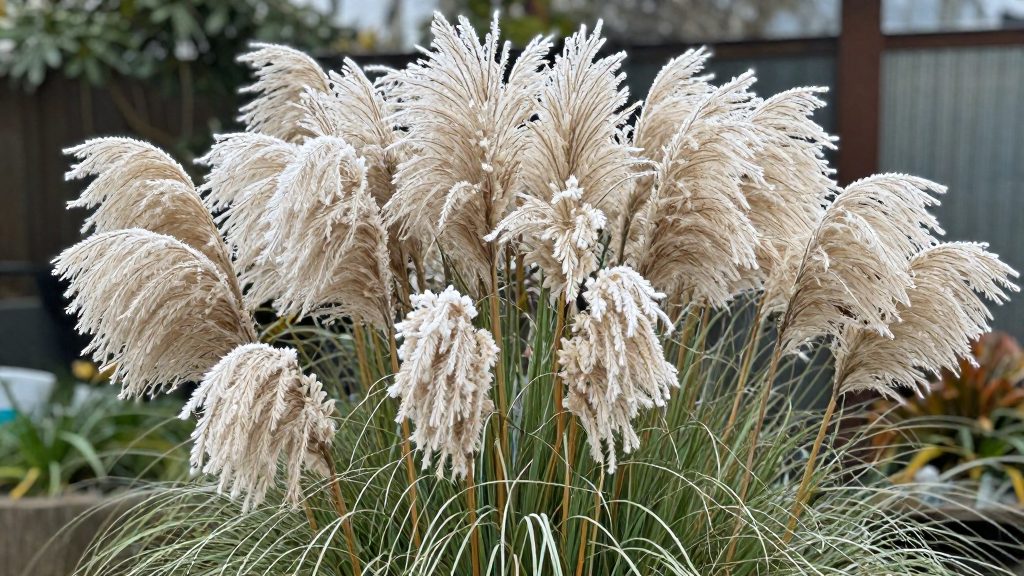
Ornamental grasses add winter interest because their stems, leaf blades, and seed heads stay standing after many perennials and deciduous shrubs have lost their flowers and foliage. According to Proven Winners (2026), Miscanthus sinensis ‘Morning Light’ looks striking with ice or snow, and several grass cultivars keep cream or pale seed heads into the cold months. Their height, form, and movement give a bed visible structure when most of the garden is bare.
Why do ornamental grasses add winter interest?
Once the growing season ends, the standing structure of a planting becomes its main visual element. Grasses supply that structure through upright clumps, arching leaves, and persistent seed heads that remain on the plant.
Plant structure and form in leafless months
Grasses keep their volume through winter, which fills space that would otherwise look empty. Proven Winners (2026) describes Miscanthus sinensis ‘Morning Light’ as about 3 feet tall, and Pennisetum alopecuroides ‘Prairie Winds Desert Plains’ (fountain grass) as over 4 feet tall, with cream, bottlebrush-shaped seed heads in winter.
| Grass (as named by Proven Winners, 2026) | Winter feature |
|---|---|
| Miscanthus sinensis ‘Morning Light’ | Striped leaves and seed heads that stand out with ice or snow |
| Panicum virgatum ‘Niagara Falls’ (native switchgrass) | Arching, powder-blue foliage and cream-colored seed heads |
| Pennisetum alopecuroides ‘Prairie Winds Desert Plains’ | Cream, bottlebrush-shaped seed heads |
Color shifts from green to tan or gold
The official sources consulted do not specify how these grasses change color as the season progresses. The documented colors are the powder-blue foliage and cream-colored seed heads of ‘Niagara Falls’ and the cream, bottlebrush-shaped seed heads of the fountain grass. The source does not describe seasonal color change.
Why dormant foliage keeps its vertical lines
Upright and arching blades hold their shape after the growing season, so the bed keeps linear lines when broadleaf plants have collapsed. Proven Winners (2026) notes that ornamental grasses sway in the breeze, so their vertical forms also add movement to an otherwise still winter garden.
Best ornamental grasses for winter structure
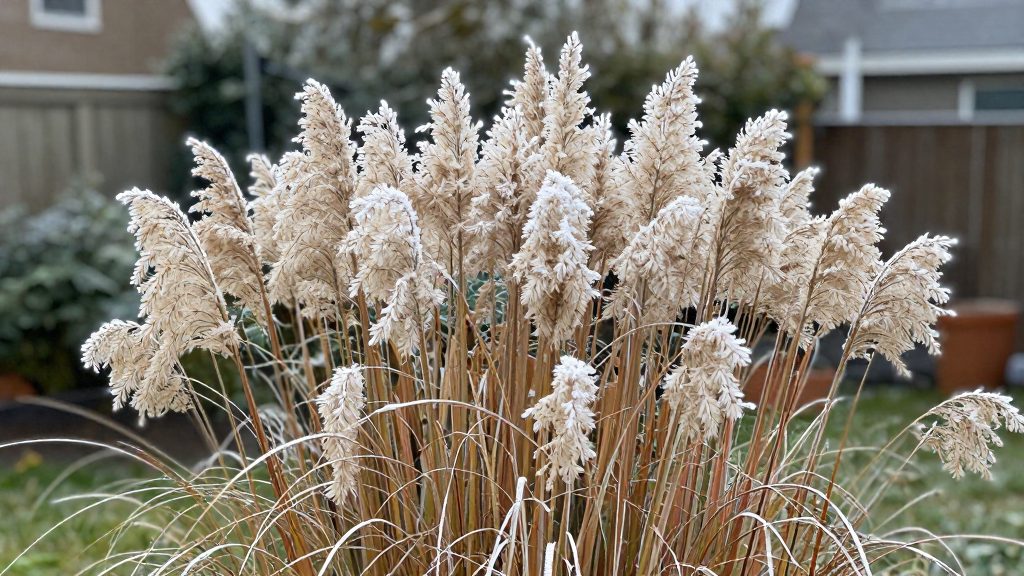
Proven Winners (2026) names three ornamental grasses with winter appeal. Two of them have stated heights: Miscanthus sinensis ‘Morning Light’ grows about 3 feet tall, and Pennisetum alopecuroides ‘Prairie Winds Desert Plains’ (fountain grass) grows over 4 feet. The source does not describe the stem stiffness of either cultivar, so the comparison below is limited to height and winter features.
| Cultivar | Height | Winter feature |
|---|---|---|
| Miscanthus sinensis ‘Morning Light’ | About 3 feet | Striped leaves and seed heads |
| Pennisetum alopecuroides ‘Prairie Winds Desert Plains’ | Over 4 feet | Cream, bottlebrush-shaped seed heads |
Ranking by height and habit
Among these two, Pennisetum ‘Prairie Winds Desert Plains’ is the taller choice and provides the greater vertical mass in a winter bed. Miscanthus ‘Morning Light’ is the shorter option, suited to spaces where a 3-foot clump is enough. Before planting any Miscanthus sinensis, check with your local extension service whether it is listed as invasive in your state.
Panicum virgatum ‘Niagara Falls’, a native switchgrass, has a different habit. Proven Winners (2026) describes its arching habit and powder-blue foliage, with cream-colored seed heads in winter. The source does not give its height, so it cannot be ranked against the other two by size.
Holding form through winter
The source does not say how well each cultivar keeps its stems upright after frost, so this point should be checked with the nursery or local extension services before choosing a cultivar for a windy site.
Using the seed heads
The seed heads of these grasses remain visible as winter structure. The same source states that ornamental grasses are deer resistant.
Which grasses look best with snow and frost?
Of the three ornamental grasses in the Proven Winners (2026) selection, only Miscanthus sinensis ‘Morning Light’ is described as striking with ice or snow. Panicum virgatum ‘Niagara Falls’ and Pennisetum alopecuroides ‘Prairie Winds Desert Plains’ are described for their winter foliage and seed heads, and the source does not say how they look under frost or snow.
| Cultivar | Winter feature (Proven Winners, 2026) |
|---|---|
| Miscanthus sinensis ‘Morning Light’ | Striped leaves and seed heads that look striking with ice or snow |
| Panicum virgatum ‘Niagara Falls’ | Arching, powder-blue foliage and cream-colored seed heads |
| Pennisetum alopecuroides ‘Prairie Winds Desert Plains’ | Cream, bottlebrush-shaped seed heads |
Morning Light striped leaves and plumes under ice
‘Morning Light’ grows about 3 feet tall. Its striped leaves and seed heads are the element to watch when ice forms on the plant, because the contrast between the stripes and the frozen surface makes the clump readable from a distance. Proven Winners suggests planting grasses where you can see them from indoors, so place this clump in a spot that is visible from the house.
Frost and rime on feathery plume tips
‘Prairie Winds Desert Plains’ grows over 4 feet tall and carries cream, bottlebrush-shaped seed heads in winter. The source does not say how these seed heads look with frost or rime. ‘Niagara Falls’ pairs its arching blue foliage with cream seed heads, so the frosted plumes contrast with the blade colour through the winter.
Snow load and stem bending during heavy snowfall
The official sources consulted do not specify snow load limits or bending behaviour for these three cultivars. Practical steps that follow from this:
- Position clumps in a spot sheltered from strong winter winds, so the stems move less.
- After a heavy snowfall, check whether plumes are bowed under the weight.
- If snow is piled on the crown, brush it off by hand from the top downward instead of pulling on the stems.
Native grasses for winter and wildlife
Panicum virgatum ‘Niagara Falls’ is a native switchgrass with arching, powder-blue foliage and cream-colored seed heads that persist into winter, according to Proven Winners (2026). The blue leaves stay visible when many other perennials are bare, so the plant keeps a clear colour accent in the winter garden.
Winter foliage and seed heads
The arching habit lets the blue blades move with the wind. The cream seed heads add a second layer of colour and texture above the foliage. Together, they give the plant winter interest without any extra care during the cold months.
For comparison, the same source lists two other ornamental grasses with winter value:
- Miscanthus sinensis ‘Morning Light’: about 3 feet tall, with striped leaves and seed heads that look striking with ice or snow.
- Pennisetum alopecuroides ‘Prairie Winds Desert Plains’ (fountain grass): over 4 feet tall, with cream, bottlebrush-shaped seed heads.
Seed heads and wildlife
Standing seed heads may offer some general habitat value, but the source does not document any wildlife benefit for this grass. Leaving the stems and seed heads in place, rather than clearing the bed, keeps that seed available through the winter months. Proven Winners (2026) does not specify which bird species feed on them, so the wildlife benefit should be understood as a general habitat effect rather than a documented list of visitors.
Deer resistance
Proven Winners (2026) describes ornamental grasses as deer resistant. This makes them a practical option in gardens where deer browse other plants. The source does not state how strongly resistance varies between deer populations or seasons. Planting a small group first and observing it over a full season is a sensible way to confirm its performance in your own garden.
Where to plant grasses for the best winter view
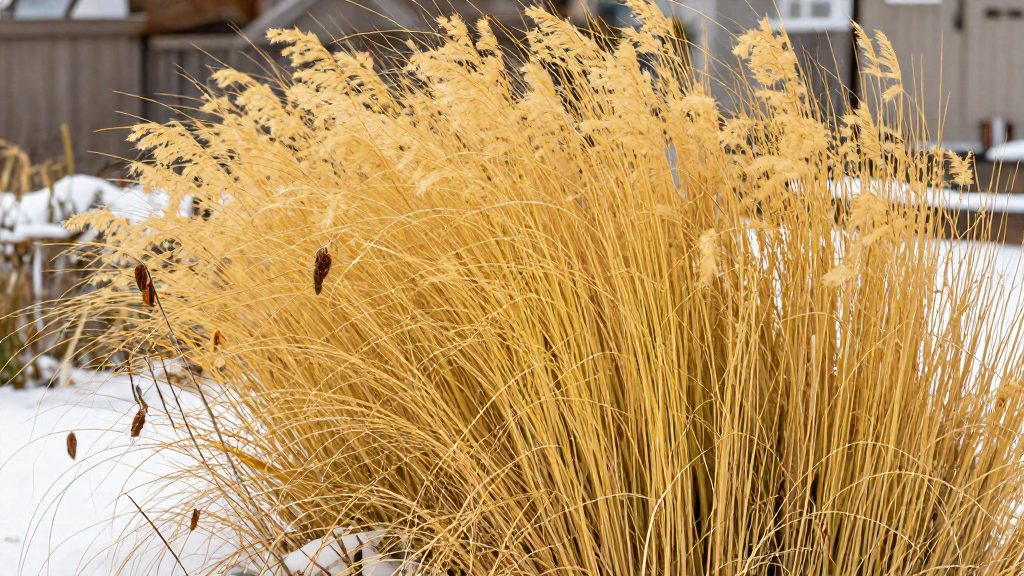
Ornamental grasses contribute most to a winter garden when they can be seen from indoors. Proven Winners (2026) suggests planting them where you can see them from inside the house. Movement and seed heads are what make them readable in the colder months, so the position of each clump matters as much as the cultivar you choose.
Placing grasses in view of indoor windows
Identify the windows that face the garden, especially those of rooms where people sit or eat in winter. Stand inside at seated height and note where your eye falls. A clump placed in that zone shows its form daily, not only when you walk outdoors.
- Set the clump in the middle distance from the window, not against the glass, so the full shape is visible.
- Avoid positions where fences, shrubs or structures will block the seed heads from the room.
- Plant two or more cultivars in the same zone so that their textures contrast.
Sightlines along paths and seating areas
Paths and benches are where people spend time outdoors in winter. Place a clump at the edge of a path so that its stems lean into the walking line and catch the light as you pass. For a seating area, position a grass at the end of the sightline from the seat, so it becomes the focal point of the view rather than a background element.
Sun exposure for upright stems
The sources consulted do not specify sun exposure requirements for these three cultivars, so this section gives no figure. Before planting, observe the chosen spot across a full day to see where direct light falls. Then check the plant label or the grower’s guidance for the specific cultivar and select a position that matches it.
Matching cultivars to viewing positions
| Cultivar | Winter feature (Proven Winners, 2026) | Placement focus |
|---|---|---|
| Miscanthus sinensis ‘Morning Light’ | Striped leaves and seed heads look striking with ice or snow | Set where snow or frost can settle on it, in view of a window |
| Panicum virgatum ‘Niagara Falls’ | Arching, powder-blue foliage and cream seed heads | Place at a path edge, where the arching foliage moves visibly in the breeze |
| Pennisetum alopecuroides ‘Prairie Winds Desert Plains’ (fountain grass) | Cream, bottlebrush-shaped seed heads | Position on a seating sightline, close enough to see the individual seed heads |
When should you cut back ornamental grasses?
Most ornamental grasses are cut back in late winter or early spring, once the winter display has finished and before new growth starts at the base of the clump. Proven Winners (2026) notes that these grasses look striking in winter: their seed heads and foliage stand out against ice or snow. Leaving the plants standing through the cold months keeps that structure in place. The official sources consulted do not specify exact calendar dates or cutting heights, so timing should be adjusted to your region and to the first signs of new shoots.
Timing window
- Late winter to early spring: cut once the coldest weather has passed and the clump still shows some structure.
- Check the base first: if green shoots are already rising from the crown, you have waited too long and should cut quickly to avoid damaging them.
- Warmer climates: growth can begin earlier, so the window is shorter.
Recommended cutting height
Cut above the crown rather than flush to the soil. Leaving a short stubble protects the growing points at the centre of the clump, which is where new leaves emerge. Use sharp bypass pruners, hedge shears, or a cordless trimmer for larger clumps, and gather the cut material promptly.
Avoiding wet or frozen conditions
Work only when the clump is dry and not frozen. Wet or iced foliage is harder to cut cleanly, and walking across a frozen or saturated clump can compact the soil and injure the crown. If the ground is soggy, postpone the job until conditions improve.
| Grass (per Proven Winners, 2026) | Height | Winter feature |
|---|---|---|
| Miscanthus sinensis ‘Morning Light’ | About 3 feet | Striped leaves and seed heads that look striking with ice or snow |
| Panicum virgatum ‘Niagara Falls’ | Not specified | Arching, powder-blue foliage and cream-colored seed heads |
| Pennisetum alopecuroides ‘Prairie Winds Desert Plains’ | Over 4 feet | Cream, bottlebrush-shaped seed heads |
Using seed heads in winter arrangements
Ornamental grass cut seed heads can be brought indoors for holiday displays. According to Proven Winners (2026), cut seed heads from ornamental grasses can be used in holiday arrangements, which makes them a practical winter material for home decor. The steps below cover harvesting, drying, arranging and storing indoors. The Proven Winners guidance does not specify drying durations or cutting techniques, so the methods described here are general practice.
Plants suited to cutting
Three grasses named by Proven Winners (2026) have seed heads that are useful for indoor displays:
| Grass | Details from the source |
|---|---|
| Miscanthus sinensis ‘Morning Light’ | About 3 feet tall; striped leaves and striking seed heads |
| Panicum virgatum ‘Niagara Falls’ | Native switchgrass; arching foliage and cream-colored seed heads |
| Pennisetum alopecuroides ‘Prairie Winds Desert Plains’ (fountain grass) | Over 4 feet tall; cream, bottlebrush-shaped seed heads |
Harvesting and drying plumes
- Select intact plumes with no visible damage or disease.
- Cut stems with clean, sharp pruners, leaving a length that suits the vase or container you plan to use.
- Dry stems upright or hung in a dry, airy indoor spot, out of direct sun, so the plumes keep their shape.
- Confirm stems are fully dry before arranging. Damp plant material can mold, which is a general risk for dried plant material.
Arranging with other winter materials
Pair plumes with contrasting textures. Stiff, upright seed heads such as fountain grass plumes work well as focal points, while the arching switchgrass stems suit loose, asymmetrical arrangements. Combine them with evergreen sprigs, dried branches or pinecones. Place taller plumes toward the back of the arrangement and shorter material in front. Group stems with similar drying states so they age at the same rate.
Handling and storing cut seed heads indoors
- Shake stems gently outdoors to remove loose debris before bringing them inside.
- Keep arrangements away from radiators and other heat sources, which can dry plumes too quickly and make them brittle.
- Seed heads are fragile. Handle them by the stem to limit shattering.
- Store unused stems flat or hung in a dry place. Dust them with a soft brush before display.
Frequently asked questions
Which grasses offer the most winter height and structure?
Pennisetum alopecuroides ‘Prairie Winds Desert Plains’ (fountain grass) grows over 4 feet tall and holds bottlebrush-shaped seed heads in cream through winter. Miscanthus sinensis ‘Morning Light’ reaches about 3 feet, and its striped leaves stand out against ice or snow (Proven Winners, 2026).
Where should I plant grasses if I want to enjoy them from indoors?
Proven Winners recommends placing them where they can be seen from inside the house. Their movement in the breeze adds motion to a bed that is otherwise bare (Proven Winners, 2026).
Are ornamental grasses deer resistant, and can I use their seed heads indoors?
According to Proven Winners (2026), ornamental grasses are deer resistant, and cut seed heads can be used in holiday arrangements. The official sources consulted do not specify how long cut seed heads keep their appearance indoors.