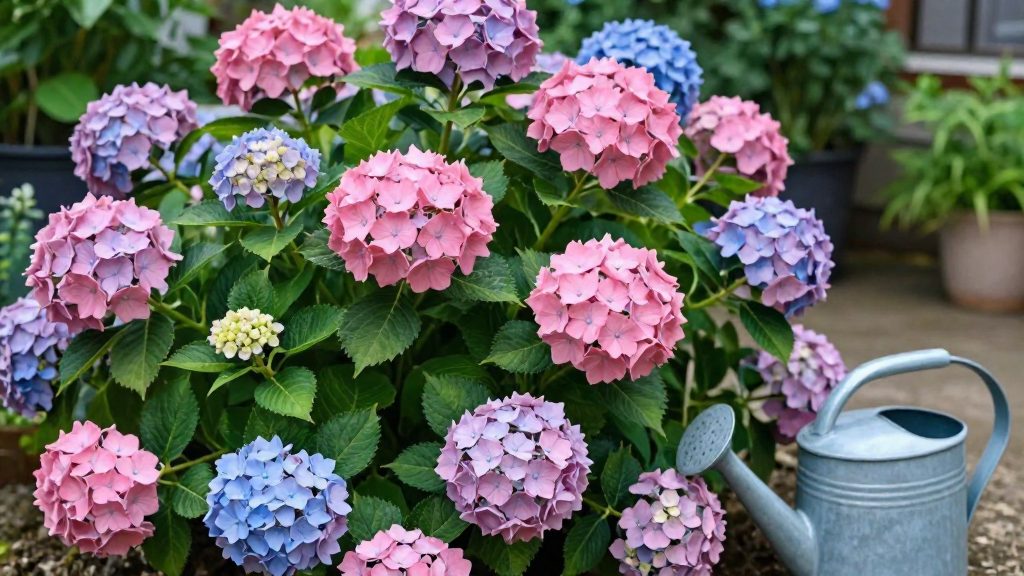
Hydrangeas that stop flowering in midsummer are usually responding to stress, not failing permanently. For repeat-blooming bigleaf hydrangeas, the causes named in the sources consulted are prolonged hot, dry weather, which can push the plant into what Clemson Cooperative Extension calls “hot weather hibernation,” and damage to developing flower buds from frost or deer. Both act on the plant before any corrective pruning or feeding can take effect.
Why do hydrangeas stop blooming mid-summer?
Hot weather hibernation after dry, hot spells
According to Clemson Cooperative Extension (2019), in hot, dry weather, repeat bloomers that are not watered enough can go into a hot weather hibernation and fail to rebloom. The plant is not necessarily dead. It stops producing new flowers while conditions remain stressful, and the extension identifies insufficient water as the trigger.
The official sources consulted do not specify a temperature threshold or a minimum number of dry days that causes this response, so the risk should be treated as a function of the heat and drought the plant experiences, not a fixed number.
Frost and deer damage to developing buds
Frost and deer both destroy developing flower buds. The University of Georgia CAES (J. T. Midcap, 2005) notes that remontant bigleaf hydrangeas bloom on new growth as well as old wood. When frost or deer destroy the buds, that new growth can still flower.
This means a gap in midsummer bloom after bud loss is not automatically permanent. The sources do not specify how much bud loss produces a visible gap or how long the plant takes to recover.
Summary of causes
| Cause | Plant part affected | Reported effect |
|---|---|---|
| Prolonged hot, dry weather | Rebloom on repeat bloomers | Hot weather hibernation; no rebloom (Clemson Cooperative Extension, 2019) |
| Frost | Developing flower buds | Buds destroyed; new growth can still flower (University of Georgia CAES, 2005) |
| Deer | Developing flower buds | Buds destroyed; new growth can still flower (University of Georgia CAES, 2005) |
Choose reblooming varieties
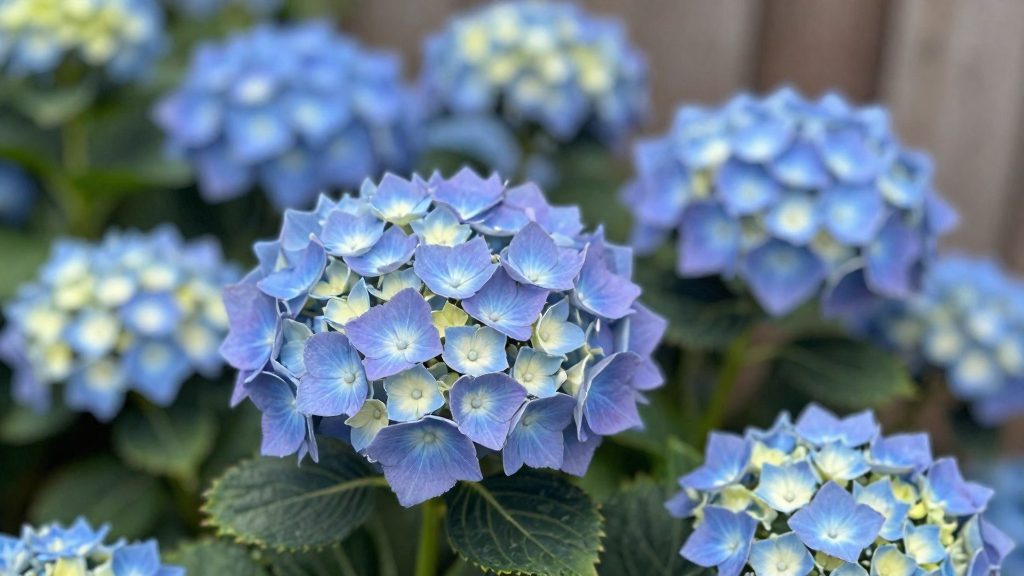
The consulted sources identify bigleaf hydrangeas as the group that reblooms. They do not describe repeat flowering in other hydrangea species, so the examples below are limited to bigleaf cultivars.
Named repeat-blooming cultivars
Clemson Cooperative Extension (2019) lists Endless Summer, Blushing Bride, Twist-n-Shout, BloomStruck and Summer Crush as cultivars sold as repeat bloomers. The University of Georgia CAES (2005) names Endless Summer and Penny Mac as the best-known remontant bigleaf types.
| Cultivar | Documented trait | Source |
|---|---|---|
| Endless Summer | Introduced in 2004 | Clemson Cooperative Extension (2019) |
| Summer Crush | Compact, 18–36 in. | Clemson Cooperative Extension (2019) |
| Penny Mac | Among the best-known remontant bigleaf types | University of Georgia CAES (2005) |
Summer Crush is the only cultivar in these sources with a stated size range, so its 18–36 in. figure is the most concrete point of comparison for limited space. Endless Summer has the most documented history among the names listed. Blushing Bride, Twist-n-Shout and BloomStruck are sold as repeat bloomers, but the consulted sources give no further traits for them. Confirm their mature size and habit with the nursery before buying.
Cold hardiness differences
The official sources consulted do not specify cold hardiness ratings for any of these cultivars, so no ranking by hardiness can be given. To compare hardiness for a specific region, check the plant tag or ask a local nursery or extension office, since hardiness depends on the climate of the planting area.
Selection checklist
- Confirm the label identifies the cultivar as a repeat bloomer.
- Note the mature size, using the 18–36 in. range for Summer Crush as the documented example.
Old wood or new wood: what changes for pruning
Repeat-blooming bigleaf hydrangeas flower on two kinds of stem. According to Clemson Cooperative Extension (2019), the first flush of early-summer flowers forms on old wood, meaning stems that grew the previous season. Later blooms form on new wood, the growth made during the current season. This split is why the plants keep flowering into fall, and it is also why an incorrect cut can remove flowers the gardener expects to see.
Bud formation on old and new stems
| Stem type | Growth origin | Flowers it produces |
|---|---|---|
| Old wood | Grew the previous season | First flush of early-summer flowers |
| New wood | Grows during the current season | Later blooms, continuing into fall |
The two stem types therefore play different roles in the flowering cycle. Old wood sets the early display, and new wood sustains flowering later in the season.
Why cutting old wood removes early blooms
Because the first flush forms on old wood, removing those stems before they bloom removes the buds that would have opened first. The University of Georgia CAES (2005) reports that remontant bigleaf hydrangeas also bloom on new growth. This shows that new wood provides a backup, but it does not replace the early-summer flush. A spring shaping cut can therefore remove some of the first-flush buds, so keep spring cuts light.
Telling old wood from new
The official sources consulted do not specify stem color as a reliable way to identify old and new wood, so this section does not use a color rule. The distinction the sources do support is growth year. New wood is the shoot produced in the current season, while old wood is the stem that grew the previous year. To sort them, identify which stems are growing this season and which were already present before the current season began, then note which stems carry the first flush. Judging by growth year avoids relying on a visual cue the sources do not confirm.
When should you prune hydrangeas for more blooms?
For repeat-blooming bigleaf hydrangeas, the timing of pruning affects how many flowers the plant produces. Clemson Cooperative Extension (2019) recommends that any necessary pruning of repeat bloomers be done immediately after the first bloom.
| Pruning task | Timing | Purpose |
|---|---|---|
| Necessary pruning of repeat bloomers | Immediately after the first bloom | Preserves new wood that carries later flowers (Clemson Cooperative Extension, 2019) |
| Size control | After the first flush of blooms | Controls plant size (University of Georgia CAES, 2005) |
| Shaping | Spring (light cuts only, since old wood carries the first flush) | Improves plant shape (University of Georgia CAES, 2005) |
Post-bloom pruning window
- Cut back only when the first flush of blooms has finished.
- Limit cuts to what is needed for the plant’s size and structure.
- Avoid heavy cutting later in the season, because later flowers form on new growth.
Spring shaping cuts
The University of Georgia CAES (2005) advises pruning in spring for shape. The official sources consulted do not specify a precise date or the stage of leaf growth for these cuts, so timing should be judged by local spring conditions.
Late-season cutoff
The official sources consulted do not specify a late-season cutoff date. Because later blooms form on new wood, heavy cutting late in the season may remove them, so keep late-season work to light tidying.
Does deadheading really help?
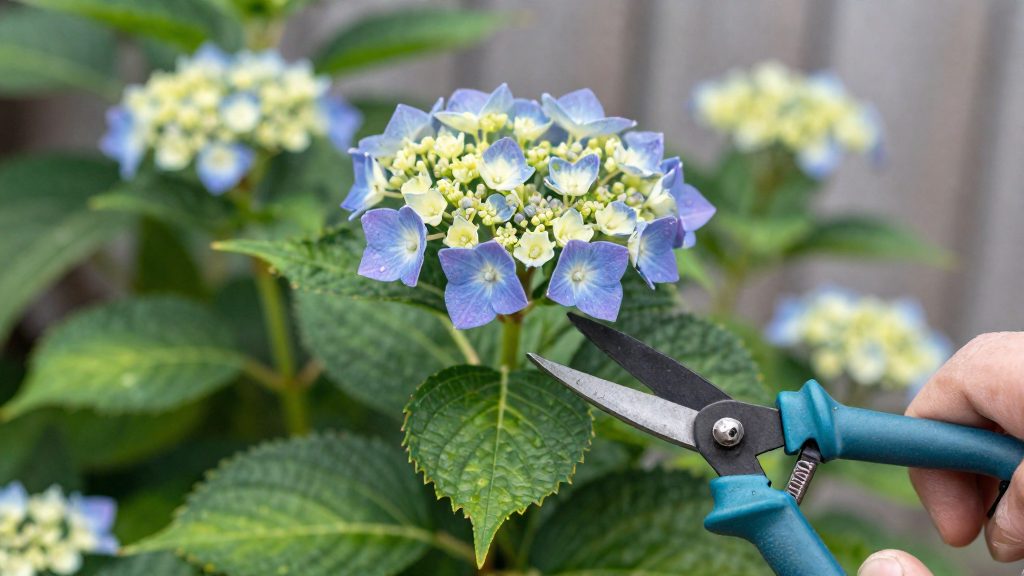
Clemson Cooperative Extension recommends deadheading repeat-blooming bigleaf hydrangeas to encourage more flower bud production (Clemson Cooperative Extension, Home & Garden Information Center, 2019-06-06). The evidence is qualitative. The official sources consulted do not specify how many additional buds a plant forms after deadheading, or how much sooner the next flush opens.
What the sources establish
- Clemson recommends deadheading to increase flower bud production (2019-06-06).
Cut placement on spent stems
The official sources consulted do not specify the exact cut point on a spent stem, so this section gives no measurement or node-based rule. The general gesture is to remove the faded flower head with clean, sharp pruners rather than pulling it off by hand, which can damage the stem beneath it.
Effect on repeat bloom timing
The sources consulted do not give a time interval between deadheading and the next flush. Deadheading is recommended as a way to support later flowering, but the sources do not promise a specific timing or a specific number of new blooms.
Water, sun and mulch
Repeat-blooming hydrangeas keep flowering through summer when three conditions are met: the site gets the right light, the root zone stays evenly moist, and the soil surface is protected. Clemson Cooperative Extension (2019-06-06) identifies morning sun with dappled afternoon shade as the best site. The University of Georgia CAES (2005-02-24) adds that these plants need to be kept moist and fertilized to support new growth and flowering. Placement and moisture work together, so both should be set up before the first heat of summer.
Site placement
Choose a spot where the plant receives morning sun and dappled shade in the afternoon. Dappled shade filters the afternoon light rather than blocking it fully. As a general practice, avoid unfiltered afternoon sun for most of the day, and avoid sites so shaded that the plant receives little light overall.
Consistent watering during dry spells
Clemson (2019-06-06) notes that in hot, dry weather, repeat bloomers that are not watered enough may stop reblooming. Watering should therefore follow a regular schedule rather than occur only when the plant visibly wilts.
- Check the soil an inch or two down before watering. Water when that layer feels dry.
- As a general practice, water the root zone deeply at soil level rather than with light, frequent sprinkling on the leaves.
- Keep the soil moist but not waterlogged. Standing water around the roots is a separate problem from dryness.
Mulch depth and placement
The official sources consulted do not specify a mulch depth or material for repeat-blooming hydrangeas. As a general gardening practice, spread a layer of organic mulch over the root zone, extending outward from the base of the plant. Pull the mulch back a short distance from the stems so the base of the plant does not stay wet against the material. Refresh the layer as it breaks down during the season.
Feeding hydrangeas: what the sources do and do not say
The University of Georgia CAES (2005) recommends keeping these plants moist and fertilized to support new growth and flowering. Feeding is a continuing part of summer care, not a single task. The official sources consulted do not specify a fertilizer product, dosage, or application date for hydrangeas, so the steps below describe the method rather than exact amounts.
Fertilizing through the summer
- Keep the feeding schedule steady through the growing season.
- Follow the rate printed on the product label. The consulted sources give no rate for hydrangeas.
- Compare products by their listed nutrient analysis, not by marketing claims.
Nitrogen versus phosphorus
The official sources consulted do not address the nitrogen-to-phosphorus balance needed for flower development. No ratio is recommended here. If you choose a product, read its label and use it as directed rather than assuming a specific nutrient mix will increase blooming.
Soil pH and flower color
The consulted sources do not state how soil pH affects flower color, so this guide gives no pH target and does not predict color changes. Avoid adjusting soil chemistry for color without a verified source for your cultivar.
Frequently asked questions
Why does my hydrangea stop blooming in July?
Repeat-blooming bigleaf hydrangeas can enter a hot weather hibernation during prolonged hot, dry weather when they do not get enough water, and then fail to rebloom. Clemson Cooperative Extension (2019) identifies consistent watering as the factor you control most directly.
Should I deadhead my hydrangeas to keep them flowering?
Yes. Clemson Cooperative Extension (2019) recommends deadheading to encourage more flower bud production. If a repeat bloomer needs pruning, do it right after the first flush of flowers, since the early blooms form on old wood and later ones form on new wood.
Can frost or deer ruin my hydrangea’s flowering for the whole season?
Frost and deer can destroy developing buds, but remontant bigleaf hydrangeas also flower on new growth, so a loss of buds does not always end bloom for the season. According to the University of Georgia CAES (J. T. Midcap, 2005), that new growth can still produce flowers. The official sources consulted do not specify how long recovery takes.