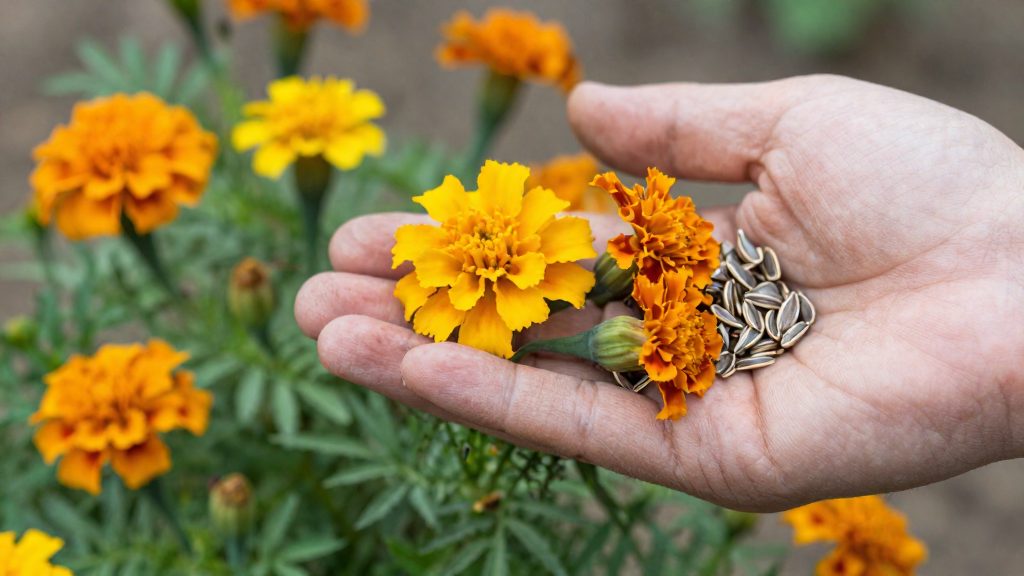
Saving marigold seed can cut the cost of replacing plants each year, but it only works reliably with the right type. Open-pollinated marigolds, such as Tagetes patula ‘Legion of Honor’, are the better choice for saving seed. Hybrid marigolds generally do not breed true, and some are sterile, so seed saved from them may produce plants that differ from the parent or no usable seed at all.
Why save marigold seeds?
Saving seed makes sense when the next generation will resemble the plant you grew. For marigolds, that depends mainly on whether the cultivar is a hybrid or an open-pollinated type. Choosing the right type before you collect anything matters more than any harvesting technique.
Hybrid versus open-pollinated marigolds
| Type | Seed-saving suitability | Notes |
|---|---|---|
| Hybrid marigold | Not recommended | Generally does not breed true; some are sterile |
| Open-pollinated or heirloom marigold, such as Tagetes patula ‘Legion of Honor’ | Recommended | Described as the better choice for saving seed (Gardener’s Path) |
Sterile hybrids
Sterile hybrids can flower normally and still produce no usable seed. Harvest care cannot correct this, so a plant that yields no viable seed after proper drying may simply be unable to reproduce.
Cross-pollination and uniformity
Pollen from nearby marigolds can create hybrids that differ in color, height and spread from the parent plant. According to Garden Gate Magazine (2009), gardeners who want a uniform planting should buy new seed each year instead of saving it. This is the main trade-off: saving seed reduces repurchasing, but it cannot guarantee a uniform bed when hybrids or mixed pollen are involved.
Keeping open-pollinated cultivars
Open-pollinated and heirloom types are the practical base for seed saving. Tagetes patula ‘Legion of Honor’ is named in Gardener’s Path as a suitable example. Because these plants are not sterile hybrids, the seed you collect from them is the realistic starting point for a continuing supply of marigolds.
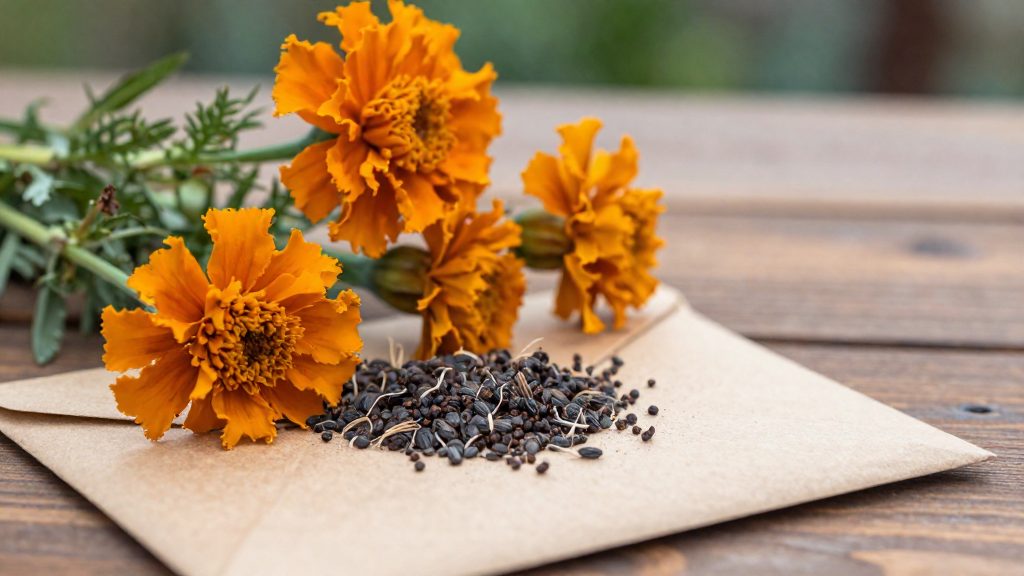
When are marigold seeds ready to harvest?
Marigold seed is ready when the seed heads have turned brown and the achenes inside are dark brown or black. Harvesting before that color change can give seed that is not viable, so the cue to watch is the seed itself, not the calendar.
| Readiness signal | Source |
|---|---|
| Seed heads turn brown | Garden Gate Magazine (2009) |
| Achenes are dark brown or black | Garden Gate Magazine (2009) |
| Base of the bloom partly green in rainy years | Southern Exposure Seed Exchange |
Dark brown or black achenes signal readiness
According to Garden Gate Magazine (2009), seed heads are ready when they are brown, and seeds that are dark brown or black are ready. Before picking, check several heads on the plant so you confirm the color across the plant rather than judging from a single head. Pale or green achenes have not finished maturing.
Harvesting early in rainy years
Wet seasons change the timing. Southern Exposure Seed Exchange advises harvesting while the base of the bloom is still partly green, because seed left too long may mold. In rainy years, harvest while the base of the bloom is still partly green rather than risk mold, then dry the seed on a plate or towel for a couple of weeks even if it looks dry.
Leaving faded blooms until fully dry
According to Gardener’s Path, faded blooms should stay on the plant until they are fully dry. Waiting for full dryness on the plant gives the achenes the longest time to mature before harvest. Gardener’s Path warns that seed harvested early may not be viable. Southern Exposure Seed Exchange makes an exception for rainy years, when harvesting while the base of the bloom is still partly green avoids mold.
How do you collect seeds from marigold heads?
Seed collection starts with choosing the right plants and waiting until the flowers are finished.
Choose heads from several plants
Collect heads from several plants instead of one. According to Gardener’s Path, this helps maintain genetic diversity in the next generation. Keep the heads from each plant in separate small piles so you can track where each lot came from.
Remove the dry heads
- Hold the stem just below the head with one hand.
- Pinch the head off with your thumb and forefinger, or cut the stem with clean, sharp scissors.
- Work gently. Pinching the head rather than squeezing it helps keep the achenes intact.
Separate achenes from chaff by hand
- Spread a sheet of plain paper on a clean, flat surface.
- Hold the head over the paper and pull the petals and receptacle apart with your fingers.
- Lift the chaff away and let the achenes collect on the paper.
- Avoid rubbing or pressing achenes between your fingers, because crushing them damages the seed.
| Step | Method | Care point |
|---|---|---|
| Pick heads | Use heads from several plants | Keeps genetic diversity |
| Remove heads | Pinch or cut the stem | Do not squeeze the head |
| Separate | Pull apart over paper | Lift away chaff by hand |
How to dry marigold seeds properly
Marigold seed needs to be fully dry before it is stored, and the drying setup has to stop moisture from building up around it.
Drying location and duration
Use a dry, airy spot. Lay the seed out on a plate or towel and leave it for a couple of weeks. Southern Exposure Seed Exchange recommends this even when the seed looks dry, so appearance alone is not a reliable guide. Keep the seed in one layer so air can reach all sides.
| Stage | Condition | Action |
|---|---|---|
| Ready to start | Seed heads brown; achenes dark brown or black | Begin drying |
| Drying period | Dry, airy place | Leave for about two weeks |
| Dryness check | Achene snaps when broken open | Proceed to storage |
The snap test
Gardener’s Path describes a simple check. Break open an achene and try to snap it. If it snaps, it is dry. If it bends or does not snap, keep drying and test again later. Testing a few seeds from different heads gives a better picture than testing one, since drying times can differ between heads.
Preventing rot from trapped moisture
The main risk during drying is moisture trapped inside the pods. Seed that is still moist can rot, so the drying period should not be shortened to save time. Keep the seed in open air rather than sealed, and do not move it to storage until the snap test confirms it is dry.
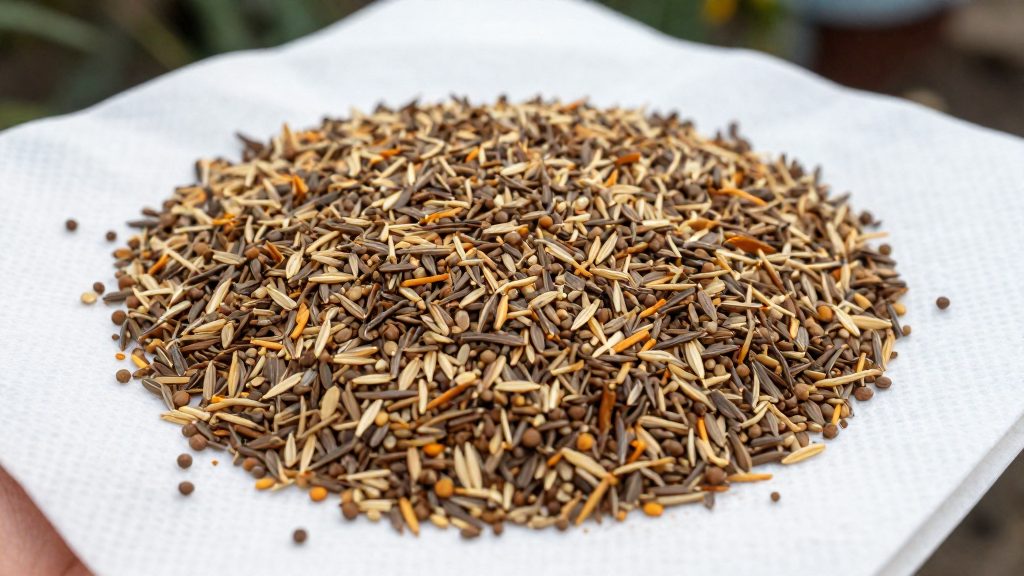
Best way to store marigold seeds
Store marigold seed in paper envelopes, label every envelope, and keep it in a cool, dry place. Gardener’s Path notes that paper envelopes make mold less likely than airtight containers, which is the main reason to choose paper for storage. Once the seed is fully dry, store it in labeled paper envelopes in a cool, dry place.
Container choice
Paper envelopes allow the seed to stay dry because the material does not trap moisture the way a sealed container can. Gardener’s Path recommends them for marigold seed. Southern Exposure Seed Exchange describes a different approach: after the seed has dried on a plate or towel for a couple of weeks, it goes into an airtight container kept in a cool, dark place. The two sources therefore differ on container type. Paper envelopes are the option that avoids the trapped-moisture risk that the airtight method carries.
| Option | Source | Key condition |
|---|---|---|
| Paper envelope | Gardener’s Path | Less likely to develop mold than airtight containers |
| Airtight container | Southern Exposure Seed Exchange | Used only after seed has dried for a couple of weeks on a plate or towel |
Labeling
Write the flower name, the cultivar and the harvest year on each envelope. For example, seed of Tagetes patula ‘Legion of Honor’, harvested in a given year, should be labeled with that full name and year. Keeping seed from several plants in separate envelopes also helps you track which collection came from where. Gardener’s Path advises collecting heads from several plants for genetic diversity, so separate labels make that practice easier to maintain.
Cool, dry location
Gardener’s Path advises keeping the envelopes in a cool, dry place, while Southern Exposure Seed Exchange specifies a cool, dark place. Choose a spot inside the home, away from humid areas such as bathrooms, unheated garages or cellars that retain moisture. Seed kept in a dry location is less likely to absorb humidity from the air. The official sources consulted do not specify exact temperatures or humidity levels for storage.
Will saved marigold seeds grow true to the parent?
Seed from open-pollinated marigolds is the most likely to resemble the parent plant, while hybrid seed generally does not breed true. Pollen from other nearby marigolds can also change the result. The result depends mainly on the type of marigold the seed came from and on whether pollen from other marigolds reached the flowers.
Hybrid versus open-pollinated seed
| Seed source | Expected result when saved | Source |
|---|---|---|
| Hybrid cultivar | Varied offspring; some plants may be sterile | Gardener’s Path |
The official sources consulted do not specify how closely each open-pollinated type will match its parent.
Isolation distance between cultivars
Some professionals suggest about one-quarter mile between cultivars of the same species to prevent cross-pollination, according to Gardener’s Path. The distance needed varies, so this figure is a general guideline rather than a fixed rule. Growing a single type of marigold in a garden, or separating types by the widest practical distance, reduces the chance that pollen from another cultivar will reach the flowers you save seed from.
Pollen drift and changes in color, height and spread
Because pollen moves between plants, an open-pollinated plant can produce offspring with changed traits if a different marigold flowers nearby.
How long do saved marigold seeds last?
Saved marigold seed typically stays viable for about two to five years when it is stored in a cool, dry place, according to Gardener’s Path (undated). Seed older than this viability window is less likely to sprout reliably, so the age of each batch matters when you plan a sowing. The official sources consulted do not specify germination percentages for each year of age, so the range above describes a general window, not a guaranteed rate.
Factors that shorten or limit viability
| Factor | Effect on seed life |
|---|---|
| Storage conditions | Cool, dry storage is the condition under which the two-to-five-year range applies (Gardener’s Path) |
Because the window is a range rather than a fixed date, two batches of the same age can perform differently depending on how they were harvested and stored. Seed that was picked early, or stored in damp conditions, should be treated as the less reliable end of the range.
Why buy fresh seed for uniform plantings
Germination declines as seed ages, so a packet near the end of its window may produce fewer seedlings than a new one. Saved seed is therefore most useful for trial plantings or informal beds where variation is acceptable.
Frequently asked questions
Can I save seed from any marigold I buy?
No. Hybrid marigolds often do not produce plants that resemble the parent, and some yield no usable seed at all. Choose an open-pollinated type, such as Tagetes patula ‘Legion of Honor’, before you start collecting.
How do I know when marigold seed is ready to collect?
According to Gardener’s Path, leave the faded blooms on the plant until they are fully dry. Garden Gate Magazine (2009) adds that the seed heads turn brown and the seeds look dark brown or black. Use the snap test: break open a seed and try to snap it, since a clean snap means it is dry enough.
How should I store marigold seed so it stays viable?
Keep dried seed in labeled paper envelopes in a cool, dry place, because paper makes mold less likely than airtight containers, according to Gardener’s Path. Write the flower name, cultivar and harvest year on each envelope. Stored this way, seed typically stays viable for about 2 to 5 years.