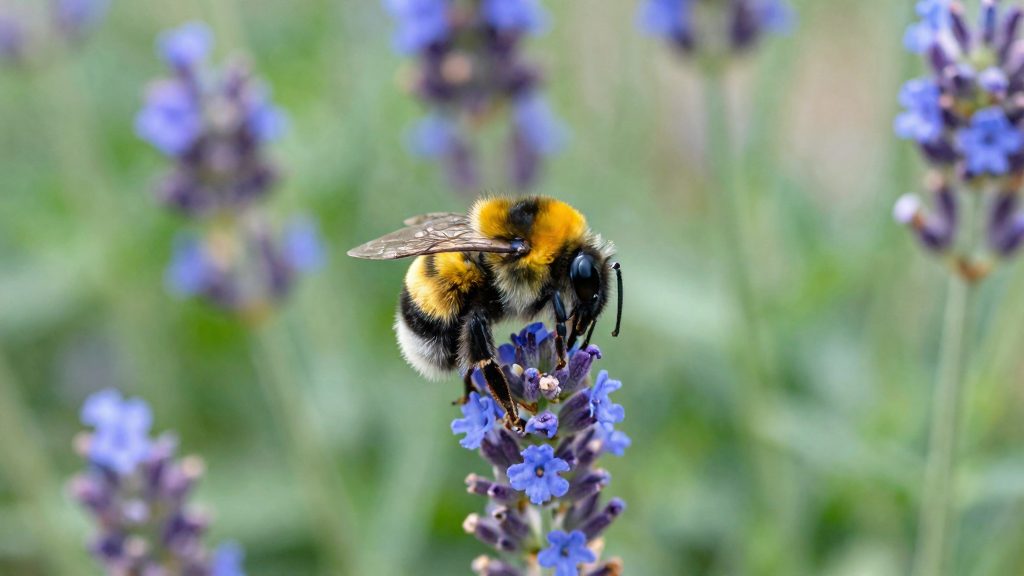
Bees are drawn to blue flowers mainly because they can see ultraviolet light, which makes blue and purple blooms stand out to them. Bees do not see red, so red flowers fall outside their visible range. According to Epic Gardening (2026-08-04), bees prefer violet and azure flowers, which makes these colours a practical starting point for pollinator-friendly planting.
Why are bees drawn to blue flowers?
Bee colour perception differs from human vision in two main ways: bees detect ultraviolet light, and they do not detect red. The table below summarises how the colours in this section compare for foraging bees, based on Epic Gardening (2026-08-04).
| Colour range | Bee response |
|---|---|
| Ultraviolet | Visible to bees |
| Blue and purple | Attractive to bees |
| Violet and azure | Preferred by foraging bees |
| Red | Outside the bee’s visible range |
Ultraviolet vision and blue-violet sensitivity
Bees can see ultraviolet light, a part of the spectrum that people cannot perceive. Because of this, blue and purple flowers appear attractive to bees. Human eyes do not register ultraviolet, so the colour a gardener sees is not the full range a bee receives. When selecting plants, judge a bloom by how bees perceive it rather than by appearance alone.
Why bees do not perceive red
Bees do not see red, so red flowers fall outside their visible range. Red blooms therefore do not match the colours bees prefer. This does not mean red flowers are never visited, but in terms of colour signalling, blue, violet and azure flowers are the better match for bees.
Violet and azure preference in foraging bees
Violet and azure flowers are preferred by foraging bees, according to Epic Gardening (2026-08-04). Blue-flowered garden plants named in the same source include bluebonnet (Lupinus texensis), Blue Victory salvia, asters, lupines and American harebell (Campanula species). Choosing several of these in the same bed gives foraging bees colours they can detect.
Best blue perennials for bees
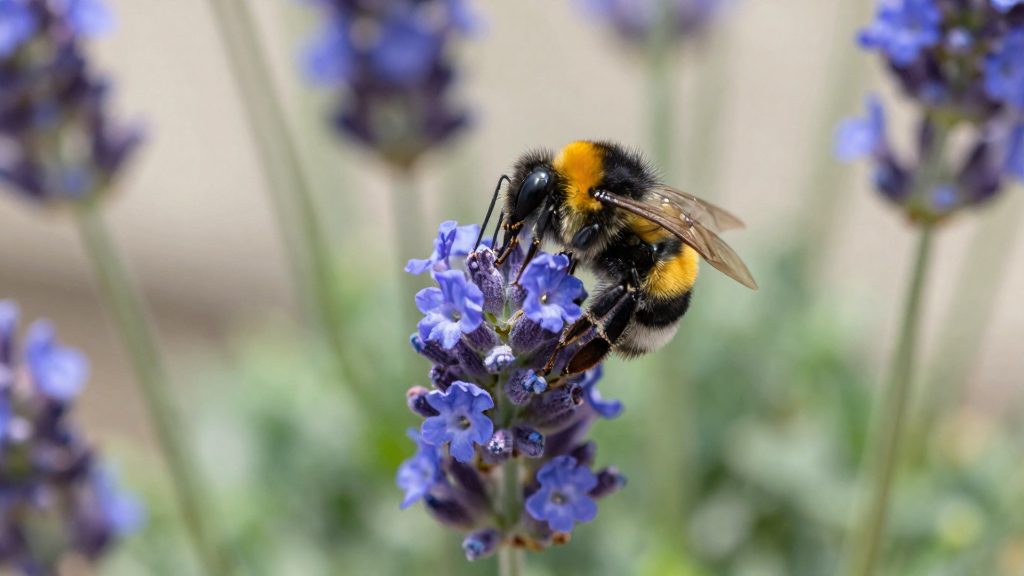
Catmint (Nepeta), Russian sage and blue anise sage (Salvia guaranitica) are cultivated blue plants recommended for bees by Honey Bee Suite, and Campanula species such as American harebell are named among blue flowers that attract bees by Epic Gardening. Honey Bee Suite (Rusty Burlew, 2011) lists catmint, Russian sage and blue anise sage among cultivated blue plants recommended for bees. Epic Gardening (2026) names American harebell and other Campanula species among blue flowers that attract bees. The consulted sources do not give bloom periods, heights or cultivation requirements for these plants, so the details below cover only what they report.
Catmint (Nepeta)
- Recommended for bees by Honey Bee Suite (Rusty Burlew, 2011).
- Bloom period and mature height are not specified in the consulted sources.
Russian sage and blue anise sage
- Russian sage: recommended for bees by Honey Bee Suite (Rusty Burlew, 2011). Height and flowering season are not specified in the consulted sources.
- Blue anise sage (Salvia guaranitica): recommended for bees by the same source. Its size and bloom timing are not given.
Campanula species (American harebell)
- Epic Gardening (2026) includes Campanula species such as American harebell in its list of blue flowers that attract bees.
- The sources do not describe the flower form of these species. Check the plant label or a regional nursery guide to confirm the flowers are open and easy for bees to reach.
Planting blue perennials for bee access
Native blue flowers by region
Native blue flowers attract the greatest diversity of local bees, according to Epic Gardening (2026-08-04). Choosing blue species that already grow in your region gives you the closest match to the bees that live nearby. Local bee diversity depends on which species are present in the area.
Selecting regional species
Begin by identifying which blue-flowering plants are native to your region. The official sources consulted do not specify a bee-diversity ranking for individual species, so confirm native status with a local native plant resource before buying seed or plants.
United States examples
The following plants are named in the sources for US gardens or US native forage:
| Plant | Documented point | Source |
|---|---|---|
| Baby blue eyes (Nemophila menziesii) | Native California annual, about 10 inches tall, re-seeds easily; selected by USDA-ARS as one of five California wildflowers that are excellent native bee forage | Honey Bee Suite (Rusty Burlew), 2011 |
| Bluebonnet (Lupinus texensis) | Named among blue flowers for US gardens | Epic Gardening (2026-08-04) |
| Native lupines (Lupinus species) | Named alongside bluebonnet as blue flowers for US gardens | Epic Gardening (2026-08-04) |
| Asters | Named among blue flowers for US gardens | Epic Gardening (2026-08-04) |
| American harebell (Campanula species) | Named among blue flowers for US gardens | Epic Gardening (2026-08-04) |
Baby blue eyes is the only species in this group with a documented USDA-ARS selection for bee forage, and that selection applies specifically to California. Bluebonnet and native lupines are named as US garden blue flowers, but the sources do not give their bee-visitation counts.
Cultivated blue flowers for pollinator beds
Three cultivated blue plants appear in the sources consulted as options for pollinator beds: bachelor’s buttons (Centaurea cyanus), Blue Victory salvia and borage (Borago officinalis). The sources do not confirm whether any of the three is an annual, so the choice of an annual sowing approach rests on your own climate and seed-packet guidance.
The three cultivated options compared
| Plant | Role cited for bees | Source |
|---|---|---|
| Bachelor’s buttons (Centaurea cyanus) | Recommended cultivated blue plant for bees | Honey Bee Suite (2011) |
| Blue Victory salvia | Named among blue flowers grown in US gardens | Epic Gardening (2026) |
| Borage (Borago officinalis) | Recommended cultivated blue plant for bees | Honey Bee Suite (2011) |
Bachelor’s buttons and borage are both recommended for bees in the same source, while Blue Victory salvia is listed for its blue flowers rather than for a specific pollinator benefit. The sources consulted do not specify the growth habit, sowing dates or flowering duration of Blue Victory salvia, so these points cannot be compared with the other two.
Planting in drifts
Sow or plant each species in a grouped patch rather than scattering single plants across the bed.
Practical placement
Choose a sunny position and water the bed without waterlogging the soil. Adjust timing to your region and climate. The official sources consulted do not specify sowing dates or flowering periods for these three plants, so consult local extension or seed-supplier guidance for those details.
Do blue flowers make blue pollen?
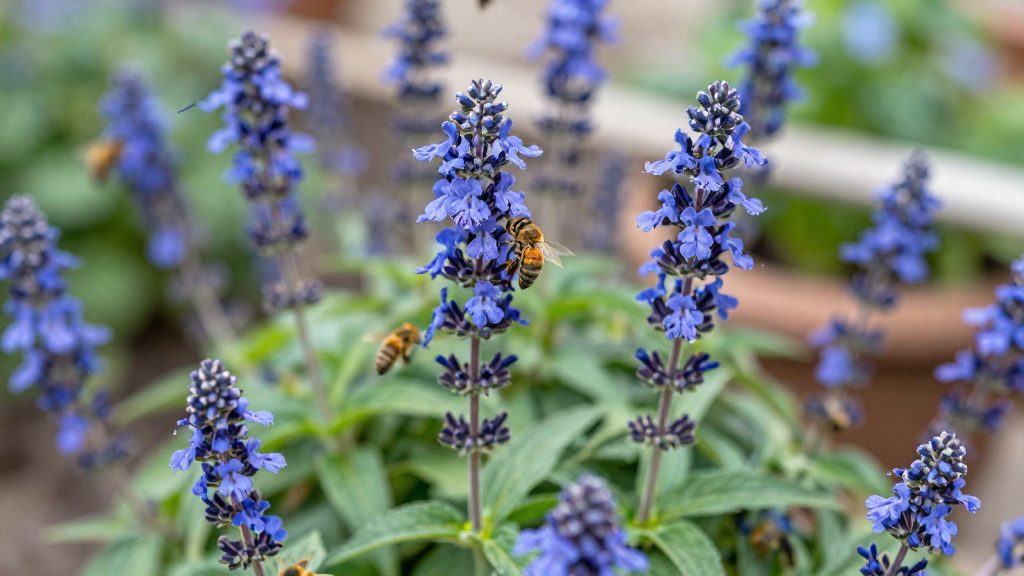
Flower colour does not predict pollen colour. According to Honey Bee Suite (Rusty Burlew), first published in the American Bee Journal, some plants produce blue pollen, while others with blue or similar-looking flowers do not. The reliable way to identify blue-pollen plants is by species name, not by petal colour alone.
Among the plants named in that source, Scilla (Siberian squill) and baby blue eyes (Nemophila menziesii) produce sapphire or denim blue pollen. Borage, viper’s bugloss, lacy phacelia and caryopteris also produce blue pollen. Chicory and forget-me-nots do not, even though both have blue flowers.
| Plant | Produces blue pollen | Pollen colour, as described |
|---|---|---|
| Scilla (Siberian squill) | Yes | Sapphire or denim blue |
| Baby blue eyes (Nemophila menziesii) | Yes | Sapphire or denim blue |
| Borage | Yes | Blue |
| Viper’s bugloss | Yes | Blue |
| Lacy phacelia | Yes | Blue |
| Caryopteris | Yes | Blue |
| Chicory | No | Not blue |
| Forget-me-nots | No | Not blue |
The comparison matters for planning. A bed of blue-flowered plants does not guarantee blue pollen, so a gardener wanting that effect should select from the blue-pollen species in the table. The source does not describe the pollen colour of chicory or forget-me-nots beyond stating that they do not produce blue pollen.
How to plant a blue bee garden
A blue bee bed works best when its flowers are grouped in drifts, when different species bloom at different times, and when the site has good light and free-draining soil. The sources consulted explain why blue flowers and grouping help bees, but they do not give a planting calendar or exact light and soil requirements, so the steps below are general methods to adapt to your region.
Plant in drifts
Grouping blue flowers in drifts, meaning blocks of one species placed close together, reduces how far bees must fly. According to Epic Gardening (2026), this saves bees energy because they do not have to travel between distant patches.
- Plant each species in a block rather than spacing single plants across the bed.
- Place blocks of different blue species next to each other so the bed reads as one connected area.
Stagger the bloom succession
A bee bed should not peak once and then fade. Select species that flower at different times, so that blue blooms are present from spring into autumn. The sources consulted do not give bloom months for each plant, so check flowering times for your area before buying.
Some plants can renew themselves. Baby blue eyes (Nemophila menziesii) is a native California annual about 10 inches tall that re-seeds easily, according to Honey Bee Suite (Rusty Burlew, 2011). Leaving it to set seed can help keep the bed in flower the following season.
Choose sun and soil conditions
- Site: Choose a sunny position for the bed. The sources consulted do not specify hours of sun required, so observe how many hours of direct light the spot receives before planting.
- Soil: Use well-drained soil. Water the bed without letting the soil stay waterlogged, which can damage roots.
- Mixed plantings: Combine species with different needs in separate blocks, so each block sits where its conditions suit it.
Pollen colour and plant choice
The sources list several blue plants recommended for bees. Honey Bee Suite (first published in American Bee Journal 163(1)) reports which produce blue pollen:
| Plant | Stated in the sources |
|---|---|
| Scilla (Siberian squill) | Produces sapphire or denim blue pollen |
| Baby blue eyes (Nemophila menziesii) | Produces sapphire or denim blue pollen |
| Borage | Produces blue pollen; recommended for bees |
| Caryopteris | Produces blue pollen; recommended for bees |
| Catmint (Nepeta) | Recommended for bees |
| Blue anise sage (Salvia guaranitica) | Recommended for bees |
Chicory is also recommended for bees but, according to the same source, does not produce blue pollen. Forget-me-nots do not produce blue pollen either.
Which flower shapes help bees most?
Bees prefer disc-shaped flowers, meaning open blooms with a flat face, because they give easy access to nectar. According to Epic Gardening (2026-08-04), bees prefer this flower shape. An open form lets a visiting bee reach the nectar without working through a narrow opening.
Disc-shaped flowers
Open, flat-faced blooms let a bee land on the petals and reach the nectar directly. Epic Gardening (2026-08-04) names several blue flowers for US gardens that suit bees: bluebonnet (Lupinus texensis), Blue Victory salvia, asters, lupines and Campanula species such as American harebell. The source does not describe the exact bloom shape of each one, so check the form of a specific cultivar before planting for bees.
Double-flowered cultivars
The official sources consulted do not specify how double-flowered blue cultivars compare with single-flowered types for nectar or pollen access. When choosing between two forms of the same plant, a practical check is to prefer the single-flowered or more open version, in line with the disc-shape principle above. This is a selection method, not a measured result.
Bell-shaped and spike-form blooms
Campanula species are named as blue bee flowers by Epic Gardening (2026-08-04), but the source does not compare their shape with disc-shaped blooms. Spike-form flowers are not classified in the consulted sources, so their relative value for bees cannot be confirmed here.
| Flower form | What the consulted sources state | Example named |
|---|---|---|
| Disc-shaped, open | Preferred by bees; easy nectar access | Not linked to a specific species in the source |
| Double-flowered | Not specified | Not named |
| Bell-shaped | Campanula listed as a blue bee flower; shape comparison not specified | American harebell |
| Spike-form | Not specified | Not named |
Frequently asked questions
Why do bees respond to blue flowers more than red ones?
Bees can perceive ultraviolet light, which makes blue and purple blooms look distinct to them, while they cannot perceive red at all. Red flowers therefore send a signal that bees largely miss, according to Epic Gardening (2026-08-04).
Which blue flowers should a beginner plant for bees?
Start with bluebonnet, Blue Victory salvia, asters, lupines or Campanula species such as American harebell, all named by Epic Gardening (2026-08-04). The Honey Bee Suite (2011) also lists cultivated blue-flowered plants for bees, including catmint, borage, Russian sage and caryopteris.
Do blue flowers need to be native or grouped together to help bees?
Native blue flowers attract the greatest variety of local bee species, according to Epic Gardening (2026-08-04). Planting them in drifts, meaning dense groups rather than scattered single plants, reduces how far bees must fly between food sources, which saves them energy.