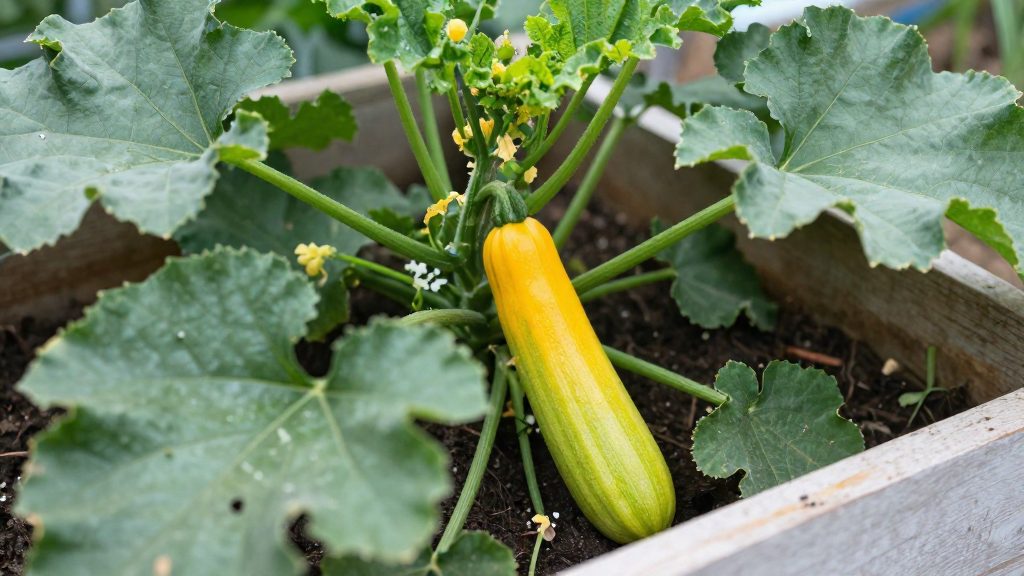
Yes, one or two zucchini plants can fit a small backyard, and bush varieties are the most practical choice for limited space. According to the Old Farmer’s Almanac (2026), bush types such as ‘Eight Ball’ and ‘Bush Baby’ need no trellis, so they stay compact and simple to manage. The official sources consulted do not specify a yield per plant or a container volume, so the yield and pot guidance below relies on general principles.
Can you grow zucchini in a small backyard?
Does one plant fit a small plot?
A single zucchini plant suits a small plot when it is a bush type. Bush plants grow as a compact clump, while vining types spread outward and need support. For a small area, the growth habit matters more than the variety name.
| Growth habit | Support needed | Fit for a small plot |
|---|---|---|
| Bush (e.g. ‘Eight Ball’, ‘Bush Baby’) | None | Best fit: compact, no trellis |
| Vining | Trellis, netting or cage | Needs more room and a support structure |
Realistic yield expectations
Yield depends on how many plants you grow and how consistently you harvest. The sources consulted give timing and fruit size rather than weight or fruit count, so plan around the following figures:
- Time to fruit: fruit typically appears around 60 days after planting, according to the Old Farmer’s Almanac (2026).
- Harvest size: the Old Farmer’s Almanac (2026) gives 4–8 inches, while the Farmers’ Almanac (2026) recommends picking at 6–8 inches, before fruit matures on the vine.
With one or two plants, expect a modest harvest that is best judged by the fruit you pick at the stated sizes.
Container growing and pot sizing
Containers are feasible for bush types, but they require closer attention to moisture. Containers hold less soil than garden beds, so they should be checked more often.
The official sources consulted do not specify a minimum pot volume or depth. Choose the largest container your space allows, and use a bush variety rather than a vining one to keep the plant contained.
Best compact zucchini varieties
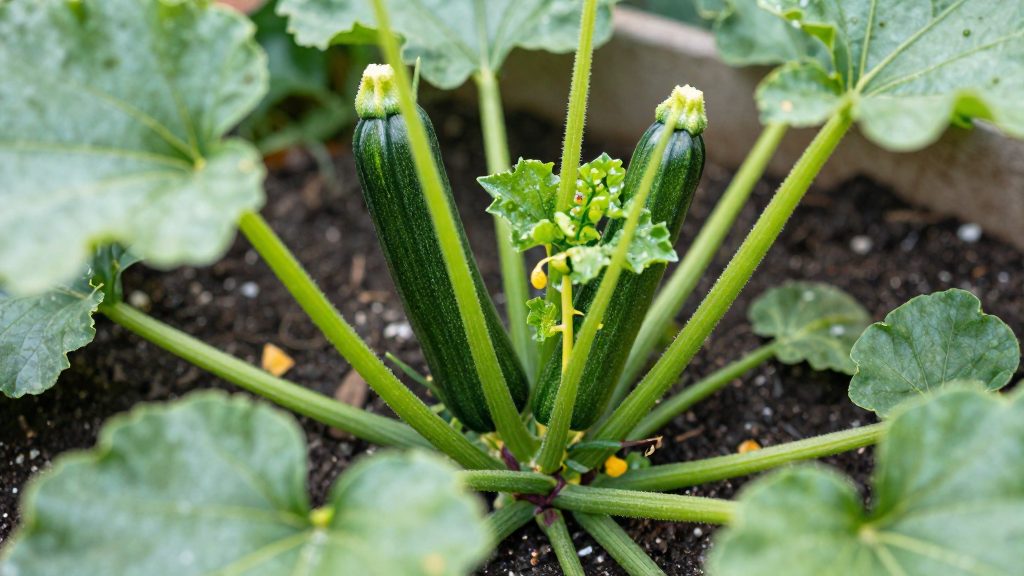
Choosing a compact zucchini starts with its growth habit, not its fruit. The Old Farmer’s Almanac (2026) separates bush zucchini from vining types, and the two named bush cultivars, ‘Eight Ball’ and ‘Bush Baby’, are the most useful starting points for a small bed. Check the habit on the seed packet or plant label before buying seed or transplants, because it determines whether the plant will fit the space you have.
Bush habit means the plant grows as a compact, upright clump rather than sending long stems across the soil. According to the Old Farmer’s Almanac (2026), bush types need no trellis. Vining types need support such as a trellis, netting or a cage.
| Growth habit | Support needed | Fit for a small bed |
|---|---|---|
| Bush (e.g. ‘Eight Ball’, ‘Bush Baby’) | None | Compact clump suited to limited space |
| Vining | Trellis, netting or cage | Trailing stems that need room and support |
Selecting compact cultivars for small beds
- Start with the habit. When bed space is limited, choose a bush cultivar over a vining one.
- Read the habit, not just the name. Labels vary, so confirm that a cultivar is listed as bush before assuming it will stay compact.
When and where to plant
Zucchini is usually sown directly in the garden, so timing depends on two conditions: the soil must be warm, and the risk of frost must be past. According to the Old Farmer’s Almanac (2026), sowing works best when the soil reaches 65 to 70°F, and seeds go in about two weeks after the last frost. Seeds are planted about 1 inch deep, and the planting spot needs at least 8 hours of direct sunlight each day.
Soil temperature and sowing timing
Air temperature alone does not show whether the soil is ready. Zucchini seed needs warm soil to germinate, so the Old Farmer’s Almanac (2026) ties sowing to a soil temperature of about 65 to 70°F. Sowing into cold soil can delay emergence or cause seed to rot.
- Check the soil, not the forecast, before sowing.
- Count from the last frost date for your area, then sow about two weeks later.
- Wait if the soil is still below the target range, even if the calendar date has arrived.
Sowing depth
Sow each seed about 1 inch deep, according to the Old Farmer’s Almanac (2026). Shallower seed can dry out at the surface, and deeper seed takes longer to emerge. Use the same depth across the whole row so the seedlings come up at a similar time.
Choosing a sunny position
Zucchini needs a site that receives at least 8 hours of direct sunlight per day, as stated by the Old Farmer’s Almanac (2026). Shade reduces flowering and fruit set, so a spot that is shaded in the morning or afternoon may not be suitable. Before sowing, observe where the sun falls across the day and pick the sunniest area available.
| Factor | Requirement | Source |
|---|---|---|
| Soil temperature at sowing | 65 to 70°F | Old Farmer’s Almanac (2026) |
| Sowing time | About 2 weeks after last frost | Old Farmer’s Almanac (2026) |
| Sowing depth | About 1 inch | Old Farmer’s Almanac (2026) |
| Direct sunlight | At least 8 hours per day | Old Farmer’s Almanac (2026) |
How much space does each plant need?
Zucchini spacing depends on growth habit: whether the plant grows as a compact bush or as a trailing vine. According to the Old Farmer’s Almanac (2026), bush types can be planted about 1½ to 2 feet apart, while vining types need about 2 to 3 feet. Measure these distances between plant centers, not between the edges of the leaves.
Spacing by growth habit
| Growth habit | Plant-to-plant distance | Approximate metric equivalent |
|---|---|---|
| Bush types (for example ‘Eight Ball’ and ‘Bush Baby’) | About 1½ to 2 feet | About 46 to 61 cm |
| Vining types | About 2 to 3 feet | About 61 to 91 cm |
The metric equivalents are conversions of the source figures.
Clearance for airflow
The same source advises that every zucchini should stay 2 to 3 feet from other plants to allow airflow. The source gives this as a separate guideline from the plant-to-plant spacing above, and it does not say how the two figures combine. For a small bed, treat 2 to 3 feet as the safer distance between a zucchini and neighboring plants.
How to calculate the distance in a small bed
- Check the growth habit on the seed packet or plant label before planting.
- Choose the distance from the table above: 1½ to 2 feet for a bush type, 2 to 3 feet for a vining type.
- Mark the planting points along the bed, starting from the edges and working inward.
- Count the plants that fit. Divide the usable length by the chosen distance and round down. This gives the approximate number of plants for one row.
- Leave the airflow gap between the zucchini and other crops, not only between zucchini plants.
Growing zucchini vertically or in raised beds
Vining zucchini can be trained upward to save ground space, and raised beds offer a contained growing area for small yards. According to the Old Farmer’s Almanac (2026), vining types need a trellis, netting or cage. Raised beds should be no more than 4 feet wide and at least 12 inches deep.
Choosing a support system for vining types
Vining varieties spread across the ground unless they are guided upward, so they need a support structure. The Old Farmer’s Almanac (2026) lists three options: a trellis, netting or a cage.
Install the support before planting. This timing matters because the Old Farmer’s Almanac (2026) notes that adding a support later can break the stems. Set the trellis, netting or cage in place first, then sow or transplant beside it.
Raised bed dimensions
A raised bed in a small backyard should follow two dimension limits, according to the Old Farmer’s Almanac (2026):
| Dimension | Guideline | Reason given in source |
|---|---|---|
| Width | No more than 4 feet | Makes the bed easier to reach into |
| Depth | At least 12 inches | Provides a root zone for the plant |
| Support (vining types) | Trellis, netting or cage, placed before planting | Prevents stem breakage |
The width limit allows you to reach the center of the bed without stepping onto the soil. The depth requirement gives roots enough room to establish.
Light requirements for a small yard
Before placing a raised bed or trellis, observe which part of the yard receives full sun across the day and position the structure there.
Watering and feeding basics
Zucchini needs steady moisture at the root zone, and the timing and delivery of water matter as much as the amount. According to Old Farmer’s Almanac (2026), the practical check is to water when the top inch of soil is dry. The official sources consulted do not specify fertilizer rates or feeding schedules, so this section covers watering and soil cover only.
| Factor | Guidance | Source |
|---|---|---|
| Moisture check | Water when the top inch of soil is dry | Old Farmer’s Almanac (2026) |
| Delivery method | Drip lines or soaker hoses at the soil line | Old Farmer’s Almanac (2026) |
| Soil cover | Mulch over the soil | Old Farmer’s Almanac (2026) |
| Raised beds | Dry out faster than in-ground beds | Old Farmer’s Almanac (2026) |
Checking the soil before watering
Push a finger into the soil near the base of the plant. If the top inch is dry, water. If it is still moist at that depth, wait and check again. This method responds to rain, heat, and soil type, so it works better than watering on a fixed calendar, especially in a small backyard where beds receive different amounts of sun and shade.
Delivering water to the roots
Use drip lines or soaker hoses laid at the soil line. This sends water directly to the roots and keeps the leaves dry. Old Farmer’s Almanac (2026) links this method to limiting fungal disease, so it is the preferred delivery approach for zucchini.
Keeping the root zone moist
Apply mulch over the soil around the plants. Old Farmer’s Almanac (2026) lists mulching together with drip or soaker delivery as one routine, which helps keep roots moist without repeatedly wetting the foliage.
Adjusting for raised beds
Raised beds dry out faster than in-ground beds. Check the top inch of soil more often in raised beds than in ground-level beds, particularly during hot, dry periods, and expect to water them more frequently.
Pests and problems to watch for
The main pests of zucchini are squash bugs and squash vine borers, according to the Farmers’ Almanac (2026). Both can damage a small plot quickly, so regular inspection is the most reliable early warning. Check the plants at least once a week, and look at both the undersides of the leaves and the base of the stems, where each pest leaves its signs.
Squash bugs: adults and egg clusters
Squash bugs gather on the plant and under its leaves. Look for the adult insects and for egg clusters on the undersides of leaves, where the Farmers’ Almanac (2026) reports they are found. Turn the leaves over rather than checking only the upper surface. Remove visible adults and egg clusters by hand as soon as you see them, before they build up in number.
Squash vine borers: entry holes and frass
Squash vine borers are identified by a small hole with sawdust-like frass at the base of a stem, according to the Farmers’ Almanac (2026). Frass is the insect’s waste, and it looks like fine sawdust on the stem or on the soil next to it. The lower stem, at soil level, is where this sign appears, so inspect it directly rather than relying on the leaves.
The table below summarises where to look for each sign.
| Sign | Where to look | Pest it indicates |
|---|---|---|
| Adult squash bugs | Under leaves | Squash bugs |
| Egg clusters | Undersides of leaves | Squash bugs |
| Small hole with sawdust-like frass | Base of a stem, at soil level | Squash vine borer |
Telling pest damage from fungal leaf symptoms
The official sources consulted do not describe the leaf symptoms of fungal disease, so this section cannot list them. What can be checked is the presence or absence of the pest signs above. Adults, egg clusters, or a stem hole with frass point to a pest as the cause. If you find none of these signs, that does not rule out a pest, because a single inspection can miss early or hidden damage. Keep inspecting regularly. In that case, identify the problem with a local gardening or agricultural advisory service before applying any treatment.
When should you harvest zucchini?
Most zucchini varieties reach harvest 45 to 60 days after planting, according to the Farmers’ Almanac (2026). The Old Farmer’s Almanac (2026) states that fruit typically appears around 60 days after planting. The first picking date therefore depends on the variety and on when the plants went into the ground.
Picking at the right size
Fruit should be picked small and shiny, before it matures on the vine. The two almanacs give slightly different size ranges for this stage:
- The Old Farmer’s Almanac (2026) gives 4 to 8 inches long.
- The Farmers’ Almanac (2026) gives 6 to 8 inches.
Both ranges describe young, tender fruit. Checking plants regularly makes it easier to pick each zucchini within this window instead of letting it grow past it.
How to cut the fruit
Cut each zucchini from the plant with a knife rather than pulling it off by hand. Leave about 1 inch of stem attached to the fruit, as the Old Farmer’s Almanac (2026) recommends.
Harvest reference
| Stage | Guideline | Source |
|---|---|---|
| Days from planting to first harvest | 45 to 60 days for most varieties | Farmers’ Almanac (2026) |
| Days from planting to fruit appearing | About 60 days | Old Farmer’s Almanac (2026) |
| Length at picking | 4 to 8 inches | Old Farmer’s Almanac (2026) |
| Length at picking | 6 to 8 inches | Farmers’ Almanac (2026) |
| Stem left on fruit | About 1 inch, cut with a knife | Old Farmer’s Almanac (2026) |
Bush and vining types are not separated in these sources for harvest timing, so the 45 to 60 day range applies to most varieties without a distinction by growth habit.
Frequently asked questions
How much space does one zucchini plant need?
Bush varieties such as ‘Eight Ball’ or ‘Bush Baby’ can be planted about 1½ to 2 feet apart, according to the Old Farmer’s Almanac (2026). Keep every zucchini 2 to 3 feet from other plants so air can move between the leaves.
When should I sow zucchini seeds outdoors?
Direct sow about 2 weeks after the last frost, when the soil is around 65–70°F, placing seeds about 1 inch deep (Old Farmer’s Almanac, 2026). The spot needs at least 8 hours of direct sun per day.
How do I water zucchini in a small raised bed?
Water when the top inch of soil is dry, and lay soaker hoses or drip lines at the soil line under mulch to limit fungal disease (Old Farmer’s Almanac, 2026). Raised beds dry out faster than in-ground beds, so check moisture more often.