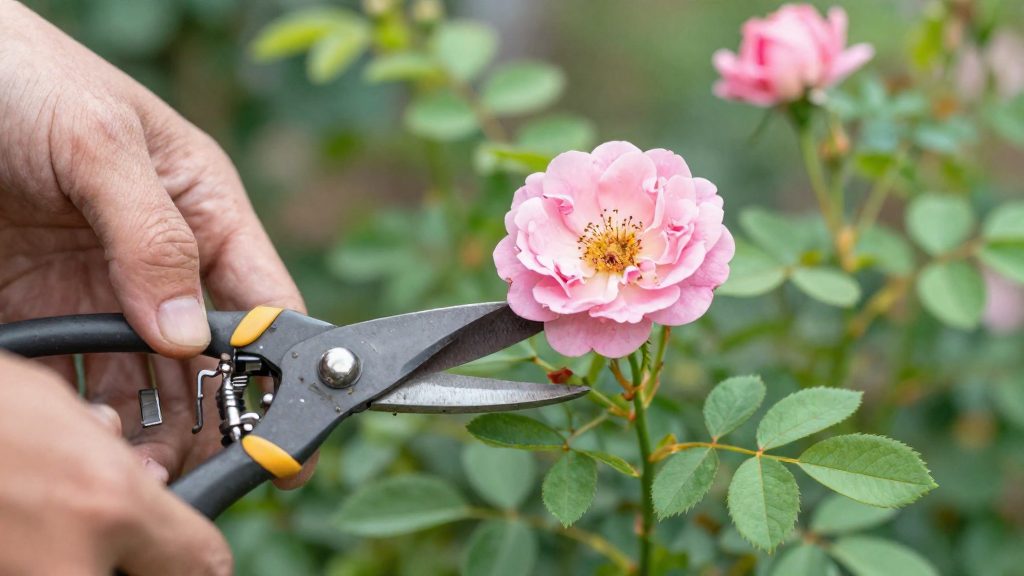
Deadheading, the removal of spent blooms, is optional, but it is worthwhile on repeat-blooming roses. According to the Old Farmer’s Almanac (2026), it can encourage more blooms, tidy the plant’s appearance, and help reduce gray mold in damp weather.
Why deadhead roses?
The benefit varies with the rose, so the task matters most on varieties that produce new flushes through the season.
Encouraging new flushes
Removing a faded flower clears the spot where it grew, leaving the plant free to produce its next flush.
Tidying the plant’s appearance
Faded flowers left on the bush make it look untidy. Removing them keeps the plant neat between flushes, which is a cosmetic benefit the Old Farmer’s Almanac (2026) lists alongside encouraging blooms.
Reducing gray mold in damp weather
The Old Farmer’s Almanac (2026) links deadheading to a lower risk of gray mold in damp weather. The official sources consulted do not specify how much this reduces the risk or how the mold is affected, so treat deadheading as one supporting measure rather than a guaranteed control. Removing spent blooms during wet periods is one way to apply this advice.
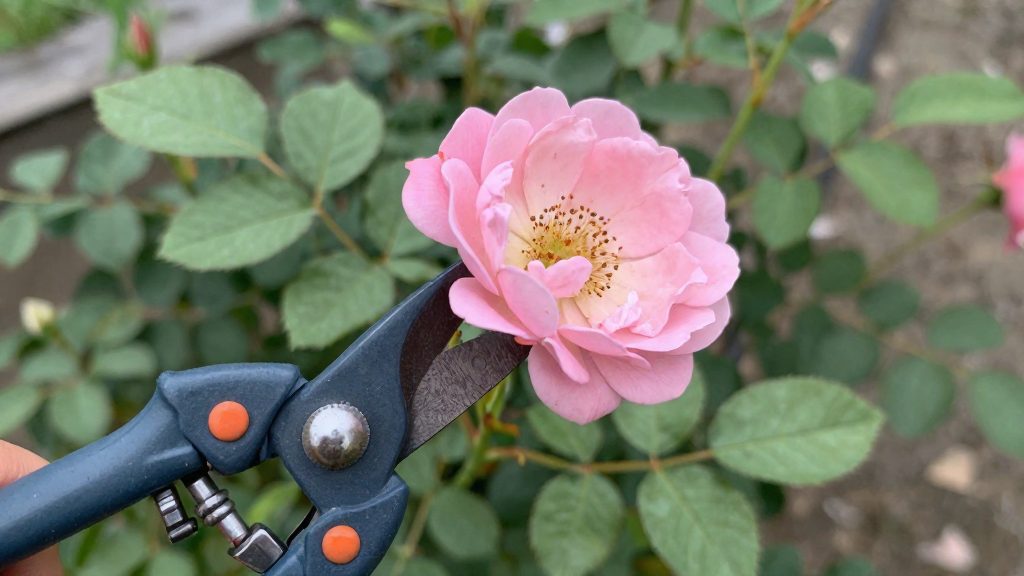
Which roses need deadheading?
Deadheading mainly benefits repeat-blooming roses, which produce flushes of flowers through the season.
Other rose types respond differently:
| Rose type | Deadheading? | Reason |
|---|---|---|
| Repeat-blooming roses | Yes, recommended | Removing spent flowers can encourage more blooms (Old Farmer’s Almanac, 2026-10-22) |
| Ramblers | No, keep spent flowers | Spent flowers are needed for rose hips to form (Epic Gardening, 2024-07-12) |
| Single-season (once-blooming) roses | No, keep spent flowers | They won’t flower a second time (Old Farmer’s Almanac, 2026-10-22), and hips form from the spent blooms (Epic Gardening, 2024-07-12) |
| Shrub roses | Usually not required | They largely self-clean (Epic Gardening, 2024-07-12) |
| Knock Out roses | Usually not required | They are self-cleaning (Old Farmer’s Almanac, 2026-10-22) |
Ramblers and single-season bloomers form the main exception to routine deadheading. Leaving their spent flowers in place allows rose hips to develop, which is the purpose of those flowers for these types. Cutting them off removes the hips before they form. Single-season roses will not flower a second time anyway.
Shrub roses and Knock Out roses are the easiest to maintain. Because they self-clean, their faded flowers drop off without intervention, so manual removal is optional. Gardeners who prefer a tidier appearance can still remove spent blooms on these types.
Tools to use
Deadheading a rose needs only a few hand tools, but the cut is only as clean as the tool that makes it. The main concern is the stem: a clean cut heals faster and leaves no torn tissue for the plant to repair.
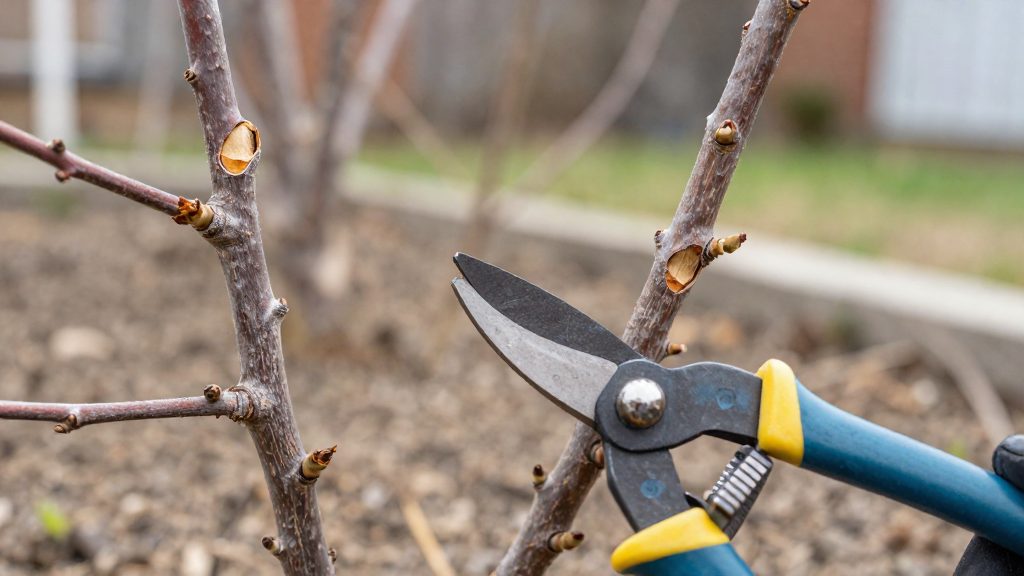
Bypass pruners are the standard choice for deadheading roses. Their two curved blades pass each other like scissors, so the cut is precise and close to the bud or leaf you are cutting back to. Anvil pruners, which press a blade onto a flat surface, tend to crush stems instead of slicing them, so they are a poor fit for live rose canes.
Sharp blades matter as much as the tool type. A dull blade bruises and crushes the stem rather than cutting it cleanly, which leaves a ragged surface where moisture and disease can enter. Check the blade edge before starting, and keep the pruners clean and in good working order between uses.
Gloves protect your hands from thorns while you work through the bush. Choose a pair that covers the wrist and is thick enough to resist punctures, and wear them throughout, including when you are only removing a few faded blooms.
Good hygiene keeps stem cuts clean from one plant to the next:
- Wipe the blades with a disinfectant or rubbing alcohol before and after pruning a plant, especially if you suspect disease.
- Clean sap and plant debris off the blades during the job, not only at the end.
- Remove cut material from the bed rather than leaving it on the soil around the plant.
- Keep the tools dry and oiled so the blades close smoothly.
Where do you cut a spent rose bloom?
On established roses, the cut goes on the stem below the faded flower, positioned by a leaf and a bud rather than by the flower head. According to the Old Farmer’s Almanac (2026-10-22), follow the faded bloom down to a leaf with five leaflets, then cut about ¼ inch above an outward-facing bud eye, sloping the cut away from the bud. Epic Gardening (2024-07-12) describes the same cut as a 45-degree angle, about 1/8 to 1/4 inch above a bud or node.
Step 1: Follow the faded stem to a five-leaflet leaf
Trace the stem down from the spent bloom until you reach the first leaf with five leaflets. This leaf is the reference point for the cut. Work from the leaf, not from the flower, so the cut lands on the stem at a consistent position on each stem.
Step 2: Locate the outward-facing bud eye
Above that five-leaflet leaf, find a bud eye, the small swelling on the stem where a new shoot can develop. Choose a bud eye that faces outward, away from the center of the bush. The cut is made about ¼ inch above this bud.
Step 3: Angle the cut away from the bud
Make the cut at about 45 degrees, sloping away from the bud. The cut should not be flat across the stem. The slope directs the cut face away from the bud, which is the orientation both sources describe.
Summary of cut positions
| Element | Position | Source |
|---|---|---|
| Reference leaf | First leaf with five leaflets, below the faded bloom | Old Farmer’s Almanac (2026-10-22) |
| Cut height | About ¼ inch above an outward-facing bud eye | Old Farmer’s Almanac (2026-10-22) |
| Cut angle | 45 degrees, sloping away from the bud | Epic Gardening (2024-07-12) |
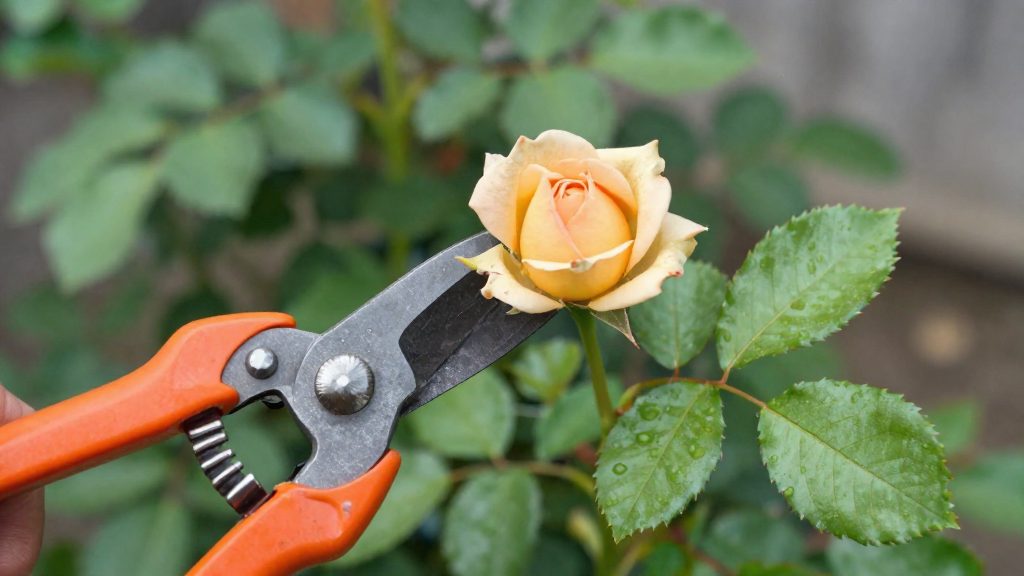
How to deadhead clusters and new plants
Flower clusters and first-season roses need different handling from a single spent bloom. On a cluster, you remove faded flowers one at a time while the rest of the group is still open, and you cut the main stem only after the whole cluster has finished. Newly planted roses get a higher cut during their first growing season so they keep more foliage. According to The Old Farmer’s Almanac (2026), these two cases follow distinct timing and placement.
Deadheading clustered blooms
Work through the cluster while it is still flowering:
- Snip each faded flower just below its head. Leave the open flowers in place.
- Repeat as individual flowers fade, rather than waiting for the entire group to finish.
- Once every flower in the cluster has faded, cut the main stem back, following the same method used for a single bloom.
Cutting newly planted roses
A rose in its first growing season should be cut higher than an established plant. Make the cut just above the uppermost three-leaflet leaf, which leaves more foliage on the plant. Cut back only the faded bloom and the stem above that leaf.
Summary
| Situation | When to cut | Where to cut |
|---|---|---|
| Individual flower in a cluster | While the cluster is still blooming | Just below the faded head |
| Whole cluster | After every flower has faded | Main stem |
| Newly planted rose | First growing season | Just above the uppermost three-leaflet leaf |
When should you stop deadheading?
In cold-winter areas, deadheading should end in late summer or early fall, often around August or September, according to Epic Gardening (2024) and the Old Farmer’s Almanac (2026). The goal is timing: the last spent flowers are left on the bush so that rose hips can form before winter arrives. Hips are the fruit that develops from a faded bloom, and they need time to mature before cold weather sets in.
The general rule is to stop six to eight weeks before the expected first frost, as Epic Gardening (2024) advises. Because the first frost date depends on your location, count back from the local date rather than from a fixed calendar day. The sources consulted do not give a single date that applies everywhere.
Use this sequence to set your final deadheading date:
- Find the expected first frost date for your area.
- Count back six to eight weeks from that date.
- Make your last deadheading cut before that point.
- Leave any blooms that fade after that point on the plant so their hips can develop.
| Situation | Deadheading guidance |
|---|---|
| Cold-winter areas | Stop in late summer or early fall, often August or September |
| Areas with a first frost | Stop six to eight weeks before the expected first frost so hips can form |
Once deadheading stops, the remaining spent flowers are allowed to ripen into hips before winter. Stopping on time gives the plant the full period needed for this development.
How often should you deadhead?
For repeat-blooming roses, a weekly check during the bloom period is usually enough. The routine does not need daily attention: one walk through the bed each week, removing the flowers that have faded since the last visit, covers the task.
Timing matters as much as frequency. Epic Gardening (2024-07-12) states that the quicker you deadhead, the faster plants reflower. Remove each spent bloom as soon as blooms fade rather than leaving it on the plant while new buds develop, A weekly check is usually enough, and removing blooms sooner can speed up reblooming.
Not every rose needs this routine. Before setting a schedule, identify which group a rose belongs to. Weekly checks make sense for repeat-blooming roses that are expected to rebloom. For self-cleaning shrub roses and once-blooming roses, a regular schedule is not needed, and ramblers should be left alone if hip formation is wanted.
Frequently asked questions
When should I stop deadheading my roses in autumn?
In cold-winter areas, stop deadheading in late summer or early fall, often around August or September, according to the Old Farmer’s Almanac (2026-10-22). Epic Gardening (2024-07-12) gives a frost-based rule instead: stop six to eight weeks before the expected first frost so that rose hips can form. This timing does not apply to frost-free areas.
How far down the stem should I cut a spent rose bloom?
On established roses, follow the faded bloom down to a leaf with five leaflets, then cut about ¼ inch above an outward-facing bud eye, sloping the cut away from the bud (Old Farmer’s Almanac, 2026-10-22). Newly planted roses should be cut higher, just above the uppermost three-leaflet leaf, during their first growing season to keep more foliage.
Do ramblers and Knock Out roses need deadheading?
Ramblers should keep their spent flowers, because rose hips form from them (Epic Gardening, 2024-07-12). Knock Out roses are usually not deadheaded, since they are self-cleaning (Old Farmer’s Almanac, 2026-10-22).