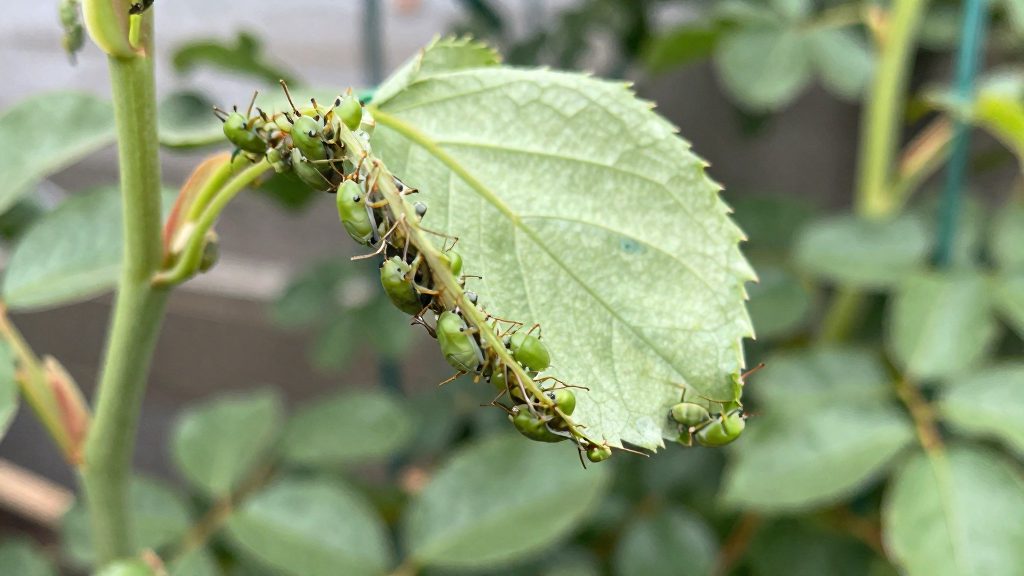
What are aphids and how do you spot them?
Signs to check on the plant
| Sign | What to check | Source |
|---|---|---|
| Sticky honeydew | Leaf surfaces and the ground or objects beneath the plant | UC IPM, University of California Agriculture and Natural Resources |
| Ants moving over the plant | Trunks and branches, especially those touching buildings or the ground | UC IPM, University of California Agriculture and Natural Resources |
| Aphids dislodged by shaking | Sturdy stems shaken gently to see which insects fall off | UC IPM, University of California Agriculture and Natural Resources |
| Lush, fast new growth | Newest shoots, where heavy nitrogen feeding can increase aphid reproduction | UC IPM, University of California Agriculture and Natural Resources |
Honeydew as an infestation sign
Honeydew is the sticky residue left by aphids. It is an indirect sign: other insects can also leave honeydew, so confirm aphids by finding them on the leaf undersides and new shoots, or by gently shaking a sturdy stem, before you treat. UC IPM notes that rinsed leaves can look clean even when aphids remain. Ants also feed on honeydew, so ant trails on a plant are a second indicator. The official sources consulted do not specify whether sooty mold develops on honeydew, so this section does not use sooty mold as a diagnostic sign.
Where to look
Inspect plants in the following order:
- Newest shoots and leaves first, since these are the parts most sensitive to heavy nitrogen feeding.
- Leaf undersides, checked with a hand lens if needed.
- Stems and trunks where ants are moving, as their routes often lead to colonies.
- Plants adjacent to ants or honeydew, which may be infested even when aphids are hard to see.
The official sources consulted do not specify exact colony sizes or the number of aphids that indicate an infestation requiring action, so monitor plants regularly and compare changes over time rather than relying on a fixed threshold.
Can a blast of water get rid of aphids?
A strong stream of water knocks aphids off a plant. The same spray also washes off honeydew, the sticky residue aphids leave on leaves and stems. Water is therefore a physical method: it removes the insects and their residue from the plant rather than killing them with a product. It works best as a first step on light infestations and on plants that can take the force of a jet without damage.
Forceful stream on stems and leaves
Aim a strong jet of water at the colonies on young shoots, stems and both leaf surfaces. Avoid this on fragile plants, where the force of the spray may cause damage.
Why dislodged aphids usually fail to return
Most aphids knocked off by the spray cannot climb back to the plant. The official sources consulted do not specify the exact reason, so the method should be judged by its result: the insects are removed from the plant and do not usually recolonize it on their own.
Timing: spray early in the day
Spraying early in the day lets the foliage dry quickly, which lowers the risk of fungal disease, according to UC IPM. Wet leaves that stay damp for long periods are more exposed to fungal problems, so the morning is the preferred time for this treatment.
| Action | Effect |
|---|---|
| Spraying early in the day | Lets foliage dry quickly, lowering the risk of fungal disease |
How do soaps and oils work against aphids?
Insecticidal soaps and horticultural oils kill aphids mainly by smothering them, according to UC IPM (University of California Agriculture and Natural Resources). The product has to contact the insect’s body to work, so the effect depends on how thoroughly the plant is covered. Coverage must include the undersides of leaves as well as the upper surfaces. Oils are typically used as a 1 to 2% solution in water. Neem oil and canola oil are plant-derived options in this group.
Why coverage matters
Soaps and oils only affect aphids they reach during spraying. Any aphid that is missed keeps feeding and reproducing. The UC IPM guidance states that these products only kill the aphids present at the time of application, so repeat applications may be needed to control a population that continues to arrive or hatch after the first treatment. Treat the whole plant, check the leaf undersides, and reapply as needed rather than relying on a single spray.
Oil dilution and application
| Parameter | Guidance |
|---|---|
| Oil concentration | 1 to 2% solution in water |
| Coverage | Thorough, including leaf undersides |
| Plant-derived options | Neem oil, canola oil |
Temperature, plant stress and leaf testing
Timing and plant condition affect whether these products are safe to use. UC IPM advises the following:
- Temperature: Do not apply when temperatures exceed 90°F.
- Plant condition: Do not apply to water-stressed plants. Water the plant first if it is dry.
- Sensitivity: Some plants are sensitive to these products. Test a few leaves several days before treating the whole plant, then check for damage before spraying the rest.
Which beneficial insects eat aphids?
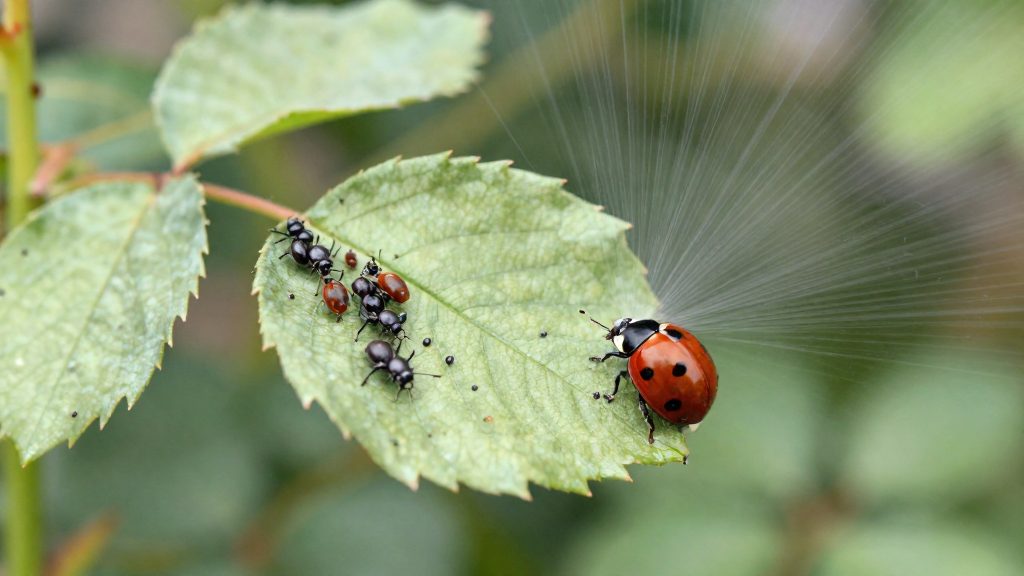
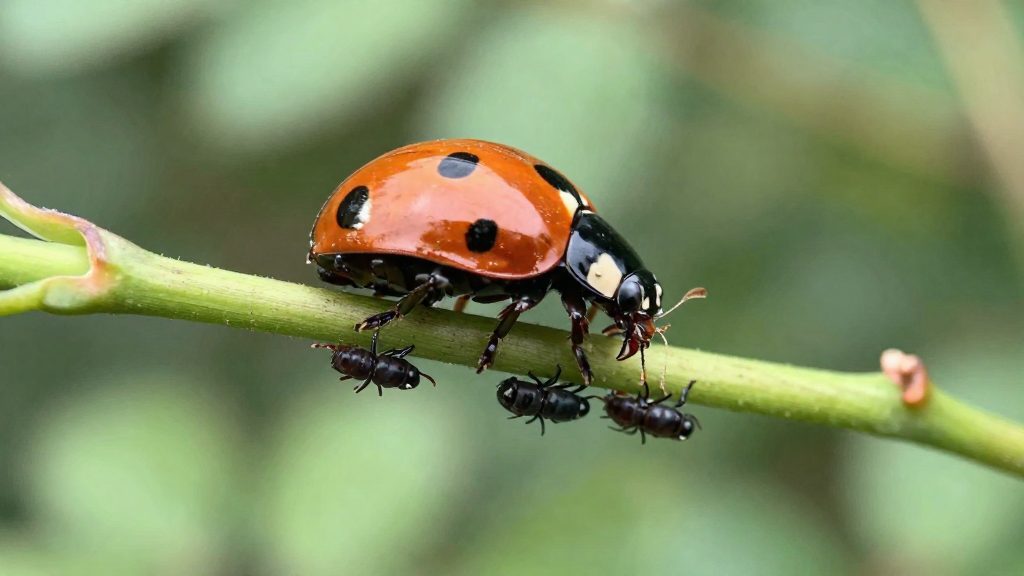
Several insects feed on aphids in the wild, and recognizing them lets you protect them before you intervene. The main natural enemies are lady beetles, lacewing larvae, syrphid fly larvae, soldier beetles, and parasitic wasps. According to UC IPM, University of California Agriculture and Natural Resources, these predators and parasitoids are natural enemies of aphids, so protecting them supports control.
Predators
- Lady beetles (ladybugs) are the best-known aphid predators. Adults and their larvae both feed on aphids.
- Lacewing larvae feed on aphids and are often found moving across infested foliage.
- Syrphid fly larvae (hoverfly larvae) are active aphid feeders, and their presence signals that predation is already happening.
- Soldier beetles are also listed among the natural enemies of aphids.
Parasitic wasps
Parasitic wasps lay their eggs inside aphids. When this happens, the aphid turns into a golden-brown “mummy.” A mummy is a sign that a parasitoid is developing inside, so leave these aphids in place. The wasp will emerge and continue to control the colony.
Releasing lady beetles
Releasing lady beetles provides only temporary control, and it requires high numbers to have any effect. UC IPM describes one heavily infested rose that needed two releases of about 1,500 beetles each, one week apart. Practical steps:
| Factor | Guidance |
|---|---|
| Release timing | At dusk, when beetles are less likely to fly away |
| Application | Mist the beetles and the plants |
| Numbers | Roughly 1,500 per release for one heavily infested rose, per UC IPM |
| Repeat release | A second release about one week after the first |
Releases make the most sense for a heavy infestation where natural enemies are scarce. Before buying beetles, check whether lady beetles, lacewing larvae, or mummies are already present. If they are, protecting them is usually more effective than adding more.
Why do ants and nitrogen fertilizer make aphids worse?
Ants and excess nitrogen increase aphid numbers through different routes. Controlling ant access to colonies addresses the ant route, and managing nitrogen supply addresses the reproduction route.
How ants farm aphids
Ants tend aphid colonies and shield them from predators and parasites. According to UC IPM, University of California Agriculture and Natural Resources, aphids receive this protection in exchange for honeydew, the sugary liquid they excrete. Colonies tended by ants are therefore more likely to persist, even when natural enemies such as lady beetles, lacewing larvae, syrphid fly larvae, soldier beetles and parasitic wasps are present on the plant.
Ant activity is usually visible on the trunk and branches, where ants move between the ground, the canopy and the colony. Breaking those routes weakens the arrangement and gives natural enemies better access to aphids.
Excess nitrogen and aphid reproduction
Aphids reproduce faster on plants with high nitrogen levels. A plant that receives more nitrogen than it needs produces more of the soft, rapidly growing tissue that aphids feed on, which supports larger populations. The guidance from UC IPM is to use only as much nitrogen as the plant requires. The official sources consulted do not give a specific dosage threshold, so growers should judge need from plant vigour and growth rather than from a fixed amount.
Ant control options
The following methods target ant movement around colonies and trunks, as described by UC IPM.
| Method | Where to use it | Key details |
|---|---|---|
| Sticky trunk band | Trunks of trees | On young or thin-bark trees, place a wrap underneath the band to protect the bark |
| Ant bait or stakes | Around colonies and ant trails | Placed where ants are active near the plant |
| Pruning | Branches touching buildings or the ground | Removes the routes ants use to reach the canopy |
Ant control works best combined with monitoring. Check trunks and branch junctions regularly for ant traffic and for signs of honeydew, and treat new routes as soon as they appear.
How can you prevent aphids from coming back?
Aphids can rebuild from individuals that survived a treatment. Prevention relies on regular inspection of new shoots, moderate fertilizing, and plant and habitat choices that reduce pressure. None of these steps eliminates aphids alone, but together they make it harder for a colony to rebuild.
Inspect new shoots on a regular schedule
Check new shoots once a week, paying attention to the tips and the undersides of young leaves. Finding a colony while it is small makes control much easier.
Spray early in the day so foliage dries quickly, which lowers the risk of fungal disease.
Balance fertilizing
Prefer slow-release organic fertilizers applied in small amounts. Heavy feeding should be avoided, since it can support repeated infestations.
The official sources consulted do not specify an exact application date. Base timing on the plant’s growth stage and your local climate rather than a fixed calendar date.
Choose resistant plants and companions
The official sources consulted do not name specific aphid-resistant cultivars, so check with a local nursery or extension service before buying. Companion planting can also support prevention. According to Farmers’ Almanac (2026), the following plants are used as companions for aphid management:
| Plant | Role in aphid prevention |
|---|---|
| Dill | Attracts predators |
| Fennel | Attracts predators |
| Yarrow | Attracts predators |
| Marigolds | Suggested as repellents |
| Alliums | Suggested as repellents |
| Nasturtiums | Act as trap plants |
Keep these companion plants near vulnerable crops rather than relying on them as the only control measure.
Reduce other reinfestation sources
Farmers’ Almanac (2026) also lists these preventive measures:
- Clear plant debris in fall.
- Control weeds, which can harbor aphids.
- Use lightweight row covers over young plants.
- Use reflective mulch.
When should you use stronger treatments?
Stronger treatments are a last step, used only when natural controls no longer keep aphids in check. The official sources consulted do not give a numeric population threshold for this decision, so the judgment rests on observed signs: a colony that keeps rebuilding after repeated treatments, ants tending the aphids, or few natural enemies on the plant.
| Observation | What it indicates, according to UC IPM |
|---|---|
| Few lady beetles, lacewing larvae or syrphid fly larvae | Natural enemies are not reducing the population enough |
| Golden-brown “mummies” on the colony | Parasitic wasps are active and should be protected |
Broad-spectrum insecticides cause the most damage to natural control. According to UC IPM, organophosphates, carbamates and pyrethroids kill the lady beetles, lacewing larvae, syrphid fly larvae, soldier beetles and parasitic wasps that feed on aphids. Using them can therefore leave the aphid population free to rebound.
The official sources consulted do not describe systemic insecticides, how they move through a plant, or their application rates. Any chemical product should be used only after reading its label and following its directions exactly. Farmers’ Almanac (2026) notes that pyrethrin is toxic to cats and fish, so keep pets away from treated plants and protect fish ponds from runoff.
Frequently asked questions
Can a strong jet of water get rid of aphids?
Yes. According to UC IPM (University of California Agriculture and Natural Resources), a strong water stream knocks aphids off the plant, and most of them cannot climb back. The spray also washes away honeydew. Spray early in the day so the foliage dries quickly, which lowers the risk of fungal disease.
Are soap and oil sprays safe to use on my plants?
They can be, but coverage matters. Insecticidal soaps and oils work mainly by smothering aphids, so you need to reach the leaf undersides, and UC IPM notes that oils are typically used as a 1 to 2% solution in water. Avoid spraying water-stressed plants or when temperatures exceed 90°F, and test a few leaves several days before treating the whole plant because some species are sensitive.
Why do aphids keep coming back after I treat them?
Most natural sprays only kill the aphids present at the time of application, so repeat applications are often needed. Broad-spectrum insecticides, such as organophosphates, carbamates and pyrethroids, can also kill natural predators like lady beetles and lacewing larvae, which reduces the biological control that would otherwise keep aphid numbers down. Encouraging natural enemies in the garden is therefore a lasting complement to direct treatments.