Spring feeding can support a tree once it starts to bud, according to Ask Extension (2024), which names late fall, after the leaves drop, as the other suitable window. The same source also notes that older trees often do not need fertilizer, because their roots draw nutrients from soil and rainfall. Spring feeding is therefore worth considering when a tree is breaking dormancy and a nutrient need has been confirmed, rather than applied to every lawn tree by default.
Should you fertilize lawn trees in early spring?
Spring feeding and post-dormancy growth
Early spring is the point when a tree starts to leave winter dormancy and push out buds. Ask Extension (2024) identifies this stage as a suitable time to fertilize. Feeding at this point is intended to support the growth that follows dormancy.
| Application window | Trigger | Source note |
|---|---|---|
| Early spring | When the tree starts to bud | Named as a fertilizing window |
| Late fall | After the leaves drop | Second window named in the same source |
The source recommends fertilizing once or twice a year and following the label instructions. Applying more often than the label allows is not endorsed.
Visible decline as a possible nutrient signal
A tree that looks weak or thin may be showing a nutrient problem, but the official sources consulted do not specify which visible symptoms reliably indicate a nutrient shortage. Decline alone should not be treated as proof of a deficiency.
Ask Extension (2024) recommends a soil test to show whether nutrients are actually lacking. Testing before spring feeding confirms whether a deficiency exists, which avoids fertilizing a tree that already has adequate nutrients. Older trees in particular often draw enough from soil and rainfall.
Turf competition around lawn trees
The official sources consulted do not address how grass or turf competes with trees for nutrients. The practical guidance they do give concerns the product itself: use a fertilizer made for trees, not a lawn or turf product. Ask Extension (2024) gives a higher-nitrogen blend such as 20-20-20 as an example and says slow-release formulas are ideal for long-term health.
When is early spring the right time?
Early spring is the window when the tree starts to bud. The second recommended window is late fall, after the leaves drop. According to Ask Extension (2024), lawn trees should be fed at one of these two growth stages rather than on a fixed calendar date. The tree’s own development is the timing signal, so the same calendar week can be right for one tree and too early or too late for another.
| Window | Timing signal | Source |
|---|---|---|
| Early spring | The tree starts to bud | Ask Extension (2024) |
| Late fall | After the leaves drop | Ask Extension (2024) |
Bud break is the primary spring signal. Check the tree’s buds before applying fertilizer, not the date on the calendar. Once the tree starts to bud, it has reached the stage the guidance identifies for spring feeding.
Late fall feeding follows leaf drop. When the leaves have fallen, the tree has reached the second recommended point in its year. Applying fertilizer before the leaves drop is outside the timing the guidance describes.
Regional climate changes when bud break happens, and therefore when spring feeding should begin. The official sources consulted do not specify how bud break dates shift by region or climate, so no regional date can be given here. Gardeners in cooler areas will generally see buds later than those in milder areas, so the bud stage on the tree itself is the reliable guide in any location.
What fertilizer is best for trees?
Ask Extension (2024) recommends a tree-specific fertilizer rather than a lawn or turf product. Lawn formulas are made for grass, so the product label is the first thing to check: it should identify the product as made for trees. Using a tree-specific formula matches the product to the plant rather than to the lawn around it.
Higher-nitrogen blends
The same source gives a higher-nitrogen blend such as 20-20-20 as an example. On a fertilizer bag, the three numbers show the percentage of nitrogen (N), phosphorus (P), and potassium (K), always listed in that order. Comparing these numbers lets you see how the nutrient ratio differs between products. A 20-20-20 blend has equal shares of all three nutrients, so it is a balanced ratio even though the source cites it as its higher-nitrogen example. Check the N-P-K numbers on the label rather than relying on the name of the blend, and treat it as one option among several ratios. The official sources consulted do not specify a single ratio that suits every tree species.
Slow-release formulas
Ask Extension (2024) states that slow-release formulas are ideal for long-term tree health. Slow-release products make nutrients available gradually over an extended period, instead of releasing them all at once. This steady supply is the reason they are associated with longer-lasting results, compared with fast-acting products that release nutrients quickly and then fade.
Summary of product types
| Product type | Source guidance (Ask Extension, 2024) |
|---|---|
| Lawn or turf fertilizer | Not recommended for trees |
| Tree-specific fertilizer | Recommended |
| Higher-nitrogen blend, e.g. 20-20-20 | Cited as an example |
| Slow-release formula | Described as ideal for long-term health |
How much fertilizer do trees need?
For most trees, the general rule is to fertilize once or twice a year and follow the label instructions on the product. Feeding more often than the label allows is not endorsed, and the label is the reference for how much to apply. Older trees often need no fertilizer at all, because their roots draw nutrients from the soil and from rainfall. Before adding any product, a soil test is the way to confirm whether nutrients are actually lacking.
| Question | Guidance |
|---|---|
| How often? | Once or twice a year, as a general rule |
| How much? | Follow the dosing instructions printed on the product label |
| Does every tree need feeding? | Older trees often do not, because roots absorb nutrients from soil and rainfall |
| Is a deficiency confirmed? | Only a soil test shows whether nutrients are actually lacking |
The sequence to follow is simple:
- Test first. A soil test shows which nutrients are low, so you apply only what is missing.
- Check the label. The product label sets the rate for the tree you are feeding. Do not exceed it on the assumption that more will help.
- Limit applications. Stay within one or two feedings per year unless the test results or the label call for something different.
- Observe the tree. Growth and leaf condition show how the tree is responding, but they do not replace a test when a shortage is suspected.
Applying more fertilizer than a tree needs is a common mistake. Extra nutrients the soil does not lack add no benefit and can stress the roots, so a test and the label should guide every decision.
Source: Ask Extension (eXtension, land-grant universities network), 2024.
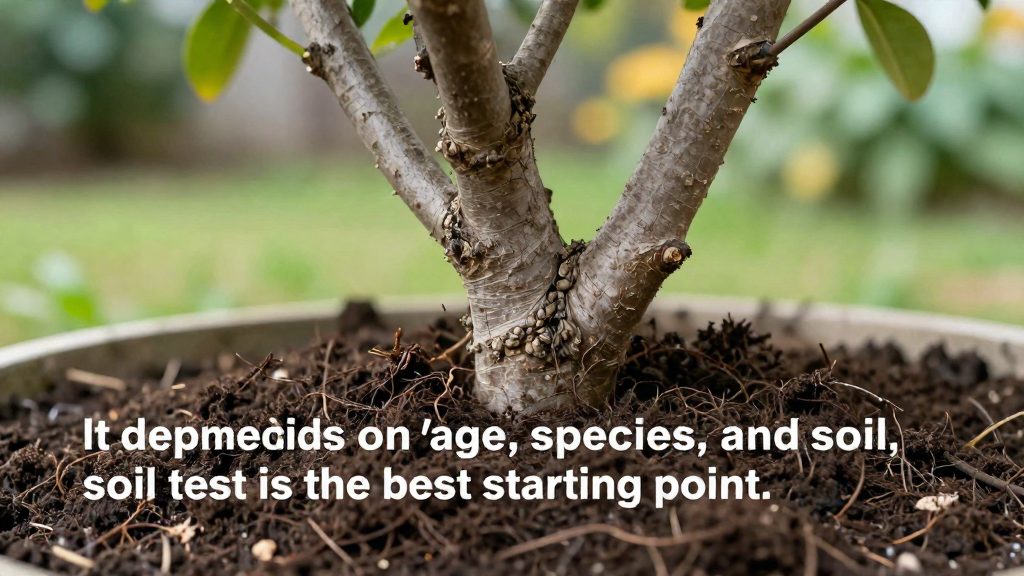
How to apply fertilizer around a tree
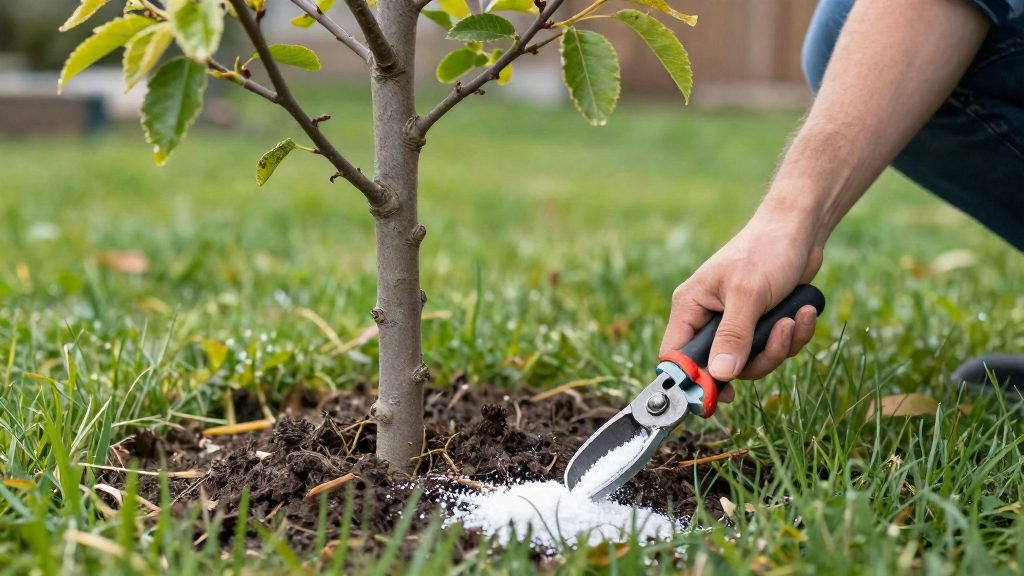
Surface application means spreading tree fertilizer over the soil in the root zone, then watering it in. According to Ask Extension (2024), a fertilizer made for trees is the right product, not a lawn or turf formula. The same source gives a higher-nitrogen blend such as 20-20-20 as an example and notes that slow-release formulas suit long-term tree health.
The root zone of a tree extends well beyond the trunk. Roots that absorb nutrients spread outward under the canopy, so the product should cover the area beneath the branch spread, not a small ring at the base.
| Step | Action | Purpose |
|---|---|---|
| 1 | Measure the canopy width | Defines the area that needs coverage |
| 2 | Spread the product evenly over the soil under the canopy | Puts nutrients where absorbing roots are |
| 3 | Keep granules off the bark and trunk base | Avoids direct contact with the stem |
| 4 | Water thoroughly after application | Moves nutrients from the surface into the soil |
Spreading across the root zone works best with a broadcast spreader or by hand. Apply evenly so no area receives a heavy concentration of granules. Sweep any granules that land on the trunk or on bark back onto the soil.
Watering in is the step that moves the product downward. Water deeply so the soil under the canopy is saturated to the root depth, but avoid creating standing water or runoff. Rain can also carry surface product into the root zone, though the source does not specify how much rainfall is needed.
The official sources consulted do not specify exact application rates per tree size. Ask Extension (2024) advises following the product label, and recommends a soil test to show whether nutrients are actually lacking. Older trees often draw enough nutrients from soil and rainfall, so a test helps decide whether to fertilize at all.
Do new or mature trees need feeding?
Newly planted trees and mature trees have different nutrient needs. According to Ask Extension (2024), older trees often don’t need fertilizer, because their roots draw nutrients from the soil and from rainfall. The first question is therefore the tree’s age and stage of establishment, not a fixed calendar date.
Newly planted trees
A young tree is still building its root system in the ground during its establishment period. The official sources consulted do not specify how long this period lasts, and they do not give a feeding schedule specific to new plantings. Until more detail is available, follow these general steps:
- Keep the root zone moist without waterlogging it, and check the planting needs of the species.
- Use a fertilizer made for trees, not a lawn or turf product. Ask Extension (2024) gives a higher-nitrogen blend such as 20-20-20 as an example and notes that slow-release formulas are ideal for long-term health.
- Apply only if a soil test shows that nutrients are lacking, and then follow the timing in the source: early spring, when the tree starts to bud, or late fall, after the leaves drop.
- Follow the label instructions for rate and frequency.
Mature trees
Established trees generally take up what they need from the surrounding soil and rain. As a rule of thumb, Ask Extension (2024) suggests fertilizing once or twice a year, following label instructions, but only when nutrients are needed. A soil test shows whether nutrients are actually lacking, so it is the reference point before applying any product to a mature tree.
Age-based decision before any application
| Tree stage | Feeding need according to the sources | Practical step |
|---|---|---|
| Newly planted | No schedule specified for establishment | Follow label instructions; apply in early spring or late fall |
| Mature, soil test shows no shortage | Often not needed | Skip fertilizer for that season |
| Mature, soil test shows a shortage | Fertilize once or twice a year | Use a tree-specific, slow-release formula per the label |
Common mistakes to avoid
Most fertilizing errors on trees come from applying product at the wrong time or to a tree that does not need it. According to Ask Extension (2024-09-19), the recommended windows are early spring, when the tree starts to bud, or late fall, after the leaves drop. Feeding outside these windows, or feeding without a reason, wastes product and adds no benefit to the tree.
Feeding drought-stressed or heat-stressed trees
Ask Extension (2024-09-19) does not address how drought or heat changes feeding recommendations, so no threshold is given here. The practical step is to first look at the tree’s water supply and general condition, then confirm whether nutrients are lacking before adding any product. Older trees often don’t need fertilizer, because their roots draw nutrients from the soil and rainfall.
Applying fertilizer to dormant trees in midwinter
Midwinter falls outside both windows listed by Ask Extension (2024-09-19): the start of budding in spring and the period after leaf drop in late fall. Product applied in deep winter does not match either recommended timing. If the planned feeding date has passed, wait for the next window rather than applying out of season.
Feeding trees in waterlogged or compacted soil
The official sources consulted do not specify how waterlogged or compacted soil affects fertilizer use on trees. The one reliable check available is a soil test, which shows whether nutrients are actually lacking. Test the soil before feeding a tree in difficult ground, instead of applying product on assumption.
Other frequent errors
| Error | Recommended approach (Ask Extension, 2024-09-19) |
|---|---|
| Using a lawn or turf product on trees | Use a fertilizer made for trees |
| Choosing a formula without considering release speed | Slow-release formulas are described as ideal for long-term health |
| Feeding older trees by default | Older trees often don’t need fertilizer |
| Applying more often than necessary | Fertilize once or twice a year and follow the label instructions |
Frequently asked questions
When is the best time to fertilize a lawn tree in early spring?
Ask Extension (2024) identifies the moment the tree starts to bud as a suitable point for feeding, with late fall after the leaves drop as the other window. Feeding at budding is meant to support the growth that follows dormancy.
Does every lawn tree need fertilizer in spring?
No. Ask Extension (2024) notes that older trees often get enough nutrients from soil and rainfall, and a soil test can show whether nutrients are actually lacking before you apply anything.
Can I use lawn fertilizer on my trees?
No. Ask Extension (2024) recommends a product made for trees rather than a lawn or turf formula, and describes a slow-release fertilizer as ideal for long-term health. Fertilize once or twice a year and follow the label instructions.