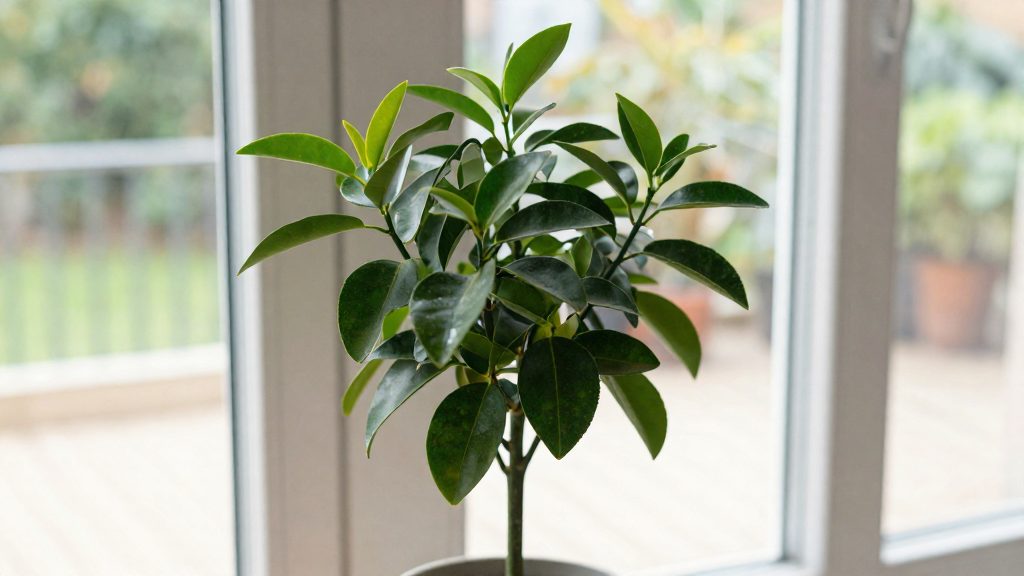
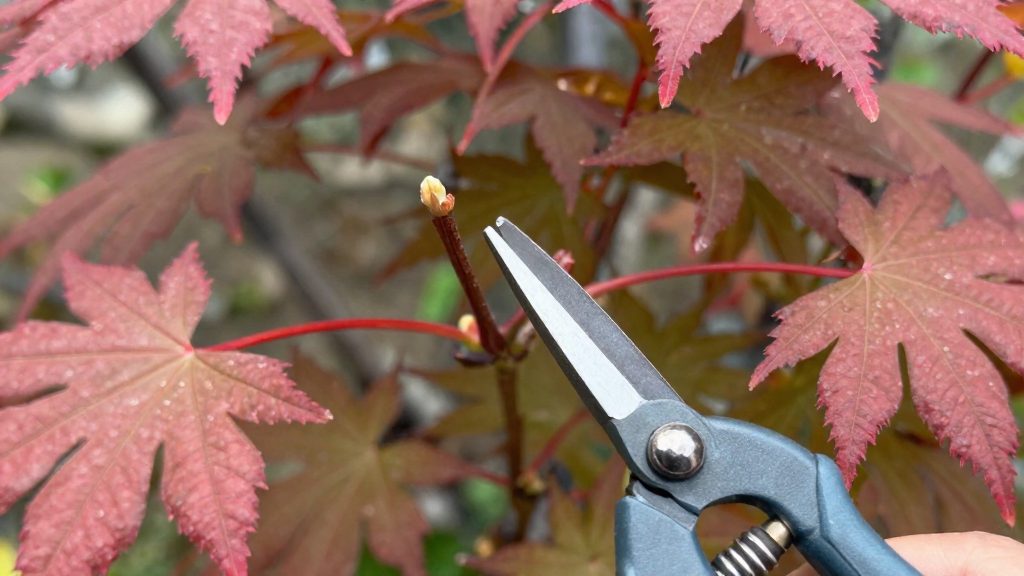
Japanese maples are best pruned in winter, while the tree is dormant. Structural work belongs in late winter, when the branching is easy to read. Fine thinning is done in summer, and spring and fall are the seasons to avoid. According to the University of Illinois Extension, fall pruning can trigger new growth that may not harden before freezing temperatures arrive, and that growth then dies. The official sources consulted do not specify calendar dates, so the exact timing should be adjusted to the local climate.
When is the best time to prune a Japanese maple?
Late winter: structural pruning
Late winter, while the tree is still dormant, is the window for structural pruning. This means removing larger limbs and correcting the framework of the crown. Plant Addicts notes that at this stage the branching is easy to see, which makes it simpler to decide which limbs to keep and which to remove.
Summer: fine thinning
Summer is reserved for fine thinning, which involves removing small shoots from the interior of the canopy. Thinning in summer lightens the crown and improves airflow through the foliage, which is the main purpose of this work.
Seasons to avoid
| Season | Work to avoid | Status |
|---|---|---|
| Spring | Routine structural pruning and thinning | Avoid (dead, damaged or diseased wood can still be removed) |
| Fall | Routine structural pruning and thinning | Avoid (dead, damaged or diseased wood can still be removed) |
Tools you need before you start
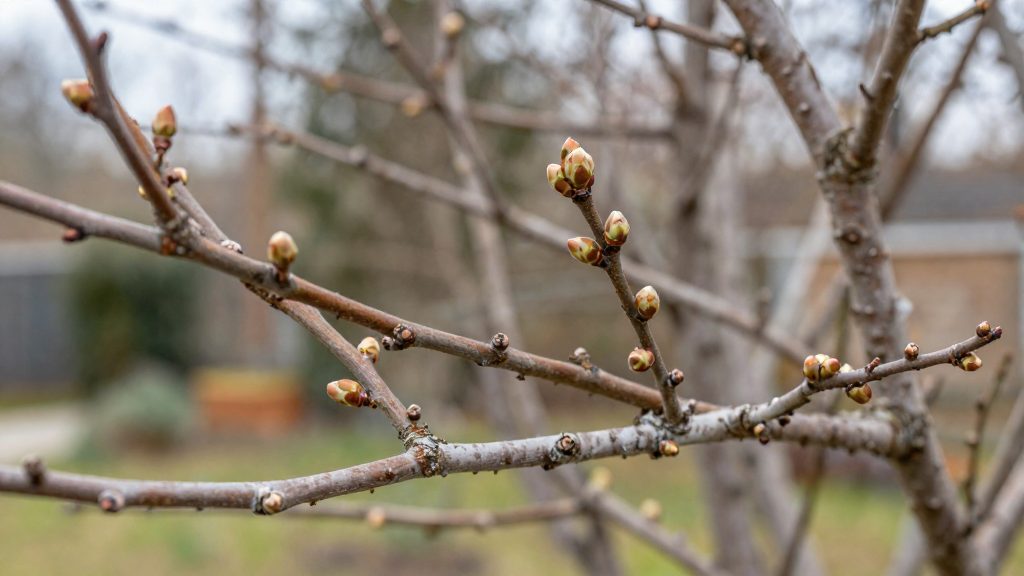
Matching the cutting tool to the diameter of the wood is the first step in pruning a Japanese maple. According to Plant Addicts, small cuts at the branch collar should be made with clean, sterilized pruners. The same source applies this to crossing branches, low-lying growth, and suckers from the grafted rootstock, so most routine work on a Japanese maple uses hand tools rather than saws.
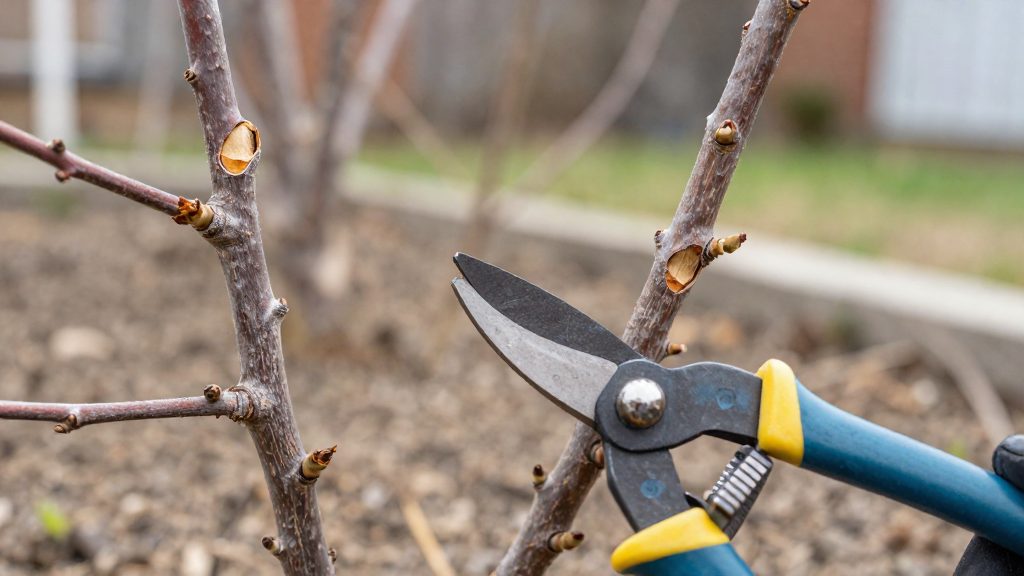
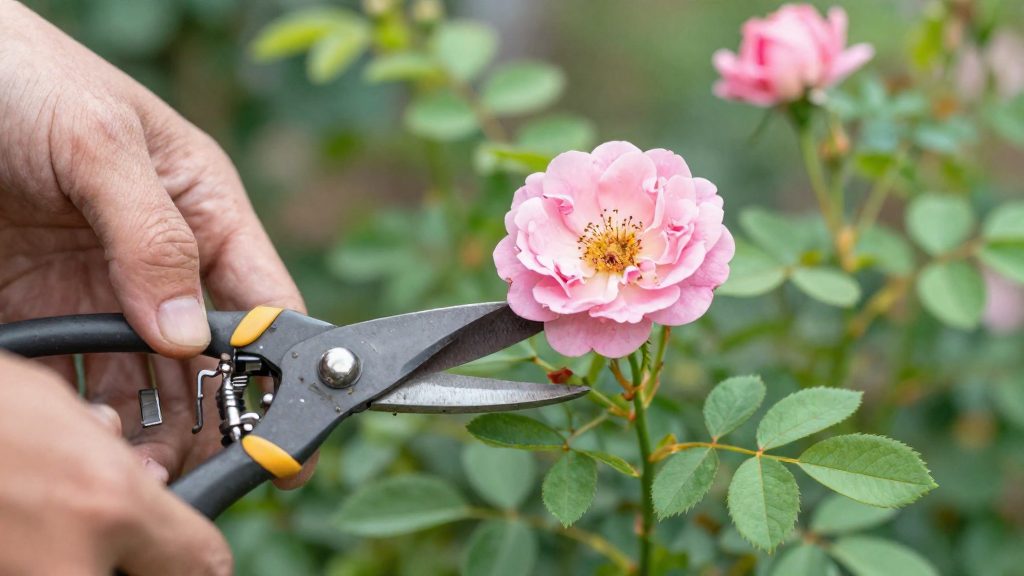
Bypass pruners are the main tool for stems at the branch collar. Their two blades pass each other like scissors, which suits the small, living stems that make up most of the cuts. Make the cut at the branch collar without cutting into the collar itself.
Sterilize the blades between each cut. Wipe the blades with a disinfectant before the next cut, so that a diseased or damaged branch does not carry problems into healthy wood. Treat this as a standing step during the job, not something done once at the start.
Loppers or a hand saw are for thicker limbs that pruners cannot cut cleanly. Loppers give extra leverage on medium wood, while a hand saw handles the heaviest limbs. Sterilize the blade of either tool before each cut, as you would with pruners.
| Tool | Best for | Hygiene between cuts |
|---|---|---|
| Bypass pruners | Small stems and suckers at the branch collar | Sterilize the blades before each cut |
| Loppers | Medium limbs too thick for pruners | Sterilize the blades before each cut |
| Hand saw | The thickest limbs | Sterilize the blade before each cut |
How do you prune a Japanese maple step by step?
Pruning a Japanese maple works best as a fixed sequence: assess the whole tree first, cut in a controlled order, then check the result. The steps below describe the working order, and the timing table that follows covers when each type of work fits.
-
Inspect the whole tree before making any cut. Walk around the tree and study its overall shape. Note any dead, damaged or diseased wood, and identify the main framework of branches you intend to keep. Making no cuts until the whole tree has been assessed helps you avoid removing a limb that is needed for balance.
-
Work from the top downward through the canopy. Begin at the highest points and move progressively lower. Each cut changes how light and branches sit beneath it, so working downward lets you see the effect of every decision before you reach the next section.
-
Angle each cut just above an outward-facing bud. Place the pruners just beyond a bud that points away from the centre of the tree, and cut at an angle.
-
Check the result before stopping. Step back and review the canopy from several sides.
| Type of work | Recommended timing | Source |
|---|---|---|
| Structural pruning | Late winter, while dormant | Plant Addicts |
| Fine thinning | Summer | Plant Addicts |
| Dead, damaged or diseased wood | Any time of year | Plant Addicts |
| Pruning in fall | Avoid: may trigger growth that does not harden before freezing | University of Illinois Extension |
| Pruning in spring | Avoid | Plant Addicts |
Which branches should you remove first?
Remove dead, damaged or diseased wood first. Plant Addicts advises removing this wood at any time of year, so it does not need to wait for the dormant-season pruning window. It is the top priority because dead or diseased wood can spread problems into healthy tissue, and it can be removed at any time of year. Check the whole canopy, including the inner branches, for wood that is brittle, dry, discolored or cracked.
Next, remove crossing branches, where one limb rubs against another. Rubbing wounds the bark and creates entry points for disease, and it weakens the branch structure over time. Keep the branch that grows outward and has the better angle, and cut the other one back to its point of origin.
Low-lying growth comes third. Branches that droop toward the ground or sit below the main framework can be removed to keep the canopy clear and the structure open. Plant Addicts lists this alongside crossing branches as a standard removal target.
Suckers from the grafted rootstock are a separate case. Many Japanese maples are grafted onto a different rootstock, and shoots that emerge from below the graft union are not part of the ornamental cultivar you planted. Cut them off at their base, which is the point where they meet the trunk or root, rather than leaving stubs. Plant Addicts advises removing these suckers as part of routine pruning.
The three-cut method for larger limbs
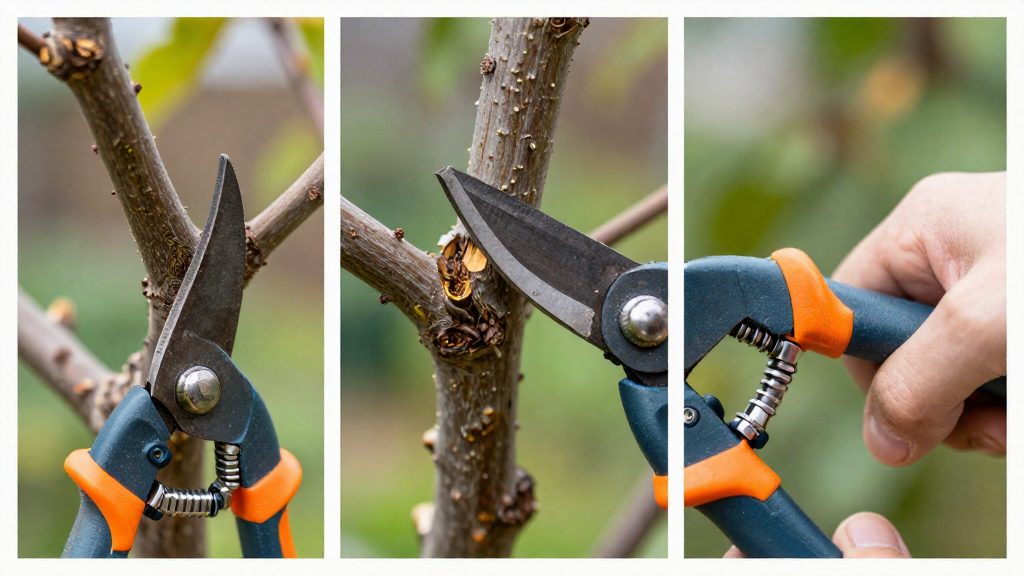
Larger limbs on a Japanese maple are removed in three separate cuts instead of one. According to Plant Addicts, the method is used for larger branches: a partial undercut is made 3–4 inches from the collar, the limb is then cut through farther out to leave a stub, and the stub is removed at the collar.
Why the order matters
A heavy limb cut through in one pass drops its weight suddenly. As it falls, it can pull a strip of bark down the trunk or tear bark away from the wood below the cut. The undercut prevents this by giving the limb a controlled point to separate. The cut farther out then removes most of the weight before the final cut is made, so the last cut carries only a light stub.
Step-by-step sequence
| Step | Where to cut | What it does |
|---|---|---|
| 1. Undercut | 3–4 inches from the collar, cut partway up from below | Creates a point where the limb can separate without tearing bark |
| 2. Top cut | Farther out on the limb, cut through from above | Removes most of the weight and leaves a stub |
| 3. Stub removal | At the collar, removing the stub | Completes the removal without cutting into the collar |
Removing the stub at the collar
Once the limb is off, the remaining stub is light and easy to control. Position the final cut so it is made at the stub, not into the collar. Keeping the cut outside the collar is the step that leaves the collar undamaged, which is why the order of the three cuts matters.
How much can you safely cut off?
Removal limits are the main safeguard when pruning a Japanese maple. According to Plant Addicts, you should remove no more than about 30 percent of the tree per year. The same source sets a second limit on branch size: branches thicker than half the trunk diameter should not be cut. A third guideline covers the reason for pruning. Plant Addicts advises against pruning only to control overall height, because this produces weaker growth. Together, these three guidelines set how much wood to remove and why.
Total removal per year
Limit the total amount of foliage and wood removed to about 30 percent of the tree in a single year. If the tree needs more corrective work than that, spread the cuts over several seasons. Stopping before the limit is reached is acceptable, since the guideline is a ceiling, not a target.
Maximum branch diameter
Compare each branch with the trunk before cutting. Do not cut any branch thicker than half the trunk diameter. Branches above that size fall outside this limit, so leave them on the tree.
Pruning for height
Avoid pruning solely to control height. Plant Addicts links height-driven pruning to weaker growth. Make each cut for a structural reason, such as removing a crossing branch or opening the canopy, rather than to shorten the tree.
| Limit | Guideline | Source |
|---|---|---|
| Total removal | About 30 percent of the tree per year | Plant Addicts |
| Branch size | Never cut branches thicker than half the trunk diameter | Plant Addicts |
| Purpose | Do not prune only to control overall height | Plant Addicts |
Mistakes to avoid
Three common mistakes can harm a Japanese maple after pruning: working with dull blades, cutting while the tree is stressed, and removing too much wood at once so the trunk or branches are left exposed. Each one affects how the wound closes and how the tree grows afterward.
Dull blades crush the bark
A blade that no longer slices cleanly tears and compresses the bark instead of severing it. The wound edge is ragged, which gives it more surface for pathogens and slows the tree’s ability to seal it.
Pruning during drought or heat stress
Pruning removes living tissue and leaves, which adds stress to a tree that is already struggling. The official sources consulted do not specify a temperature or moisture threshold for this. As a practical rule, postpone non-urgent cuts when the tree is visibly wilting or during heat.
Hard pruning that exposes bark
Heavy cuts remove the canopy that normally shades the trunk and inner branches. Newly exposed bark can be scorched by direct sun. Spread structural work over several visits rather than taking out large wood in one session.
Pruning weeping and upright varieties
Weeping and upright Japanese maples grow in different habits, so the same cut can change the tree’s shape in very different ways. The work should follow the form of each cultivar.
Weeping forms: keeping the pendulous silhouette
Weeping cultivars keep their character through the outline of their branches. Thinning should remove crossing branches and any dead, damaged or diseased wood, while leaving the arching, cascading limbs in place. To preserve the pendulous form, avoid shortening the tips of long, drooping branches unless the branch has to be removed. Work from the inside of the canopy outward so the outer weeping layer stays full.
Upright forms: maintaining balanced branch spacing
Upright cultivars are shaped by spacing branches evenly around the trunk. Remove crossing branches so that remaining limbs do not rub against each other, and keep the interior of the canopy open enough for air and light to reach it. Balance is better achieved by selective thinning than by shortening the whole crown.
Grafted weeping cultivars: watching the graft union
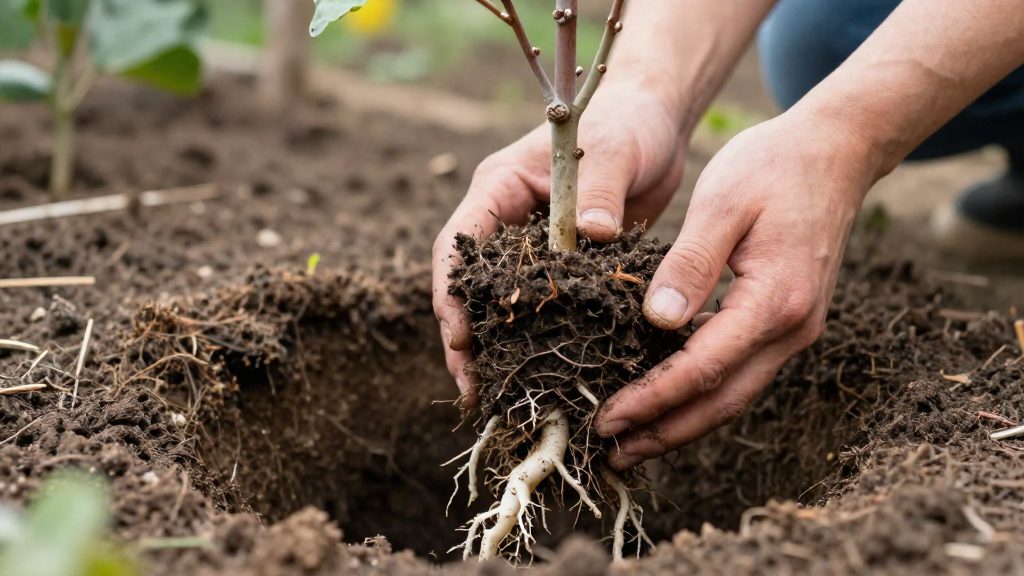
Many weeping cultivars are grafted onto a rootstock, and the graft union is the point where the two join. Before pruning, locate the union and keep it clearly visible above the soil line. Make sure cuts to nearby branches do not damage the union.
| Growth habit | Pruning focus | Avoid |
|---|---|---|
| Weeping | Keep arching limbs; remove crossing and dead wood | Shortening drooping tips |
| Upright | Even branch spacing; open interior canopy | Pruning to control height |
| Grafted weeping | Locate the graft union; keep it above soil | Cuts that damage the union |
Frequently asked questions
Can I remove dead or diseased branches outside the usual pruning seasons?
Yes. According to Plant Addicts, dead, damaged or diseased wood can be removed at any time of year, so the spring and fall restrictions apply only to routine structural work and thinning.
How much of a Japanese maple can I safely remove in one year?
Plant Addicts advises limiting removal to about 30% of the tree per year. The same source also warns against cutting any branch thicker than half the trunk diameter, because heavy cuts of that size tend to weaken regrowth.
What should I do if my Japanese maple’s branches are cutting across each other?
Remove one of the crossing branches, choosing the weaker or poorly placed one. Plant Addicts also recommends removing suckers from the grafted rootstock, the thinner shoots that grow below the graft union, using clean, sterilized pruners.