Lilacs are pruned right after the flowers fade because the buds for next year’s flowers form over the summer. Pruning at that point gives new shoots time to grow and set buds this year for flowers next year, according to Global News (Canada) (2012). Cutting later in the year removes the buds that form over the summer, according to Bob Vila.
Why prune lilacs right after flowering?
How the bud cycle sets up next year’s bloom
Lilac flower buds form during the summer, after the current season’s flowers have ended. The shoots that carry these buds are the ones growing at that time, so bud set and shoot growth happen in the same season. Pruning right after bloom works with this schedule. The cut comes before the summer bud formation is complete, so the plant keeps the growth it needs to flower the following year.
Why new shoots need time before winter
New shoots need time to grow and set buds before winter. A shoot that is cut late in the year has less of the growing season left to develop the buds it will carry into the cold months. Because the buds for next year form on this year’s growth, a late cut reduces the number of flowering sites available for next year. Pruning right after flowering leaves the full growing period available to the new shoots.
Where the plant’s energy goes
Removing spent flowers helps the plant put its energy into next year’s blooms, according to Global News (Canada) (2012). Once the flowers have faded, the plant’s resources can move toward bud development rather than staying tied to the old flower clusters.
| Stage | What happens to the plant | Pruning consequence |
|---|---|---|
| Flowers fade | Spent flower clusters remain on the plant | Removing them directs energy into next year’s blooms (Global News (Canada), 2012) |
| Summer | Flower buds for next year form (Bob Vila) | Cuts made later in the year remove these buds (Bob Vila) |
| Before winter | New shoots grow and set buds this year (Global News (Canada), 2012) | Pruning right after bloom leaves this growth period intact |
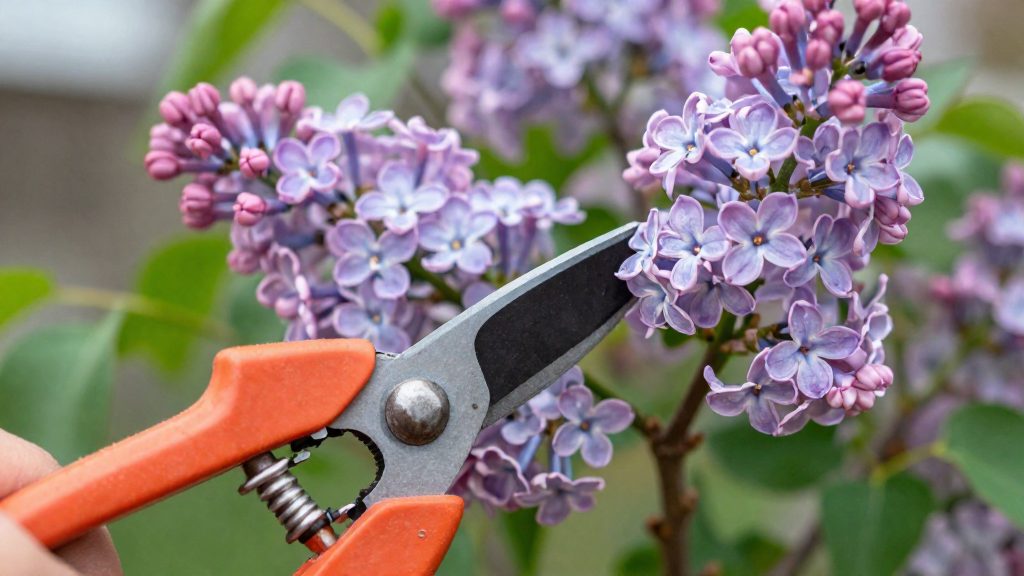
When to prune lilacs: right after the flowers fade
The best time to prune a lilac is right after the flowers fade. Bob Vila advises pruning within about two weeks of blooming, since pruning later in the year removes the buds that form over the summer. The sources consulted do not give regional bloom dates for Canada, so timing is best tied to when your own bush finishes flowering rather than to a fixed calendar date.
Setting the post-bloom window
Bloom dates vary by region and season, so a set calendar date is less reliable than observing the plant. Use the following approach:
- Watch the bush and note when the last flower clusters fade.
- Start the about two weeks window from that point.
- Complete the main pruning within that window so the plant has the rest of the growing season to form next year’s buds.
Why timing matters
| Pruning timing | Effect on next year’s flowers |
|---|---|
| Within about two weeks after blooming | Leaves time for buds to form for next year |
| Later in the year, during summer | Removes buds that form over the summer |
| Late winter | Removes buds already set for spring, which costs blooms |
Late winter pruning is also best avoided. According to Bob Vila, pruning in late winter costs you blooms, because it removes buds already set for spring.
Tools to prepare
Lilac pruning after bloom needs three cutting tools, matched to stem thickness, and a sanitation step between plants. The main risk is tearing or crushing wood, which slows healing and leaves openings for pests and disease. Sharp, clean tools make clean cuts on every stem size.
| Tool | Use on lilac | Notes |
|---|---|---|
| Bypass hand pruners | Thinner, living stems and deadheading spent flower clusters | Two curved blades pass each other, so they cut cleanly without crushing the stem |
| Loppers | Thicker stems that are too large for hand pruners | Long handles add leverage; use them for older canes near the base |
| Pruning saw | The thickest old canes | Use it when loppers cannot cut through the wood cleanly |
Choose the smallest tool that can cut the stem cleanly. Forcing a tool that is too small for the wood can damage the blades and leave ragged cuts. Keep bypass pruners for the small stems and deadheading work, and reserve loppers and the saw for older, heavier wood.
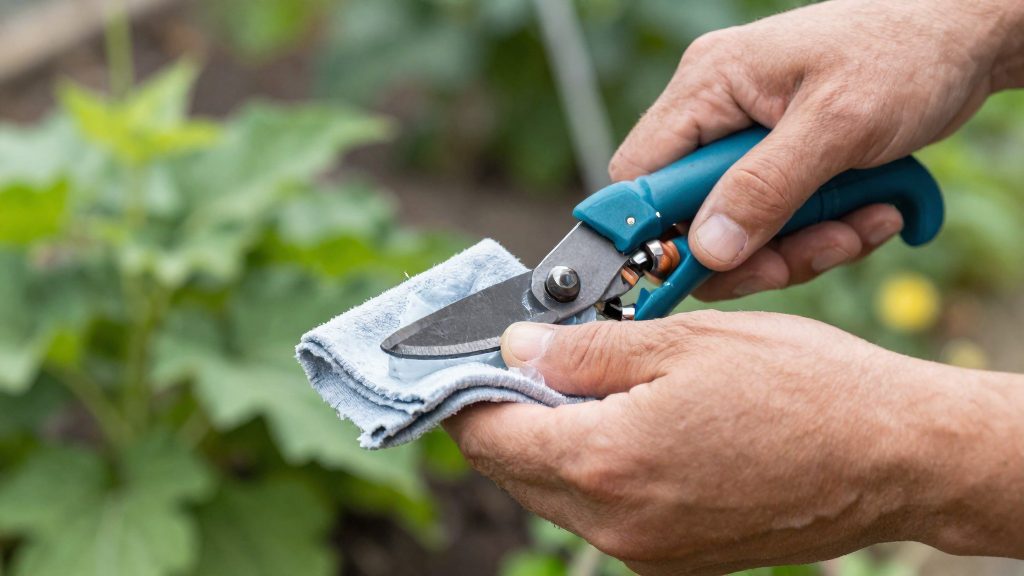
Before starting, check that each blade is sharp and free of nicks. Dull blades crush stems, which is harder on the plant than a clean cut.
Sanitation between plants matters most when you prune several shrubs in one session. Clean the blades before moving to the next lilac, and again after cutting out any dead, broken or borer-infested canes. Clean tools reduce the chance of carrying problems from one shrub to another.
Deadheading and removing dead wood
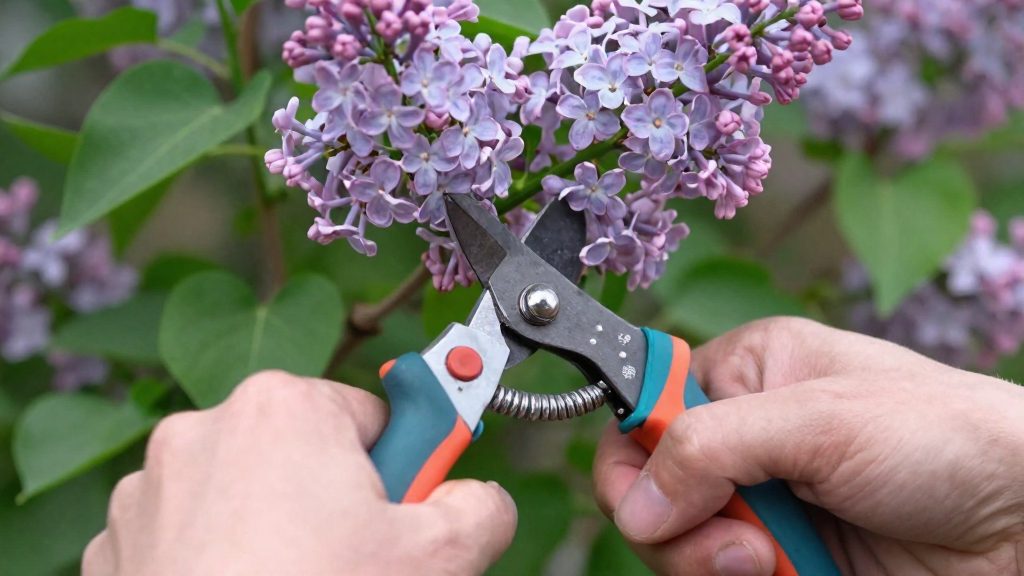
Deadheading and dead-wood removal are the routine cuts for a lilac after flowering. Deadheading takes off the spent flower clusters, and dead-wood removal takes out canes that are dead, broken or damaged. According to Global News (Canada) (2012), removing spent flowers lets the plant put its energy into next year’s blooms, which is the main reason to do these cuts in the same pass.
Deadheading spent flower clusters
Deadheading is done cluster by cluster. Cut each faded cluster above the first pair of leaves below it, so the leaves stay on the shoot. Bob Vila gives this cut as the standard method for routine pruning.
Removing dead, broken and damaged canes
Cut any dead wood at the base of the bush. The sources recommend removing dead, broken or borer-infested canes at the base, not partway up the stem. Check each cane for dieback, cracks or breaks, and for holes or frass that suggest borers. Remove any cane that shows these signs.
Removing the weaker of two rubbing canes
Where two canes rub together, remove the weaker one. The rubbing point is usually easy to spot once you walk around the bush. Keep the stronger cane and remove the weaker one at the base, so that the remaining cane has room to grow without contact.
| Cut type | Where to cut | When to make it |
|---|---|---|
| Spent flower cluster | Above the first pair of leaves below the cluster | After the flowers fade |
| Dead, broken or borer-infested cane | At the base | Whenever the cane shows these signs |
| Weaker of two rubbing canes | Remove the weaker cane at the base | Where two canes rub together |
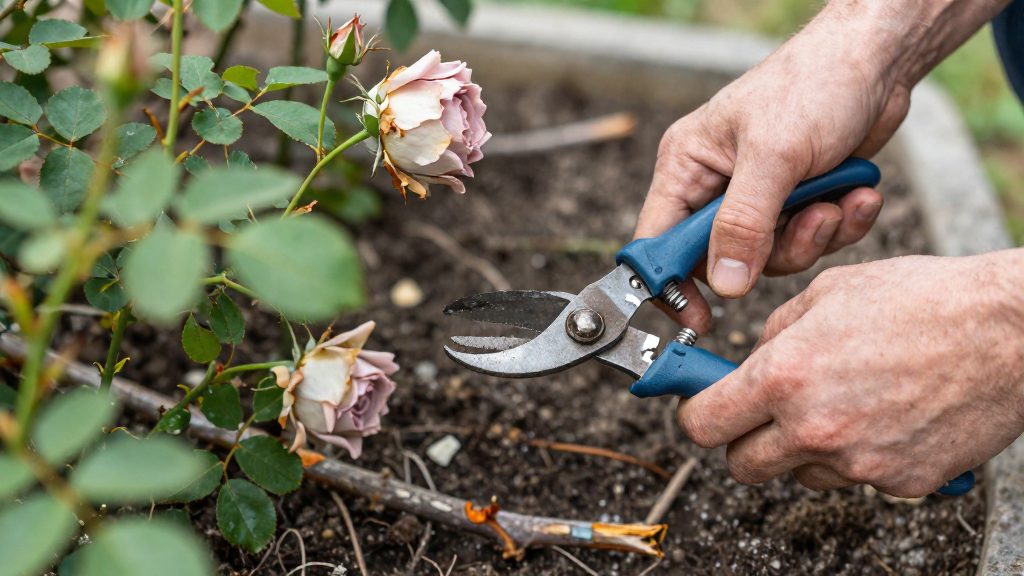
How to thin old stems and suckers
Lilacs sucker heavily, and the new shoots that rise from the base can crowd the centre of the plant into a dense clump. According to Global News (Canada) (2012), cut some of the oldest stems at the base to within about a foot (about 30 cm) of the ground, and thin crowded suckers. The goal is an open, fountain-like shape, which is achieved by thinning crowded suckers and cutting back tall or droopy stems.
Cutting the oldest stems at the base
- Identify the oldest stems at the base of the bush.
- Cut each selected stem at the base, leaving the cut end within about a foot (about 30 cm) of the ground.
Thinning crowded suckers
Suckers are shoots that emerge from the roots or the base of the plant. When several cluster in one spot, they form a tight mass of stems.
- Walk around the base and identify shoots that are crowding each other or the main stems.
- Cut unwanted suckers cleanly with sharp pruners, close to where they emerge.
- Keep the strongest shoots and leave them spaced apart so that air and light can reach the middle of the plant.
- Repeat the check each year, since lilacs keep producing suckers.
Cutting back droopy stems
Stems that arch or hang well below the rest of the bush spoil the rounded outline. Global News (Canada, 2012) recommends lowering them by cutting back to a strong side branch.
- Choose a droopy or overly tall stem and trace it to a healthy side branch that grows outward or upward.
- Make the cut just above that side branch, so the branch takes over as the new growing tip.
- Work one stem at a time, stepping back to check the overall outline between cuts.
Shaping for an open form
| Problem | Action | Result |
|---|---|---|
| Crowded suckers | Cut unwanted shoots at their point of origin | Less dense clumping |
| Tall or droopy stem | Cut back to a strong side branch | Lower, more balanced outline |
| Closed centre | Keep well-spaced shoots, remove crowding ones | Open, fountain-like form |
How to rejuvenate an overgrown lilac?
Rejuvenating an overgrown lilac is a staged process. According to Bob Vila, you remove about one-third of the oldest, largest canes at the base each year, repeating this for three years. The shrub is renewed gradually, so younger canes remain on the plant during the process. A full cutback is a faster alternative, but it causes a longer bloom loss.
Staged renewal (three years)
| Year | Action | Expected result |
|---|---|---|
| Year 1 | Remove about one-third of the oldest, largest canes at the base | Old wood is reduced; younger canes stay on the plant |
| Year 2 | Remove about one-third of the oldest, largest canes at the base | Further renewal of the shrub’s framework |
| Year 3 | Remove about one-third of the oldest, largest canes at the base | Shrub is renewed over the three-year cycle |
Full cutback (single step)
Cutting the whole bush to about 6 inches (about 15 cm) renews the plant in one operation. The trade-off is that it eliminates blooms for at least 1 to 2 years, according to Bob Vila. This option suits gardeners who can accept a season or more without flowers.
Mistakes that cost you next year’s blooms
Some pruning errors remove the flower buds before they open or leave the shrub with damage that lowers its bloom potential for seasons afterward. Most of these come from cutting without checking where the buds form.
Hedge shearing removes flower-bearing growth. Shearing trims every shoot to the same plane, which can cut away growth that would carry next year’s buds, and the rounded or boxy outline it creates works against the open, fountain-like shape recommended by Global News (Canada) (2012). Use hand pruners or loppers on individual stems instead.
Ragged stubs are the second error. Stubs are short lengths of stem left above or below a node, often after a cut made too far from a branch or bud. The correct method is to cut back to a strong side branch, as Global News (Canada) (2012) describes when lowering tall or droopy stems. Make the cut just above that side branch. A clean angled cut leaves no dead wood between the cut and the remaining branch, while a flat or ragged cut leaves a short stub with no growth to carry on from it.
| Error | What it damages | Correct approach |
|---|---|---|
| Hedge shearing | Cuts off the new growth that carries next year’s flower buds | Prune individual stems by hand at their base or at a side branch |
| Ragged stubs | Leaves short, unsupported stems with no side growth to take over | Cut back to a strong side branch with a clean angled cut |
| Leaving dead or broken canes | Keeps weak or damaged wood that competes with healthy growth | Remove dead, broken, or borer-infested canes at the base (Bob Vila) |
Leaving dead, broken, or weak canes in place also reduces the energy available for flowering. Clear wood of this kind before deciding where the healthy stems will be cut.
Frequently asked questions
When is the right time to prune a lilac after it flowers?
Prune within about 2 weeks of blooming, because the flower buds for next year form over the summer and a later cut removes them, according to Bob Vila. Waiting until late winter also costs you blooms.
My lilac is old and overgrown. Can I cut it back hard?
Cutting the whole bush to about 6 inches (about 15 cm) removes blooms for at least one to two years, according to Bob Vila. A gentler rejuvenation pruning is less disruptive: remove about one-third of the oldest, largest canes at the base each year for three years.
How do I handle suckers and spent flower clusters?
Cut some of the oldest stems at the base to within about a foot (about 30 cm) of the ground and thin crowded suckers, according to Global News (Canada) (2012). For routine deadheading, cut just above the first pair of leaves below each faded cluster.