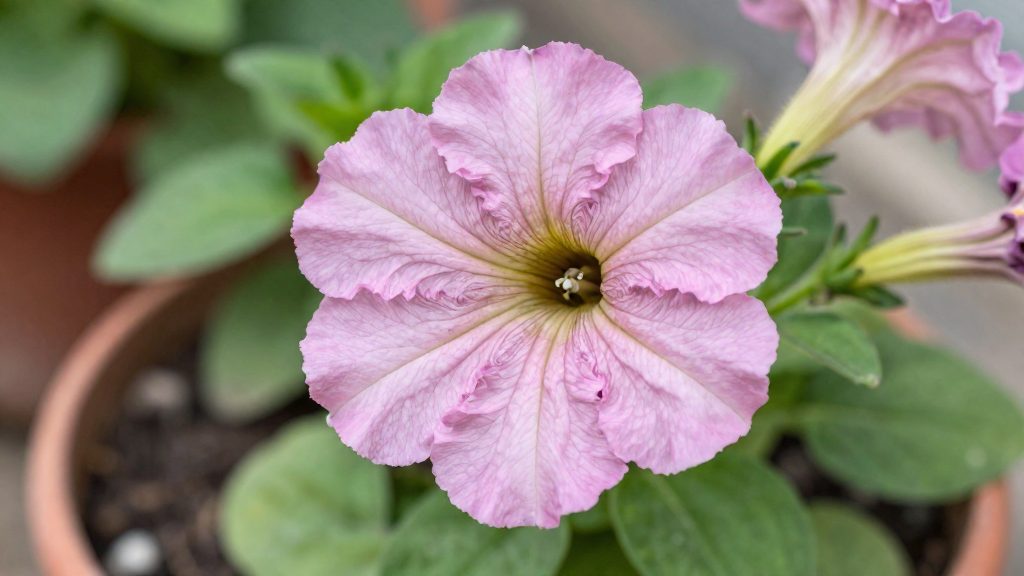
Deadheading petunias means removing spent flowers so the plant directs its energy toward new blooms rather than seed production. According to Epic Gardening (2026), each flower lasts about two weeks, and removing faded blooms weekly or every two weeks keeps plants tidy and flowering. Some petunia types clean themselves, so the task depends on the variety you grow.
Why Deadhead Petunias?
Faded flowers form seeds, and the seed pod develops in the green base of the flower, called the calyx. Removing only the petals leaves that seed-forming part in place. Epic Gardening (2026) recommends removing the whole spent flower, including the calyx, so the plant stops investing in seed.
Deadheading Method
- Pinch or cut: Pinch the faded flower between your thumb and index finger, removing the seed pod at its base. Alternatively, use clean, sharp scissors, a knife, or pruners (Gardeningetc, 2026; Epic Gardening, 2026).
- Cut above the leaves: Follow the stem down to the nearest leaves and cut just above them (Epic Gardening, 2026).
- Avoid pulling: Do not yank the flower straight up, because this can uproot the plant (Epic Gardening, 2026).
Timing and Frequency
Deadheading can be carried out throughout the flowering season. Gardeningetc (2026) describes it as non-essential but worthwhile when time allows.
Which Petunias Need Less Work
| Petunia type | Deadheading need |
|---|---|
| Wave and Supertunia | Self-cleaning; spent flowers drop without intervention |
| Floribunda | Less deadheading required |
| Milliflora | Almost no pinching required |
| Calibrachoa (million bells) | Self-cleaning; no deadheading needed |
Sources: Epic Gardening (2026); Gardeningetc (2026).
Cutting Leggy Stems in Midsummer
By mid-summer, petunias often become sparse, with flowers only at the tips of long, bare stems. Gardeningetc (2026) advises cutting these shoots to about half their length, just above a node, then fertilizing and watering well. Plants may look ruffled at first but recover.
Epic Gardening (2026) distinguishes this cutting from pinching. Cutting bare stems stimulates flowering and keeps trailing varieties compact, while pinching removes the tops of stems to produce a shorter, bushier plant.
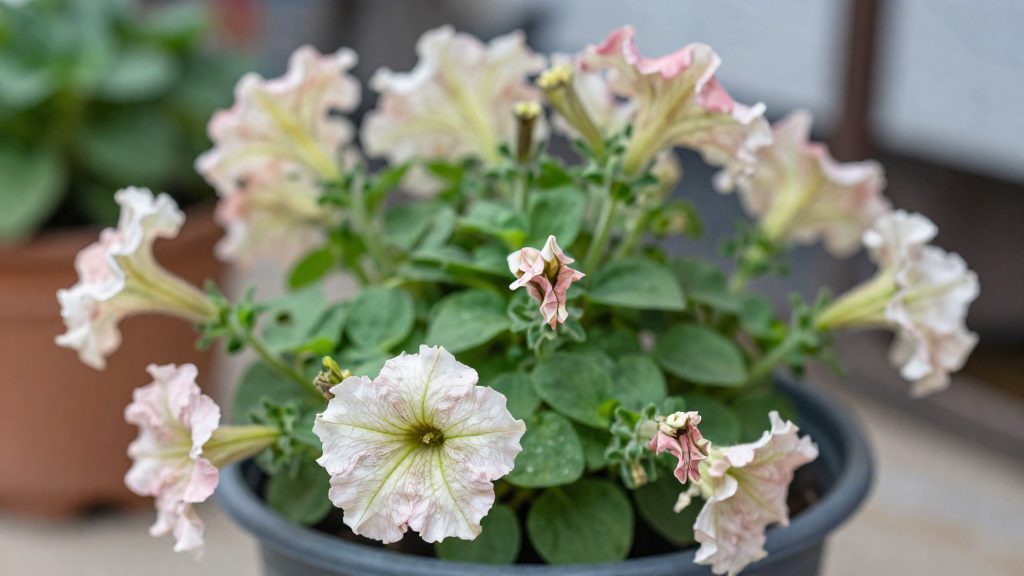
How to deadhead a petunia step by step
Deadheading means removing spent flowers before they set seed, which pushes the plant to keep producing blooms. According to Epic Gardening (2026), you can use scissors, a knife, or your fingers. Remove the whole spent flower, including the green base (the calyx), because seeds form there.
- Find a faded bloom. Look for flowers that have lost their colour or started to wilt.
- Grip the stem. Pinch the spent flower between your thumb and index finger, or use clean, sharp pruners or scissors. Gardeningetc (2026) notes that you can also remove the seed pod at the base.
- Follow the stem down. Trace the stalk to the nearest leaves.
- Cut just above the leaves. Make the cut just above the leaf cluster.
- Repeat through the season. Deadheading can be done throughout the flowering period. Gardeningetc (2026) describes it as not essential but worthwhile if time allows.
Timing
According to Epic Gardening (2026), an individual flower lasts about two weeks. Deadheading once a week or once every two weeks is enough to keep plants looking tidy.
Leggy plants in mid-summer
In that case:
- Cut the shoots to about half their length, just above a node.
- Fertilize and water well afterwards.
- Expect the plants to look ragged at first. Gardeningetc (2026) states that they recover.
Cutting back in this way differs from pinching, which removes the top of the stems to produce a shorter, more compact plant (Epic Gardening, 2026).
Deadheading needs by type
| Type | Deadheading need | Source |
|---|---|---|
| Wave and Supertunia | Self-cleaning; drops spent flowers without intervention | Epic Gardening (2026) |
| Floribunda | Less deadheading than other types | Epic Gardening (2026) |
| Milliflora | Almost no pinching required | Epic Gardening (2026) |
| Calibrachoa (million bells) | Self-cleaning; no deadheading needed | Gardeningetc (2026) |
How often should you deadhead petunias?
For most petunias, deadheading once a week or once every two weeks keeps the plant looking tidy, according to Epic Gardening (2026). Individual flowers last about two weeks, so a regular schedule removes spent blooms before they set seed. Gardeningetc (2026) adds that deadheading can continue through the whole flowering season. It is not essential, but it is worth doing if you have the time.
How much work a plant needs depends on its type:
| Type | Deadheading need |
|---|---|
| Wave and Supertunia | Self-cleaning; spent flowers drop off without intervention |
| Floribunda | Less deadheading required |
| Milliflora | Almost no pinching needed |
| Calibrachoa (million bells) | Self-cleaning; no deadheading needed |
Calibrachoa are close relatives of petunias, according to Gardeningetc (2026).
Mid-summer cutback is a separate task. By mid-summer, petunias often become sparse, with flowers only at the ends of long bare stems. Gardeningetc (2026) recommends cutting the shoots back by about half their length, just above a node, then fertilizing and watering well. The plants may look ragged at first but recover. Cutting back is different from pinching, which removes the tips of stems to produce a shorter, more compact plant (Epic Gardening, 2026).
Which varieties don’t need deadheading?
Not every petunia needs regular deadheading. According to Epic Gardening (2026), the Wave and Supertunia series clean themselves: their spent flowers drop off without any intervention from the gardener. The Floribunda types need less deadheading than standard petunias, and Milliflora types need almost no pinching. Calibrachoas, the close relatives of petunias also sold as million bells, are self-cleaning and do not need deadheading, according to Gardeningetc (2026).
| Group | Deadheading needed | Source |
|---|---|---|
| Wave and Supertunia series | None: spent flowers fall off on their own | Epic Gardening (2026) |
| Floribunda types | Less than standard petunias | Epic Gardening (2026) |
| Milliflora types | Almost no pinching | Epic Gardening (2026) |
| Calibrachoa (million bells) | None: self-cleaning | Gardeningetc (2026) |
Check the plant label before deciding on a schedule. For the varieties that do need it, the method is simple.
Self-cleaning does not mean maintenance-free. Gardeningetc (2026) describes a mid-summer problem where petunias become bare, with flowers only at the tips of long, leafless stems.
Deadheading and Cutting Back Petunias in Summer
Removing spent flowers and cutting back bare stems are two separate tasks, and both help keep flowering going.
Removing spent flowers
Deadheading means removing faded blooms with scissors, a knife, or by pinching them off by hand. Remove the entire spent flower, including the green base (the calyx), because seeds form there. Do not pull the flower straight up, since this can uproot the plant.
Pinch the faded flower between thumb and index finger, removing the seed pod at its base, or use a clean, sharp pruner. According to Epic Gardening (2026), spent flowers last about two weeks, so deadheading once a week or every two weeks keeps plants tidy. Gardeningetc (2026) notes that deadheading can be done throughout the flowering season. It is not essential, but it is worthwhile if time allows.
Cutting back leggy stems
When stems become bare, cut them back. Cutting back is different from pinching.
Deadheading needs by type
| Type | Self-cleaning? | Deadheading need |
|---|---|---|
| Wave | Yes, drops spent flowers on its own | None |
| Supertunia | Yes, drops spent flowers on its own | None |
| Floribunda | Not stated | Less deadheading than other types |
| Milliflora | No | Almost no pinching |
| Calibrachoa (million bells) | Yes, self-cleaning | None |
According to Epic Gardening (2026), the Wave and Supertunia series clean themselves, Floribunda types need less deadheading, and Milliflora types need almost no pinching. Gardeningetc (2026) describes calibrachoas, close relatives of petunias, as self-cleaning as well.
Fertilizing and Watering After Cutting Back
Cutting back is mainly used on petunias that have become sparse by mid-summer, when flowers appear only at the ends of long, bare stems. According to Epic Gardening (2026), this cut can stimulate flowering and keep trailing varieties compact. It is different from pinching, which removes the tops of stems to produce a shorter, bushier plant. After cutting back, the plant needs fertilizer and water to support new growth.
| Step | Action | Detail |
|---|---|---|
| 1 | Identify sparse growth | Long, bare stems with flowers only at the tips |
| 2 | Cut the shoots | Cut to about half their length, just above a node |
| 3 | Fertilize | Apply fertilizer after cutting. The sources consulted do not specify a product, dose or interval |
| 4 | Water thoroughly | Water well after feeding |
| 5 | Allow recovery | Plants may look ragged at first, then recover |
Keep the tools clean so that each stem is cut neatly.
Adapting Your Deadheading Routine to the Variety
The sources consulted do not specify Canadian regional dates, frost windows, or local temperature thresholds for petunias, so the guidance below covers general adjustments rather than local timing. The main variable a gardener controls is the deadheading schedule. Set the routine around the flowering period you actually observe in your garden.
Match the Deadheading Effort to the Variety
Petunia types differ in how much manual work they need, which matters when you want to limit maintenance. According to Epic Gardening (2026) and Gardeningetc (2026):
| Type or group | Deadheading need |
|---|---|
| Wave and Supertunia series | Self-cleaning; spent flowers drop without intervention (Epic Gardening, 2026) |
| Calibrachoa (million bells) | Self-cleaning; no deadheading needed (Gardeningetc, 2026) |
| Floribunda | Less deadheading required (Epic Gardening, 2026) |
| Milliflora | Almost no pinching required (Epic Gardening, 2026) |
| Other petunias | Regular deadheading, weekly or every two weeks (Epic Gardening, 2026) |
How to Remove Spent Flowers
Pinch the faded bloom between your thumb and index finger, or cut it with clean, sharp scissors or a knife. Remove the spent flower calyx, the green base where seeds form, because leaving it behind lets seed pods develop. Follow the stem down to the nearest leaves and cut just above them. Do not pull the flower straight up, since this can uproot the plant (Epic Gardening, 2026). Gardeningetc (2026) notes that deadheading can continue through the whole flowering season and is not strictly required, but it is worthwhile when time allows.
Midsummer Cutback
By mid-summer, petunias often become leggy, with flowers only at the tips of long bare stems. Gardeningetc (2026) recommends a midsummer cutback: cut the shoots to about half their length, just above a node, then fertilize and water well. The plants may look ragged at first but recover. This differs from pinching, which removes the top of the stems to produce a shorter, more compact plant (Epic Gardening, 2026).