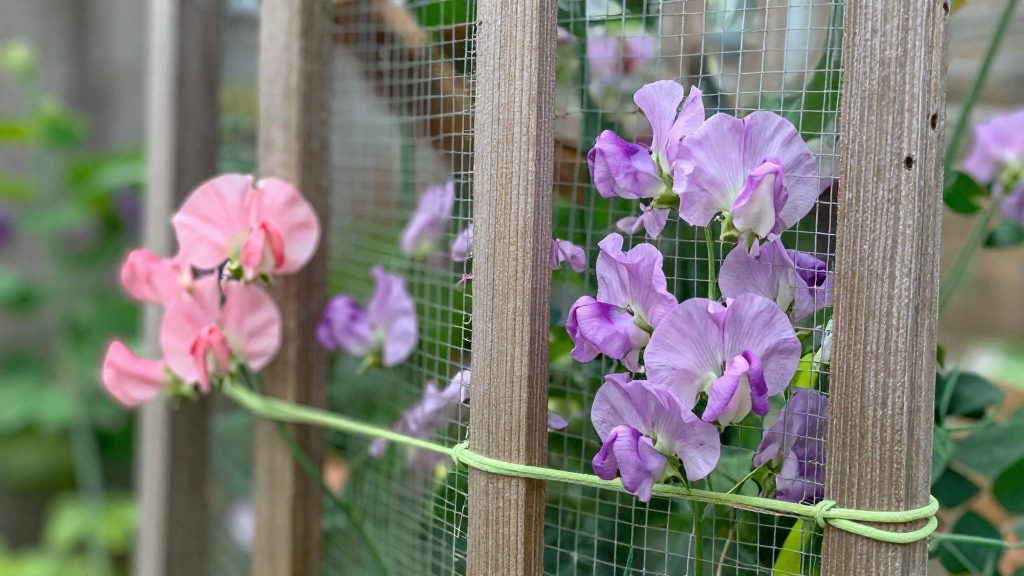
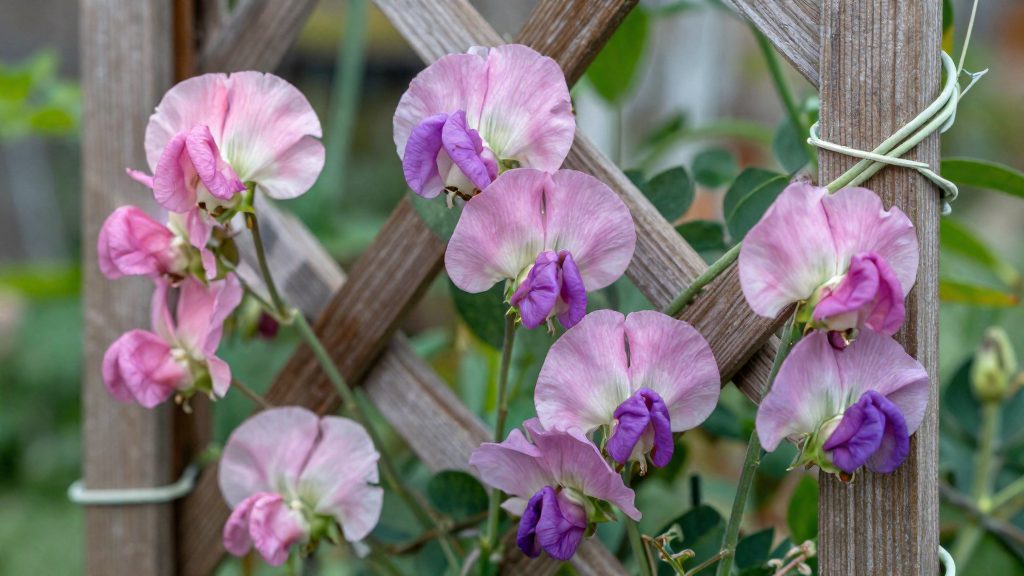
Sweet peas are grown on a trellis because they need a vertical structure to climb. Growing them vertically also suits small plots, and it places the flowers at a height where they are easier to pick.
Why grow sweet peas on a trellis?
Climbing habit and dependence on support
Sweet peas are climbing plants, and the consulted sources do not describe the mechanism by which their stems attach to a support. Their practical requirement is clear: according to Cornell University (2026), they must have a trellis for support. Without one, the stems have nothing to climb, and growth sprawls along the ground.
Because the vines grow quickly, regular tying is part of the routine. Floret Flower Farm (2026) advises tying the vines regularly to the support, since they can grow more than 1 ft (30 cm) per week. Tying regularly during active growth keeps the stems attached to the structure.
Vertical growing in small spaces
A trellis lets the plant use height rather than ground area, which makes sweet peas practical for small gardens, narrow beds and balconies with a suitable structure. The climbing habit means one row of support can carry a large number of flowering stems in a footprint much smaller than a bed of unsupported plants.
Floret Flower Farm (2026) recommends a trench 1 ft (30 cm) deep filled with compost or well-rotted manure. In a narrow vertical bed, this preparation concentrates nutrients where the roots are, which is useful when the planting area is limited.
Easier picking of flowers held at height
Growing on a trellis brings the blooms up to standing height, so they can be cut without bending or kneeling. This is a practical advantage during the harvest period.
Picking at height on a regular schedule keeps the plant producing flowers for longer.
When to sow sweet peas: mild-winter regions versus colder regions
Sowing time for sweet peas depends mainly on how severe the winter is. According to Floret Flower Farm (2026), gardeners in mild-winter regions sow in autumn, while gardeners elsewhere sow in late winter or early spring. Canada includes areas with very different winters, so the first step is to decide which group your garden falls into based on local conditions. The official sources consulted do not specify sowing windows by province or climate zone, so the local winter pattern should guide the final choice.
| Winter type | Sowing window |
|---|---|
| Mild-winter region | Autumn |
| All other regions | Late winter or early spring |
Whichever window applies, seeds are soaked for 24 hours before sowing, according to Floret Flower Farm (2026). Soaking is a fixed step in the routine, so plan to start it the day before you sow.
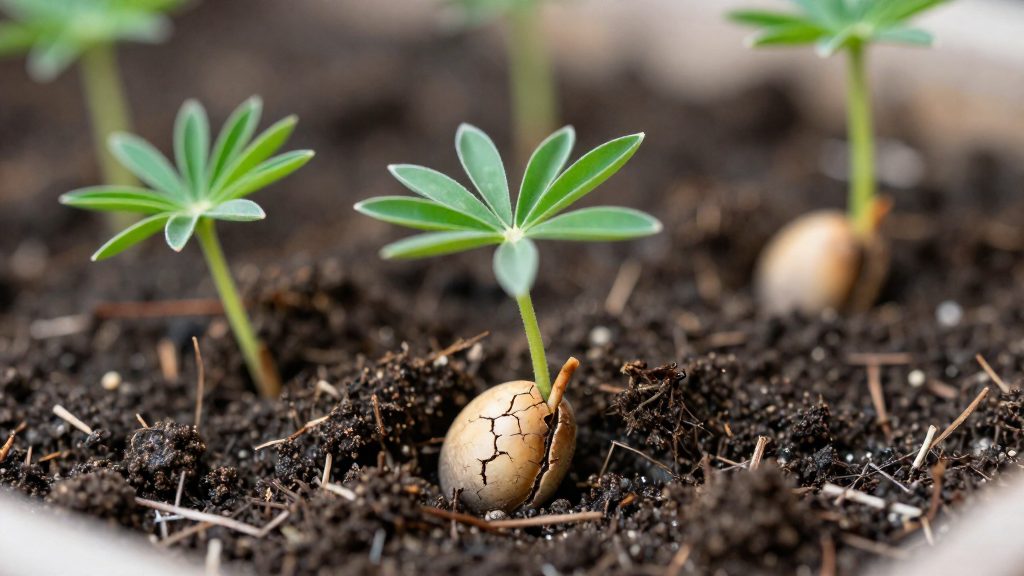
Germination timing is the next point to plan for. Cornell University (2026) reports that seeds germinate in 10 to 21 days at 60 °F (about 16 °C). Counting from the sowing date gives a realistic range for when seedlings should appear. Keep in mind that this range applies at about 16 °C. Cooler soil will slow emergence, and the sources consulted do not give a figure for other temperatures.
Autumn sowing and spring sowing both have the same goal: getting seedlings established before they need to climb. Because sweet peas need a support from the start, the sowing site should be chosen with the trellis already in place. Mild-winter gardeners sowing in autumn should choose a site that will be ready before the plants are established, while spring sowers should aim to have seedlings growing steadily once the weather warms.
Choosing and building the right trellis
Sweet peas are climbers and depend on a support structure for the whole plant. Floret Flower Farm (2026) describes a reference design of tall posts about 2.4 m (8 ft) apart, carrying either netting or 1.8 m (6 ft) metal fencing.
Post structure
- Set tall posts in a straight line, about 8 ft (2.4 m) apart.
- Choose posts strong enough to hold the climbing surface and the weight of mature vines.
- Anchor the posts firmly in the ground, since the structure must stay upright under the load of a vigorous plant.
Climbing surface
The reference design offers two options, both attached to the posts:
| Component | Reference specification | Source |
|---|---|---|
| Post spacing | About 8 ft (2.4 m) apart | Floret Flower Farm (2026) |
| Climbing surface, option 1 | Netting | Floret Flower Farm (2026) |
| Climbing surface, option 2 | 6 ft (1.8 m) metal fencing | Floret Flower Farm (2026) |
Netting gives a lightweight, flexible surface for tendrils to grip. Metal fencing at 6 ft (1.8 m) gives a rigid surface fixed to the posts. The official sources consulted do not compare the two options on durability or cost.
Site and height considerations
Because the structure is built for vines that grow quickly, the reference dimensions are posts about 8 ft (2.4 m) apart carrying 6 ft (1.8 m) metal fencing, or netting.
Soil, sun and planting spacing
Sweet peas need a full sun position and a deeply enriched planting bed. Choose a site that receives direct sun for most of the day, away from tree roots and deep shade, since the vines will climb to the full height of the trellis and need light along their whole length. Floret Flower Farm (2026) classes sweet peas as heavy feeders, so the soil should be prepared before planting rather than fed afterward.
For the bed, dig a trench about 30 cm (1 ft) deep along the line of the trellis and fill it with compost or well-rotted manure. This gives the roots a rich zone to grow into, and the trench should be ready before the seedlings go in. The official sources consulted do not specify a soil pH range, so test the soil if you need a precise value.
Seedlings are planted out around the last spring frost, once the risk of frost has passed in your area. Floret Flower Farm (2026) recommends two rows, one on each side of the trellis, about 20 cm (8 in) apart. This arrangement lets the vines support each other and gives an even distribution of foliage along the netting or fencing.
Plant density on a trellis is set at 2 to 4 plants per foot (roughly 30 cm of trellis length).
| Element | Recommended setting | Source |
|---|---|---|
| Sun exposure | Full sun | Floret Flower Farm (2026) |
| Compost trench | About 30 cm (1 ft) deep, filled with compost or well-rotted manure | Floret Flower Farm (2026) |
| Planting out | Around the last spring frost | Floret Flower Farm (2026) |
| Row spacing | Two rows about 20 cm (8 in) apart, one on each side | Floret Flower Farm (2026) |
| Plant density | 2 to 4 plants per foot of trellis | Cornell University (2026) |
Training and pinching young vines
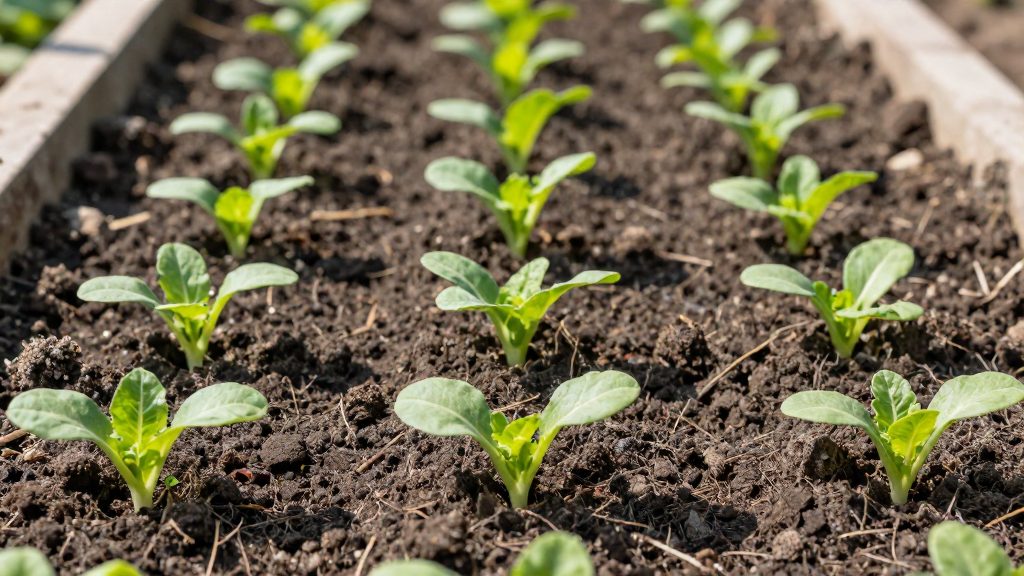
When sweet pea seedlings reach 10 to 15 cm (4 to 6 in) tall, pinch out the central growing tip. Floret Flower Farm (2026) advises removing the tip and leaving 2 or 3 leaf nodes below the cut. This encourages basal branching, so the plant produces several side shoots from the base instead of one main stem. More stems give the plant more places to climb and flower, which makes the trellis cover more evenly.
Pinching is a single cut at the top of the young plant, made with clean snips or fingers. Do not remove more than the tip and the leaf nodes described above. Once the tip is pinched, the side shoots that develop will need to be guided onto the trellis netting or fencing.
Young shoots may not always head toward the netting or fencing, so guide them onto the support by hand. Tie loosely with soft material so that the stems can thicken without being constricted.
| Stage | Measure | Source |
|---|---|---|
| Pinching height | 10 to 15 cm (4 to 6 in) | Floret Flower Farm (2026) |
| Tip removed | Central growing tip | Floret Flower Farm (2026) |
| Leaf nodes left below cut | 2 or 3 | Floret Flower Farm (2026) |
| Expected result | Branching from the base | Floret Flower Farm (2026) |
Watering, feeding and deadheading
Sweet peas grown on a trellis keep flowering longest when spent blooms are removed often. Floret Flower Farm (2026) advises deadheading and harvesting frequently, because letting plants set seed shortens the blooming period. The sources consulted do not specify watering volumes or a fertilizer dose and interval, so the guidance below covers the methods that can be verified and leaves out numbers that cannot.
Deadheading and harvesting
Deadheading means removing faded flowers before they form seed. Pick open flowers as well, since cutting them also removes blooms that would otherwise set pods. Harvest at short intervals throughout the flowering period rather than in one large cut. Work along both rows of the trellis so that flowers are removed evenly across the plants.
Seed pods and the blooming period
Seed pods are the main reason flowering slows down. Once a plant puts energy into developing pods, it produces fewer new flowers. The practical trade-off is simple: if you want continuous blooms, remove pods as they appear. If you want seed for the following year, leave a few pods on selected vines and accept a shorter flowering season from those plants.
| Task | Guidance | Source |
|---|---|---|
| Deadheading | Remove spent blooms often | Floret Flower Farm (2026) |
| Harvesting | Pick frequently during flowering | Floret Flower Farm (2026) |
| Seed pods | Shorten the blooming period | Floret Flower Farm (2026) |
| Watering rate | Not specified | The sources consulted do not specify |
| Fertilizer dose and interval | Not specified | The sources consulted do not specify |
Watering
The sources consulted do not give a watering rate, frequency, or volume for sweet peas. In general practice, water at the base of the plants rather than over the foliage, keep the soil evenly moist during flowering, and avoid waterlogging. Check the soil before each watering and adjust to local rainfall and temperature, since the right amount varies with region and season.
Feeding
The sources consulted do not specify a fertilizer type, dose, or application interval. Base any feeding decisions on the plants’ appearance and growth rate, and keep the same approach across both rows so that the whole trellis develops evenly.
Common problems and cold protection
Sweet pea seedlings tolerate cold but are exposed to cold injury early in the season, and heat later reduces flower size and yield. According to Cornell University (2026), seedlings tolerate cold but need protection when temperatures fall below 25 °F (about -4 °C). Heat reduces flower size and overall yield.
Cold injury threshold
- Seedlings: protect from frost when temperatures drop below 25 °F (about -4 °C), per Cornell University (2026).
- Cover young plants on nights forecast to fall below this threshold, and remove the cover once temperatures rise.
- Check local forecasts, since the threshold is a temperature and not a calendar date, and conditions vary by region.
Heat effects
Heat has two measurable effects on sweet peas: smaller flowers and lower overall yield (Cornell University, 2026). The sources consulted do not specify heat-mitigation methods such as shading or mulching, so no specific technique is recommended here.
Pest and disease data
The official sources consulted do not specify which pests or diseases affect sweet peas, their symptoms, or control methods. Gardeners should check regional extension services for local pest and disease information before treating plants.
| Factor | Effect or threshold | Source |
|---|---|---|
| Seedling cold | Protection needed below 25 °F (about -4 °C) | Cornell University (2026) |
| Heat | Smaller flowers and reduced yield | Cornell University (2026) |
| Pests and diseases | Not specified in the sources consulted | Not applicable |