Pruning tools should be disinfected at minimum when cutting diseased material, and ideally between every cut, according to Iowa State University Extension and Outreach (2026-04-20). Soil, sap, and plant debris must be removed first, because they reduce how well a disinfectant works. The preferred option is 70% alcohol, applied undiluted by wiping or dipping. A 10% bleach solution, soaked for at least 10 minutes and then rinsed in clear water, is recommended instead of alcohol for apple trees with fire blight.
Why disinfect pruning tools?
Pruning tools can carry plant pathogens from one plant to another, so cleaning them between cuts limits that transfer. The guidance below comes from two university extension sources, and where they differ, the stricter instruction is given.
- Minimum: disinfect between plants when pruning diseased material.
- Ideal: disinfect between every cut, according to Iowa State University Extension and Outreach (2026-04-20).
- First step: remove soil, sap, and debris before applying any disinfectant.
Disinfectant options
| Method | How to apply | Contact time | Notes |
|---|---|---|---|
| 70% alcohol (isopropyl or ethanol) | Undiluted; wipe or dip the tool | Prolonged soaking is not necessary (Iowa State, 2026-04-20); dip for at least 30 seconds (University of Wisconsin–Madison, 2016-12-28) | Wisconsin describes dipping as probably the best option; spray until dripping, then air-dry |
| 10% bleach (1 volume bleach to 9 volumes water, bleach poured into the water) | Soak the blades | At least 10 minutes, then rinse with clear water | Use within 2 hours; Iowa State recommends it instead of alcohol for apple trees with fire blight (2026-04-20) |
Bleach precautions
Wisconsin lists a minimum soak of 30 seconds for bleach, while Iowa State gives 10 minutes. Following the stricter guidance, soak blades for at least 10 minutes. The University of Wisconsin–Madison Plant Disease Diagnostics Clinic (2016-12-28) also notes that bleach is corrosive to metal and causes rust with repeated use, so rinse the blades with clear water after each soak.
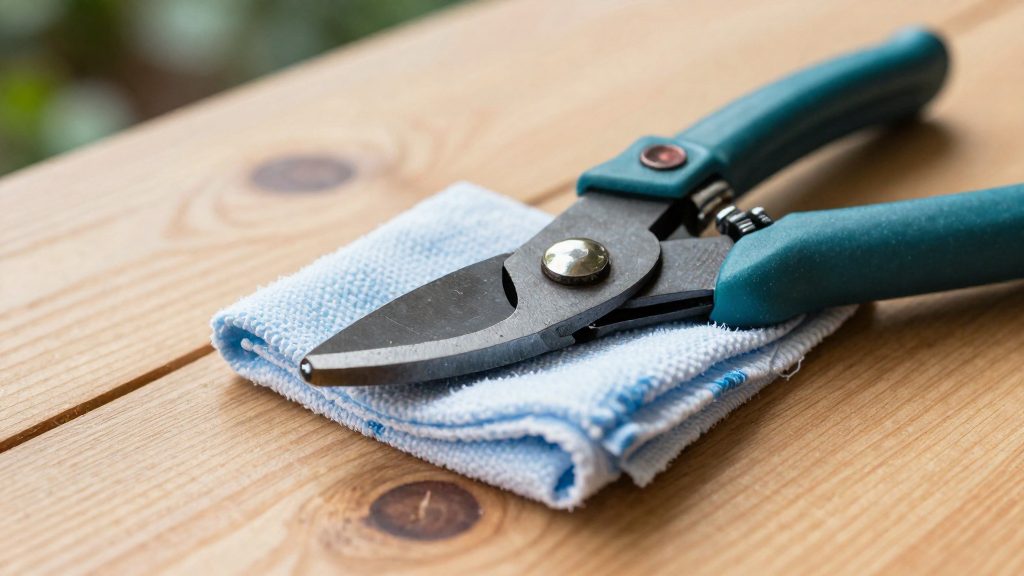
When to disinfect pruning tools between cuts
According to Iowa State University Extension and Outreach (2026), pruning tools must be disinfected at a minimum when moving between plants while cutting diseased material. Ideally, disinfection happens between every cut. Before applying any disinfectant, remove soil, sap, and plant debris from the blade, because the disinfectant must reach a clean cutting surface. The University of Wisconsin–Madison Plant Disease Diagnostics Clinic (2016) gives a similar frequency: disinfect between every cut, or at least between each tree or shrub.
Common disinfectant methods
| Method | Preparation | Contact | Notes |
|---|---|---|---|
| 70% alcohol (isopropyl or ethanol) | Used undiluted | Wipe the blade, or dip it for at least 30 seconds (Wisconsin, 2016). Prolonged soaking is not needed (Iowa State, 2026). | Preferred disinfectant. Wisconsin describes dipping as probably the best option. Let the blade air-dry after a spray application. |
| 10% bleach | 1 volume of bleach to 9 volumes of water, pouring the bleach into the water | Soak blades for at least 10 minutes, then rinse with clear water | Iowa State recommends it instead of alcohol for apple trees with fire blight. Use within 2 hours of mixing. |
Practical sequence
- Clean the blade of soil, sap, and debris.
- Apply the chosen disinfectant, following the contact time for that method.
- Rinse bleach-treated blades with clear water, then dry them.
- Repeat between cuts, or at each new plant when working with diseased material.
Iowa State (2026) states that household wipes and sprays have not been well evaluated for plant pathogens, so alcohol is preferred over them. The same source describes 10% trisodium phosphate (TSP) as very corrosive and little recommended for home gardeners. Wisconsin’s shorter bleach soak of at least 30 seconds conflicts with Iowa State’s 10-minute guidance, so the stricter 10-minute soak applies.
Clean before disinfecting
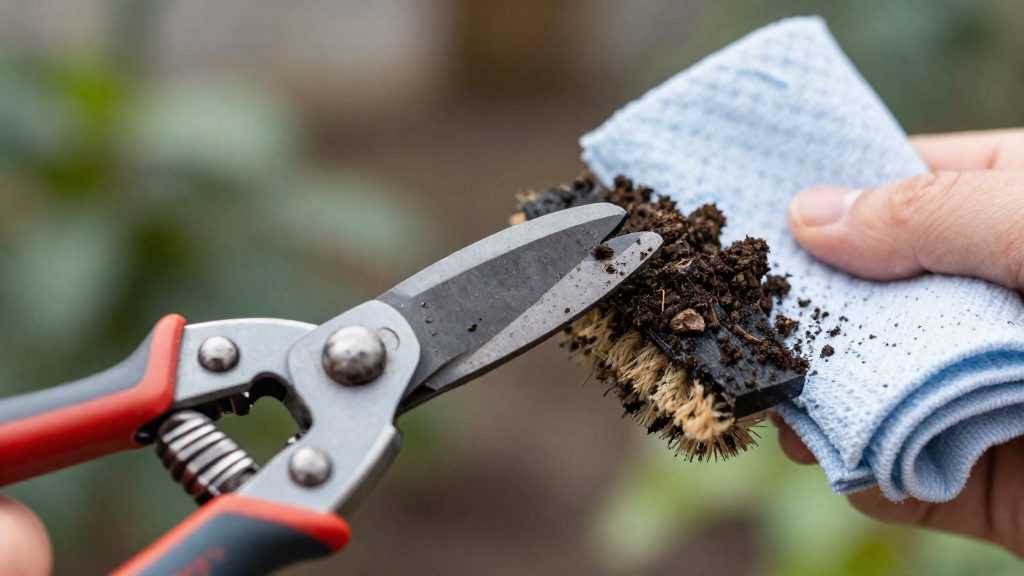
Disinfectant works on the blade surface, so the tool has to be cleaned first. According to Iowa State University Extension and Outreach (2026-04-20), soil, sap, and plant debris must be removed before any disinfectant is applied. Pruners that still carry residue will not be properly disinfected, and the cleaning step has to happen before every disinfection, not only once per session.
The minimum rule is to disinfect between plants whenever you prune diseased material. The same source recommends disinfecting ideally between every cut. Since the cleaning step comes before each disinfection, the sequence repeats at the same frequency.
| Step | Action | Purpose |
|---|---|---|
| 1 | Remove soil from the blades and hinge | Soil shields pathogens from the disinfectant |
| 2 | Scrape off dried sap | Sap coats the blade and blocks contact |
| 3 | Brush away plant debris | Leftover tissue can carry infected material to the next cut |
| 4 | Check that the blade is clean before disinfecting | Residue reduces contact between the disinfectant and the metal |
Cleaning first is the step most often skipped, and it determines whether the disinfectant reaches the cutting surface. Between plants is the minimum frequency when pruning diseased material. Between each cut is the recommended frequency.
70% alcohol: the simplest method
70% alcohol is the most accessible disinfectant for pruning tools. The Plant Disease Diagnostics Clinic at the University of Wisconsin–Madison (2016) describes dipping blades in 70% alcohol for at least 30 seconds as probably the best option among the methods it covers. The alcohol can be isopropyl or ethanol and is used undiluted, so no mixing is required. Iowa State University Extension and Outreach (2026) states that prolonged soaking is not necessary.
Clean the tool before disinfecting. Remove soil, sap and plant debris first, because residue can keep the alcohol from reaching the metal. Then apply the alcohol using one of the methods below.
| Method | How to apply | Source |
|---|---|---|
| Wipe | Wipe the blade with undiluted 70% alcohol | Iowa State University Extension and Outreach (2026) |
| Dip | Submerge the blade for at least 30 seconds | University of Wisconsin–Madison (2016) |
| Spray | Spray until the tool drips, then let it air-dry | University of Wisconsin–Madison (2016) |
Household disinfectant wipes and sprays have not been well evaluated against plant pathogens. Iowa State University Extension and Outreach (2026) recommends alcohol over these products.
Practical sequence
- Remove soil, sap and debris from the blades.
- Apply undiluted 70% alcohol by wiping, dipping or spraying.
- For spray application, let the tool air-dry before the next cut.
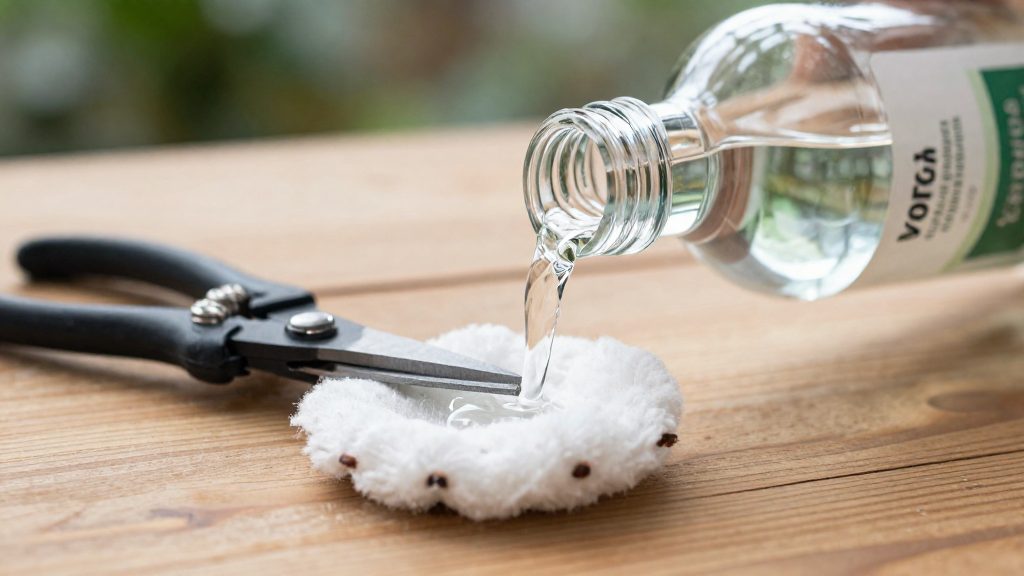
Bleach: how to dilute it and what risks it poses to blades
Bleach is recommended by Iowa State University Extension and Outreach (2026) as an alternative to alcohol for pruning apple trees affected by fire blight. The working solution is a 10% bleach solution, made from 1 volume of bleach and 9 volumes of water. The bleach is always poured into the water, never the reverse, and the solution must be used within 2 hours of preparation.
Preparing and using the solution
- Clean the blades first by removing soil, sap, and plant debris, since these interfere with contact between the blade and the disinfectant.
- Pour 1 volume of bleach into 9 volumes of water.
- Soak the blades for at least 10 minutes.
- Rinse the blades with clear water to limit corrosion.
| Step | Requirement | Source |
|---|---|---|
| Dilution | 1 volume bleach to 9 volumes water | Iowa State University Extension and Outreach (2026) |
| Working life | Use within 2 hours | Iowa State University Extension and Outreach (2026) |
| Soak time | At least 10 minutes | Iowa State University Extension and Outreach (2026) |
| Rinse | Clear water | Iowa State University Extension and Outreach (2026) |
The University of Wisconsin–Madison Plant Disease Diagnostics Clinic (2016) gives a shorter minimum of 30 seconds for a bleach soak. Where the two sources differ, the stricter 10-minute guidance applies.
Risks for blades
Bleach is corrosive to metal. According to the University of Wisconsin–Madison Plant Disease Diagnostics Clinic (2016), repeated use of a 10% solution causes rust on blades. Rinsing with clear water is the step that limits this damage.
Alternatives and frequency
Iowa State University Extension and Outreach (2026) recommends 70% alcohol (isopropyl or ethanol) for general use. It is applied undiluted, by wiping or dipping, and prolonged soaking is not necessary. Household wipes and sprays are not well evaluated for plant pathogens, and 10% TSP is very corrosive and little recommended for home gardeners.
Disinfect tools at minimum between plants when pruning diseased material. Ideally, disinfect between every cut. If that is not practical, the Wisconsin clinic advises disinfecting between each tree or shrub.
Choosing between alcohol, bleach and other disinfectants
For pruning tools, the choice of disinfectant depends on the risk. According to Iowa State University Extension and Outreach (2026-04-20), tools must be disinfected at minimum between plants when pruning diseased material, and ideally between every cut. Before any disinfectant is applied, the tool must be cleaned of soil, sap, and plant debris, because residue reduces contact between the product and the blade. For apple trees affected by fire blight, Iowa State recommends a 10% bleach solution rather than alcohol. The University of Wisconsin–Madison Plant Disease Diagnostics Clinic (2016-12-28) describes 70% alcohol soaking as probably the best option for general use.
| Disinfectant | Preparation and use | Contact time | Key limits |
|---|---|---|---|
| 70% alcohol (isopropyl or ethanol) | Used undiluted, by wiping or dipping the tool | Wisconsin: at least 30 seconds of soaking; Iowa State: prolonged soaking not necessary | Preferred over household products (Iowa State, 2026-04-20) |
| 10% bleach solution | 1 part bleach to 9 parts water, bleach poured into the water; use within 2 hours | Soak blades at least 10 minutes, then rinse with clean water (Iowa State, 2026-04-20) | Recommended over alcohol for apple trees with fire blight; corrosive to metal |
| 10% TSP | Soak, then rinse | Soak for 3 minutes (Iowa State, 2026-04-20) | Very corrosive; little recommended for home gardeners |
| Household wipes and sprays | Applied as sold | Not specified by the official sources consulted | Effectiveness against plant pathogens not well evaluated; alcohol preferred |
Using alcohol correctly
Alcohol is the simplest option for routine work between plants. Iowa State specifies that 70% alcohol is applied undiluted, either by wiping the blades or dipping them. Wisconsin describes a spray application that is applied until the tool drips, followed by air drying. After a spray application, Wisconsin says to let the tool air-dry.
Using bleach correctly
Bleach is the choice when fire blight is present on apple trees. Iowa State gives the following steps:
- Pour the bleach into the water, never the reverse, to make a 1:9 solution (10%).
- Prepare the solution fresh and use it within 2 hours.
- Soak the blades for at least 10 minutes.
- Rinse with clear water to limit corrosion.
Wisconsin gives a shorter soak of at least 30 seconds. Where the two sources differ, follow the stricter guidance of 10 minutes. Wisconsin also notes that bleach corrodes metal and causes rust with repeated use, so rinse the blades with clear water and dry them after treatment.
Choosing between products
- For general pruning, use 70% alcohol: Iowa State prefers it over household products, and Wisconsin describes dipping in it as probably the best option.
- For apple trees with fire blight, use the 10% bleach method, followed by rinsing and drying.
- Avoid household wipes and sprays as a primary method, because their effectiveness against plant pathogens has not been well evaluated.
- When working with diseased material, disinfect at a minimum between plants, and ideally between every cut. Wisconsin advises disinfecting at least between each tree or shrub.
How to Maintain Blades After Disinfection?
Blade care after disinfection depends on the product used. Bleach affects metal more than alcohol does. The University of Wisconsin–Madison Plant Disease Diagnostics Clinic (2016) notes that a 10% bleach solution is corrosive to metal and causes rust when used repeatedly. Alcohol is the simpler option for routine maintenance.
| Disinfectant | Contact time | Step after treatment |
|---|---|---|
| 70% alcohol (isopropyl or ethanol) | Wipe or dip. Prolonged soaking is not needed (Iowa State University Extension and Outreach, 2026) | Air dry. For spray, apply until dripping, then air dry (University of Wisconsin–Madison Plant Disease Diagnostics Clinic, 2016) |
| 10% bleach (1 volume bleach to 9 volumes water, bleach poured into the water) | Soak at least 10 minutes. Use within 2 hours of preparing the solution (Iowa State University Extension and Outreach, 2026) | Rinse with clear water to limit corrosion (Iowa State University Extension and Outreach, 2026) |
Clean off sap and debris first
Remove soil, sap, and plant debris before disinfecting. Residue left on the blade reduces contact between the disinfectant and the metal, and it can also hold moisture against the blade. Iowa State University Extension and Outreach (2026) lists this step before any disinfection.
Rinse and dry completely after bleach
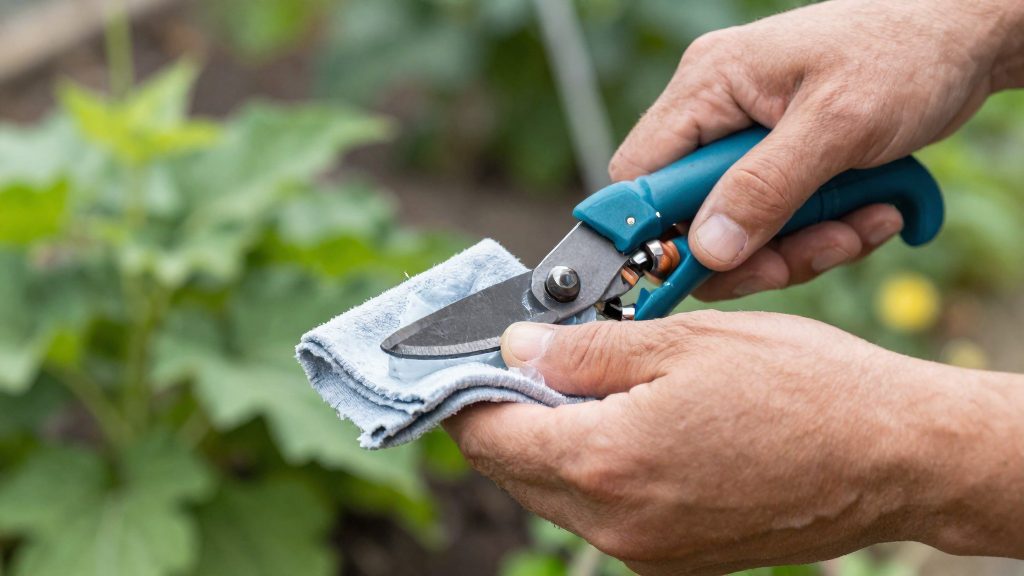
After a bleach soak, rinse the blades with clear water to remove residue. Then dry them fully with a clean cloth, including the pivot area and the spaces between the blade and the hook or anvil. Any moisture left on metal encourages rust.
Limit repeated bleach contact
Reserve bleach for situations where it is specifically recommended. Iowa State University Extension and Outreach (2026) recommends bleach instead of alcohol for apple trees with fire blight. For routine sanitizing between cuts, use 70% alcohol, which the same source describes as preferred over household products. Repeated bleach use causes rust, so rinse the blades after each soak.
Frequently asked questions
How often should I disinfect pruning tools?
Disinfect between plants whenever you have been cutting diseased wood. Iowa State University Extension and Outreach (2026-04-20) recommends going further and wiping the blades between every cut, which is the most protective routine.
Should I use alcohol or bleach on my pruners?
For most jobs, 70% alcohol applied undiluted is the default choice. Iowa State University Extension and Outreach (2026-04-20) recommends a 10% bleach solution, soaked for at least 10 minutes and rinsed, only for apple trees with fire blight, and bleach corrodes metal, so rinse and dry the tools afterward.
Can I use household disinfectant wipes instead of alcohol?
Household wipes and sprays are not the preferred option. Iowa State University Extension and Outreach (2026-04-20) notes that their effectiveness against plant pathogens is not well evaluated, so alcohol is advised instead. The same source also warns against 10% TSP, which is very corrosive and little recommended for home gardeners.