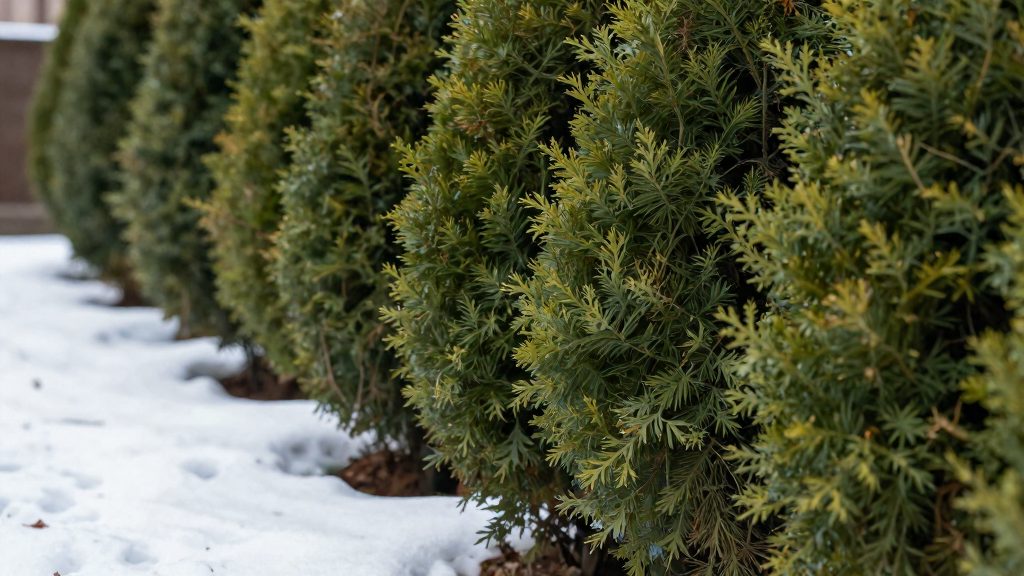
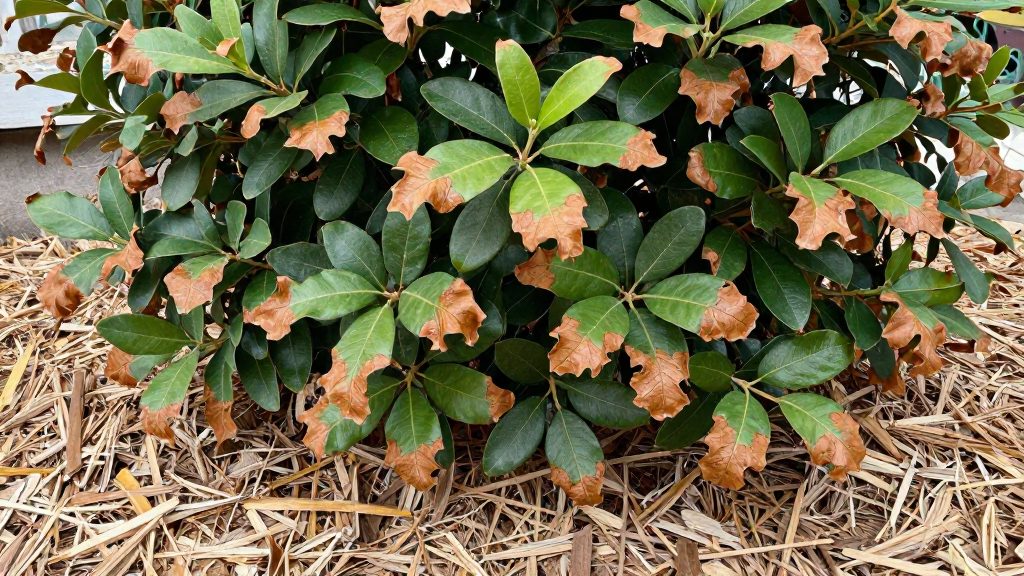
Winter burn is the browning and drying of evergreen foliage that occurs when winter conditions pull water out of leaves faster than the roots can replace it. According to the University of Wisconsin–Madison Extension Horticulture, the damage typically appears on sunny, windy winter days when the soil is frozen and the roots cannot take up water. Boxwood, hemlock, rhododendron and yew are among the sensitive evergreens, and the risk is highest for new transplants, exposed sites and plants near roads treated with de-icing salt.
What Is Winter Burn on Evergreens?
Winter burn develops when evergreen foliage keeps losing moisture during cold weather while frozen soil blocks the roots from supplying replacement water. Sunny and windy conditions speed this water loss, so the leaves dry out even though the plant has no access to water in the ground.
The University of Wisconsin–Madison Extension Horticulture identifies these conditions as making the problem worse:
- New transplants with weak root systems
- Sudden cold snaps
- Wind exposure
- Road de-icing salt
Colorado State University Extension (PlantTalk Colorado) also lists southwest sides of buildings, windswept sites and roadsides as higher-risk locations. Sensitive evergreens generally do best on the north-east or east side of a building, or in partial shade.
Water and Mulch Guidelines
| Situation | Guidance |
|---|---|
| Established evergreens | About 1 inch (2.5 cm) of water per week |
| New transplants | Up to 2 inches (5 cm) per week during the growing season, until the soil freezes or heavy snow arrives |
| Mulch on clay soil | 2 inches (5 cm) deep, out to the drip line |
| Mulch on sandy soil | 4 inches (10 cm) deep, out to the drip line |
Keep mulch at least 4 inches (10 cm) away from trunks and shrub bases. Davey Tree Expert Company recommends watering shrubs thoroughly in fall until the ground freezes.
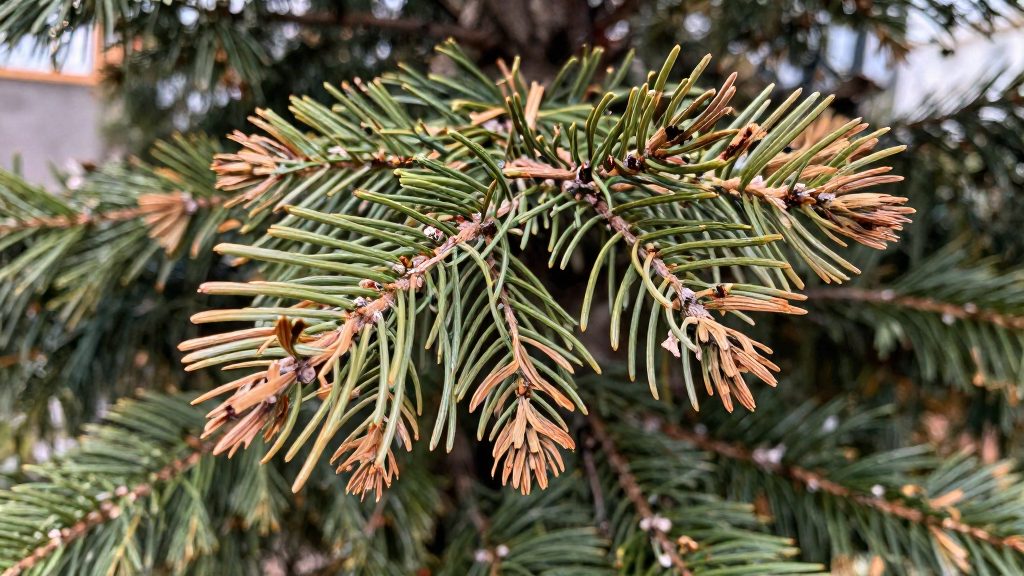
Why do evergreens get winter burn?
Winter burn occurs when evergreen foliage loses more water than the plant can replace. On sunny, windy winter days, the leaves keep transpiring, but when the soil is frozen, the roots cannot take up water to replace what is lost. The result is browned, dried needles or leaves. The damage comes from water loss while the roots cannot replace it, so exposure to sun and wind strongly influences where it appears.
The water imbalance
The process has three parts:
- Foliage keeps losing water on bright, dry, windy days, even in winter.
- Frozen soil blocks uptake, so roots cannot supply the water needed to replace losses.
- Exposed leaves dry out first, typically on the side facing the sun and wind.
Browned foliage is the visible result of this water loss.
Factors that increase the risk
| Factor | Why it matters |
|---|---|
| New transplants with weak roots | Limited root systems cannot supply enough water to the foliage |
| Sudden cold snaps | Make winter burn worse |
| Wind | Increases water loss from the leaves |
| Road de-icing salt | Makes winter burn worse |
| Southwest sides of buildings | Receive strong winter sun and drying wind |
| Windswept sites and roadsides | Expose foliage to continuous desiccating conditions |
According to Colorado State University Extension (PlantTalk Colorado), long dry winter spells, generally those lasting more than a month, also raise the risk and can make irrigation necessary even in winter.
Sensitive evergreens and suitable sites
The University of Wisconsin–Madison Extension Horticulture identifies several evergreens as especially sensitive. The table below lists the recommended site for each.
| Plant | Recommended site |
|---|---|
| Boxwood | Northeast or east side of a building, or partial shade |
| Hemlock | Northeast or east side of a building, or partial shade |
| Rhododendron | Northeast or east side of a building, or partial shade |
| Yew | Northeast or east side of a building, or partial shade |
These plants do best away from exposed, sunny, and windy positions. Choosing the right location before planting helps limit winter burn.
How to Choose the Right Location
Site selection is the most direct way to limit winter burn on evergreens. According to University of Wisconsin–Madison Extension Horticulture, sensitive evergreens such as boxwood, hemlock, rhododendron and yew do best out of exposed, sunny and windy spots. Placing them in a sheltered position reduces that combined stress before any protection is needed.
| Site | Winter burn risk | Placement guidance |
|---|---|---|
| North-east or east side of a building | Lower | Recommended for sensitive evergreens |
| Partial shade | Lower | Suggested alternative to a sunny, exposed spot |
| Southwest side of a building | Higher | Named as a site that raises risk |
| Windswept site | Higher | Wind increases water loss from foliage |
| Roadside | Higher | Road de-icing salt makes winter burn worse |
Favour a north-east or east exposure
A north-east or east exposure is the default choice. The university recommends planting sensitive evergreens on the north-east or east side of a building, or giving them partial shade. Check each candidate spot for sun and wind exposure through winter, not only in summer, because a position that looks sheltered in spring can receive strong winter sun and wind.
Avoid high-risk sites
Colorado State University Extension (PlantTalk Colorado) identifies southwest sides of buildings, windswept sites and roadsides as locations that raise the risk of winter desiccation. Keep evergreens away from these positions where possible. Roadsides carry an added hazard from de-icing salt, so plant farther from the curb when a roadside location cannot be avoided.
Use a windbreak when the site cannot change
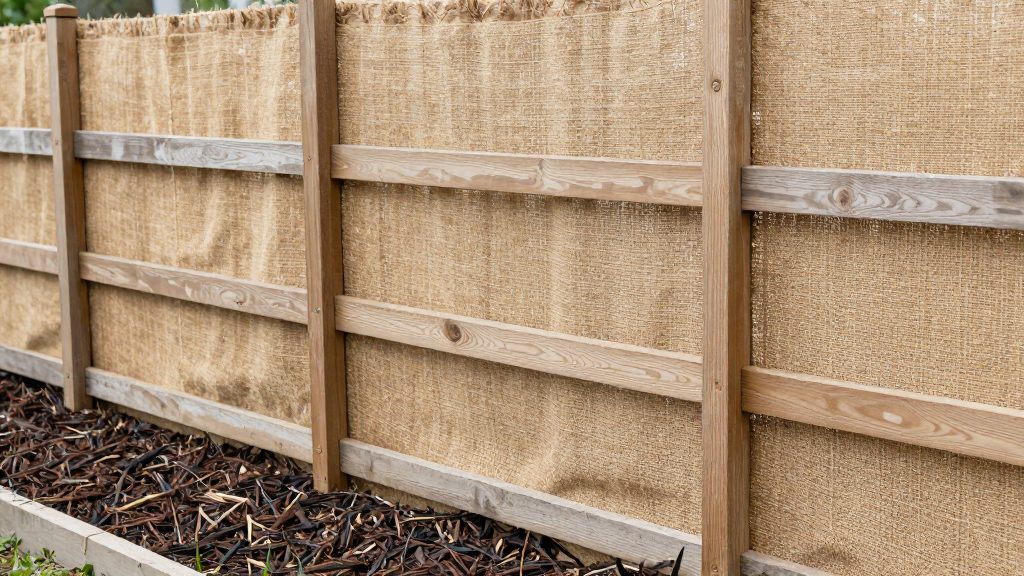
When a spot is exposed to the south, west or prevailing wind, Davey Tree Expert Company advises wrapping shrubs in burlap if they face harsh sun or wind all winter. Where possible, build a burlap screen rather than wrapping plants individually. Set stakes 4–5 ft (about 1.2–1.5 m) tall roughly 2 ft (about 60 cm) outside the drip line on the south, west and windy sides, attach burlap or snow fencing, and leave the top open. Remove it in spring. Don’t wrap individual plants tightly, because that traps ice and moisture.
New transplants need extra attention
Newly planted evergreens have weak roots and are more vulnerable to winter burn, so their first winter is when location matters most. Observe local sun and wind patterns during the coldest months and adjust placement or screening to match.
How to Water Before the Freeze
Watering before the ground freezes is the step that gives evergreens water to draw on during winter. Winter burn starts when sunny, windy winter days pull water from the foliage while frozen soil stops the roots from replacing it. Soil that enters winter dry has no reserve to supply, so autumn watering matters as much as any care given in spring.
Colorado State University Extension (PlantTalk Colorado) advises watering evergreens in fall so they enter winter with good soil moisture, then watering again during long dry winter spells, generally those lasting more than a month. Davey Tree Expert Company recommends watering shrubs thoroughly in fall until the ground freezes.
The amount depends on the age of the plant:
| Plant situation | Water amount | Source |
|---|---|---|
| Established evergreens | About 2.5 cm (1 inch) per week | University of Wisconsin–Madison Extension Horticulture |
| New transplants | Up to 5 cm (2 inches) per week during the growing season, until the soil freezes or heavy snow arrives | University of Wisconsin–Madison Extension Horticulture |
Apply water with a soaker or drip hose at the drip line, the outer edge of the branch spread, rather than spraying the foliage. Slow application lets the soil absorb water instead of letting it run off.
Sites with the highest risk need the most attention. The sources name southwest sides of buildings, windswept sites and roadsides. Sensitive evergreens such as boxwood, hemlock, rhododendron and yew do best in sheltered spots, on the north-east or east side of a building, or in partial shade. Road de-icing salt also makes winter burn worse, so keep plants away from salt spray where possible.
Mulch helps the root zone keep its moisture. Davey Tree Expert Company advises a layer 7.5–10 cm (3–4 inches) deep, slightly deeper than the University of Wisconsin–Madison figure for clay soil. The University of Wisconsin–Madison Extension Horticulture recommends 5 cm (2 inches) on clay soil or 10 cm (4 inches) on sandy soil, extended to the drip line and kept at least 10 cm (4 inches) away from trunks and shrub bases.
Mulch and burlap screens
Mulch and windbreak screens target the two main causes of winter burn: water loss through the foliage and drying wind. According to the University of Wisconsin–Madison Extension Horticulture, root zone mulch helps keep soil moisture steady around the roots, while a burlap screen shields the plant from sun and wind on exposed sides. Both measures work best when set up in fall, before the ground freezes.
Mulching the root zone
Spread mulch out to the drip line, the outer edge of the branch canopy, and keep it at least 4 inches (about 10 cm) away from trunks and shrub bases. Recommended depth depends on soil type:
| Soil type | Mulch depth (UW–Madison Extension) | Metric equivalent |
|---|---|---|
| Clay soil | 2 inches | about 5 cm |
| Sandy soil | 4 inches | about 10 cm |
Davey Tree Expert Company advises a 3–4 inch (about 7.5–10 cm) layer over the root zone. Mulch that is too deep can shelter mice and voles, so check for rodent activity before adding more.
Building a burlap screen
The University of Wisconsin–Madison Extension Horticulture describes this method for sites with strong winter sun or wind:
- Drive 4–5 ft (about 1.2–1.5 m) stakes into the ground about 2 ft (about 60 cm) outside the drip line.
- Place the screen on the south, west and windy sides of the planting.
- Wrap the stakes with burlap or snow fencing, leaving the top open.
- Remove the screen in spring.
Should you use an anti-desiccant?
An anti-desiccant spray gives limited protection against winter burn on evergreens. According to the University of Wisconsin–Madison Extension Horticulture, these sprays break down quickly and must be reapplied after rain or snow. Colorado State University Extension (PlantTalk Colorado) reports that anti-transpirant sprays applied in October or November may help reduce winter desiccation. Because the protection is temporary, a spray works best as one part of a broader plan. Winter burn occurs when sunny, windy winter days pull water from evergreen foliage while frozen soil prevents the roots from replacing it, so the spray should not be the only measure.
When a spray may help
- Timing: Apply in October or November, the window named by Colorado State University Extension.
- Reapplication: Reapply after rain or snow, because the University of Wisconsin–Madison Extension Horticulture notes the product breaks down quickly.
- Combination: Use it alongside fall watering, mulching and wind protection rather than in place of them.
Comparison of winter protection methods
| Method | Source | Key guidance |
|---|---|---|
| Anti-desiccant spray | University of Wisconsin–Madison Extension Horticulture | Limited benefit; breaks down quickly; reapply after rain or snow |
| Anti-transpirant spray | Colorado State University Extension (PlantTalk Colorado) | Applied in October or November may help reduce winter desiccation |
| Burlap screen | University of Wisconsin–Madison Extension Horticulture | Stakes 4–5 ft (1.2–1.5 m) high, about 2 ft (60 cm) outside the drip line on south, west and windy sides; top left open; remove in spring |
| Fall watering | Davey Tree Expert Company; Colorado State University Extension (PlantTalk Colorado) | Water thoroughly in fall until the ground freezes (Davey); water again during long dry winter spells, generally those lasting more than a month (CSU) |
| Mulch | University of Wisconsin–Madison Extension Horticulture | 2 in (5 cm) deep on clay soil, 4 in (10 cm) on sandy soil, out to the drip line, kept 4 in (10 cm) from trunks |
Sources differ on wrapping. Davey Tree Expert Company advises wrapping shrubs in burlap when they face harsh sun or wind all winter. The University of Wisconsin–Madison Extension Horticulture recommends a separate screen instead, which keeps the foliage from being enclosed.
When to Prune and Fertilize
Timing matters more than quantity for both pruning and fertilizing evergreens before winter. Both practices can push new growth late in the season, and that growth may not be ready for cold weather. According to the University of Wisconsin–Madison Extension Horticulture, the two practices to avoid are pruning in late summer or early fall and applying quick-release, high-nitrogen fertilizer in late summer or fall. The official sources consulted do not give exact calendar dates, because the safe window depends on your region’s first frost.
| Practice | Timing to avoid | Reason given |
|---|---|---|
| Pruning | Late summer and early fall | Can trigger new growth that won’t harden off before winter |
| Quick-release, high-nitrogen fertilizer | Late summer and fall | Advised against at this time of year to avoid late growth |
Pruning
- Prune evergreens outside late summer and early fall.
- If a plant needs pruning in autumn, the source does not specify a safe cut-off date, so check your provincial or regional extension service.
- Sensitive evergreens such as boxwood, hemlock, rhododendron and yew are listed by the same source among plants that do best out of exposed, sunny, windy spots. Plant them on the north-east or east side of a building, or give them partial shade.
Fertilizing
- Skip quick-release, high-nitrogen fertilizers in late summer and fall.
- The official sources consulted do not specify which fertilizer types or application rates suit evergreens in autumn. Follow the product label and your regional extension recommendations.
- Apply any fertilizer early enough in the season that the plant has time to finish its growth before cold weather arrives. The sources consulted do not give a specific number of weeks.
What to do in spring?
Spring care for winter-stressed evergreens involves three tasks: removing the winter protection, restoring watering at growing-season rates, and checking that the mulch is still at the correct depth and distance from the stems. The University of Wisconsin–Madison Extension Horticulture advises taking down the burlap screen in spring. The official sources consulted do not specify a calendar date, so timing depends on local conditions. Adjust the timing to local conditions. Remove the stakes and burlap together, and do not leave individual plants wrapped, since tight wrapping traps ice and moisture.
| Task | Guidance | Source |
|---|---|---|
| Remove burlap screen | Take it down in spring | UW–Madison Extension (University of Wisconsin–Madison Extension Horticulture) |
| Water established evergreens | About 1 inch (2.5 cm) per week | UW–Madison Extension |
| Water new transplants | Up to 2 inches (5 cm) per week during the growing season | UW–Madison Extension |
| Mulch depth | 2 inches (5 cm) on clay soil; 4 inches (10 cm) on sandy soil | UW–Madison Extension |
| Mulch placement | Keep at least 4 inches (10 cm) from trunks and shrub bases | UW–Madison Extension |
Watering is the task that most affects recovery. Established evergreens need about 1 inch (2.5 cm) of water per week, while new transplants need up to 2 inches (5 cm) per week during the growing season. Apply water with a soaker or drip hose at the drip line, the outer edge of the branch spread, so that water reaches the root zone rather than running off. Roots that were damaged or are still establishing depend on this moisture to replace water lost through foliage.
Inspect the mulch as the weather warms. Mulch should cover the root zone out to the drip line at the depths listed above, without touching the trunk or the base of the shrub. The University of Wisconsin–Madison Extension notes that heavy mulch can shelter mice and voles, so check the stems for gnawing when the mulch is pulled back. Spring is also the stage at which you can assess which branches and needles are damaged; the official sources consulted do not specify when to prune winter-damaged foliage, so avoid heavy cutting until new growth is visible.