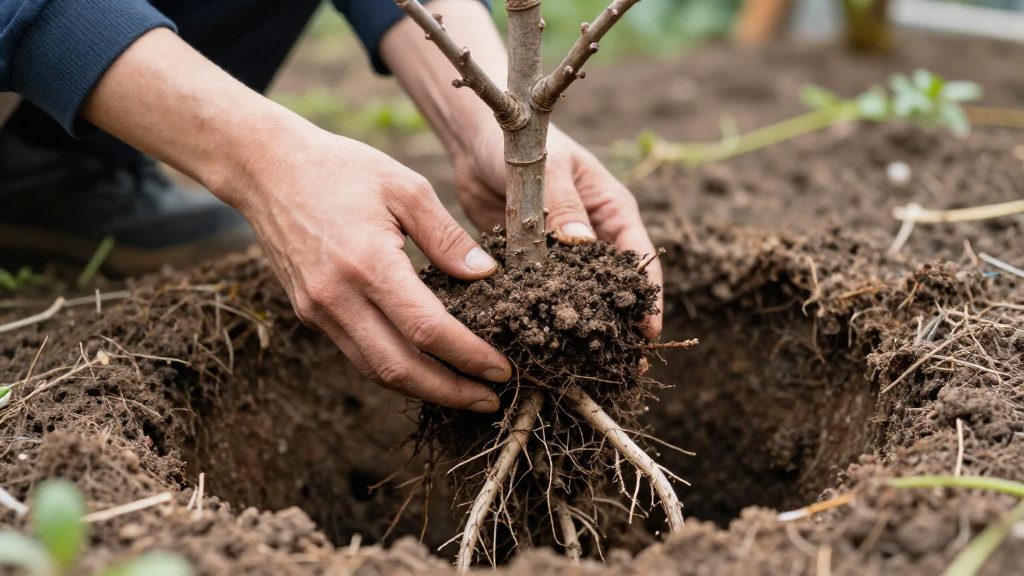
Bare-root trees are best planted while dormant: in fall after the leaves drop, or in early spring before leaves or new growth appear, according to the Arbor Day Foundation (2026). Before planting, the roots should be soaked in water for 3 to 6 hours and kept from drying out. Iowa State University Extension and Outreach (2026) adds that damaged roots should be pruned first and then soaked for 1 to 2 hours, with longer soaks also acceptable. The official sources consulted do not give fixed calendar dates, so the exact planting window depends on your region and local climate.
When to Plant a Bare-Root Tree?
Timing is set by the tree’s dormant state rather than by a single calendar date. The two planting windows are summarized below.
| Window | Timing reference | Source |
|---|---|---|
| Fall | After leaves drop | Arbor Day Foundation (2026) |
| Early spring | Before leaves or new growth appear | Arbor Day Foundation (2026) |
Planting while the tree is dormant is the timing the Arbor Day Foundation recommends for bare-root trees. Planting outside these two windows is not covered by the sources consulted.
Preparing the Roots Before Planting
Root preparation begins as soon as the tree arrives. The root soak is the key step:
- Soak the roots in water for 3 to 6 hours (Arbor Day Foundation, 2026).
- Prune damaged or broken roots first, then soak. Iowa State University Extension and Outreach (2026) gives 1 to 2 hours and notes that soaking for several hours is also acceptable.
- Keep the roots from drying out between soaking and planting.
Checking Conditions Before You Start
Before committing to a planting day, confirm that the tree is still dormant and that the ground is workable. The sources consulted do not specify soil temperature or frost thresholds for each region, so check local extension guidance for your area. Once the tree is in the ground, the first growing season requires attention: check it once or twice a week and water when the soil around the roots is dry (Iowa State University Extension and Outreach, 2026).
How to Prepare and Soak Bare-Root Roots
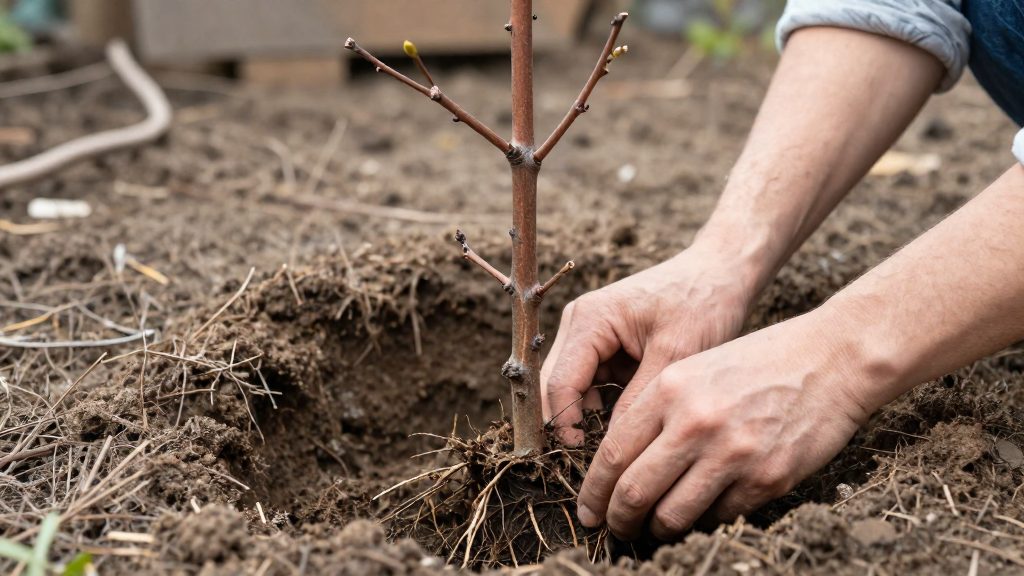
Bare-root trees are sold without soil around the roots, so root moisture is the main risk between delivery and planting. Preparation has two parts: pruning damaged roots, then soaking the root system before it goes into the ground. According to Iowa State University Extension and Outreach (2026), pruning comes first, so that the soaked roots are healthy tissue that can take up water.
Step 1: Inspect and prune the roots
- Remove roots that are broken, torn, or dried out.
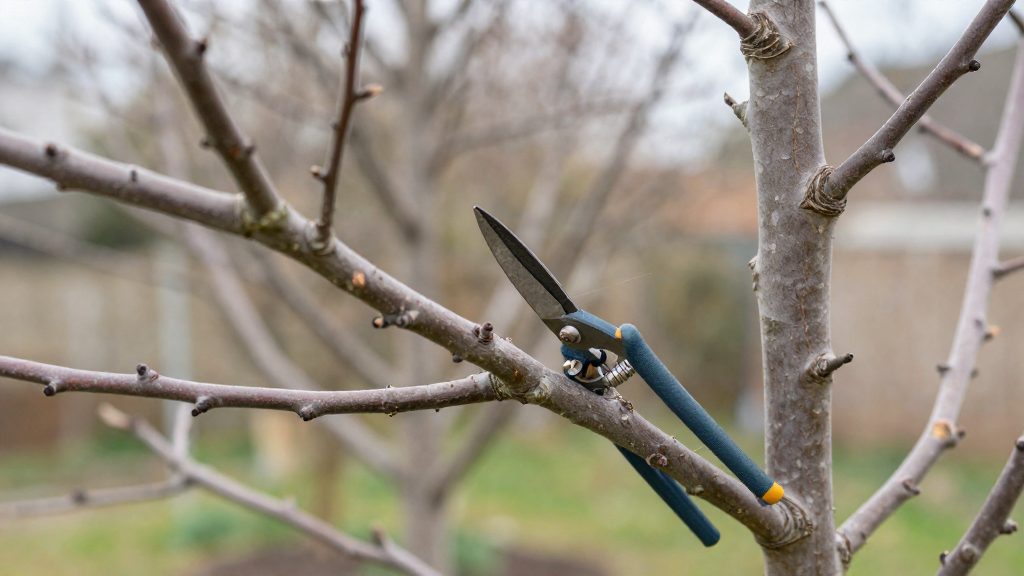
- Cut back to healthy, flexible tissue with clean, sharp pruners.
- Work quickly so the root system does not dry while it is exposed.
Step 2: Soak the roots
Sources give different soaking times. The table below shows both recommendations.
| Source | Soaking time | Condition |
|---|---|---|
| Arbor Day Foundation (2026) | 3 to 6 hours | Roots must not dry out before planting |
| Iowa State University Extension and Outreach (2026) | 1 to 2 hours | Applied after pruning damaged roots; soaking for several hours is acceptable |
Submerge the root system fully in water for the chosen period. The Arbor Day Foundation says the roots should not dry out before planting, so the soak should be timed to end shortly before the tree goes into the hole.
Step 3: Confirm planting timing
Prepare the roots only when the tree can be planted within the right window. According to the Arbor Day Foundation (2026), bare-root trees should be planted while dormant: in fall after the leaves drop, or in early spring before leaves or new growth appear. The sources consulted do not cover planting outside these periods.
What size hole should you dig?
Dig the hole 2 to 2.5 times wider than the root spread, according to Iowa State University Extension and Outreach (2026). Measure the spread across the roots as they naturally extend, because a bare-root tree has no soil ball to size the hole around.
Depth depends on the roots, not on a fixed measurement. Dig only as deep as the distance from the trunk flare (the point where the trunk widens into the roots) to the bottom of the roots. Once planting is finished, the flare should sit level with the surrounding soil.
| Hole element | Guideline |
|---|---|
| Width | 2 to 2.5 times the root spread |
| Depth | Distance from the trunk flare to the bottom of the roots |
| Surface level | Trunk flare level with the surrounding soil |
To shape the hole:
- Mark a circle at the target width and dig the outer ring first.
- Loosen the soil at the base and remove stones and clumps.
- Lay the root spread beside the hole to check its width and depth before final digging.
- Build a cone-shaped mound of soil in the center, then set the tree on top and spread the roots evenly down its sides, without bending or kinking them.
Before you backfill, confirm the flare position. The soil should not cover it, and the tree should sit at the same depth it grew in the nursery, as the Arbor Day Foundation (2026) advises.
How to Position the Tree and Backfill the Hole
Positioning a bare-root tree depends on three measurements: the width of the hole, its depth, and the height of the trunk flare, the point where the trunk widens into the roots. According to Iowa State University Extension and Outreach (2026), dig the hole 2 to 2.5 times wider than the root spread, and only as deep as the distance from the trunk flare to the bottom of the roots. The flare must sit level with the surrounding soil. Arbor Day Foundation (2026) adds that the tree should be set at the same depth it grew in the nursery.
| Element | Guideline |
|---|---|
| Hole width | 2 to 2.5 times the root spread |
| Hole depth | Distance from trunk flare to bottom of roots |
| Trunk flare | Level with surrounding soil |
| Graft union | 1 to 3 inches above the flare |
Planting steps
- Build a cone-shaped mound of soil in the bottom of the hole, then set the tree on top of it.
- Spread the roots evenly around the mound without bending or kinking them.
- Check the flare height against the surrounding soil before filling.
- Refill the hole with the original soil. Arbor Day Foundation (2026) advises against adding peat, bark, fertilizer, potting soil or chemicals, and Iowa State University Extension and Outreach (2026) gives the same no-amendment guidance.
- Water when the backfill is about three-quarters done, then again once the hole is filled to ground level. This removes air pockets around the roots (Iowa State University Extension and Outreach, 2026).
Keeping the flare at the correct height and the root system spread out before backfilling are the two steps that most directly determine how the tree settles into the soil.
How to Water and Mulch After Planting
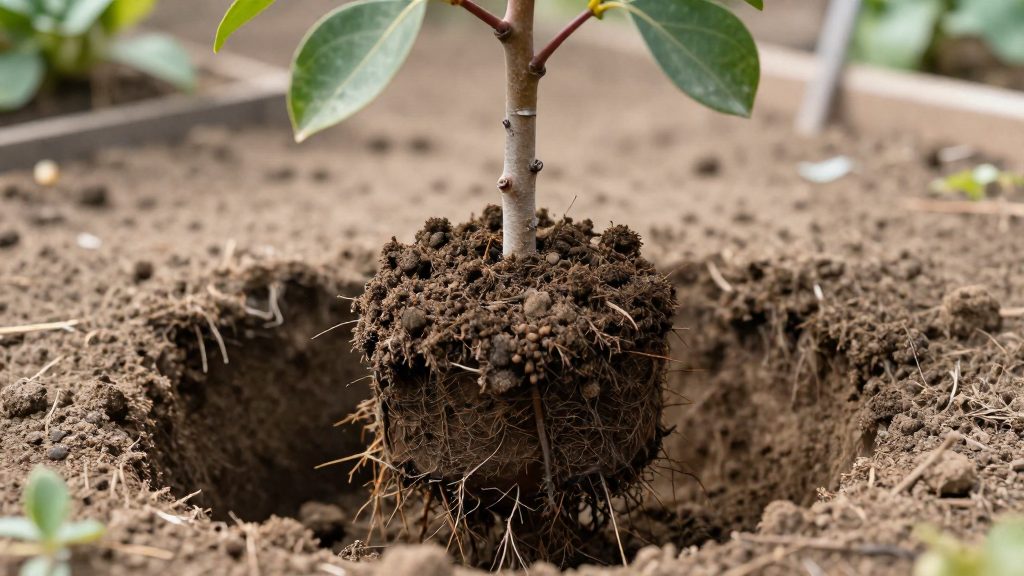
Watering and mulching after planting protect a bare-root tree while its roots re-establish in the soil. Backfill watering settles the soil and removes air pockets, and the tree then needs regular checks during its first growing season. According to Iowa State University Extension and Outreach (2026), the soil around the roots should be watered when it is dry. According to the Arbor Day Foundation (2026), mulch and deep watering in dry weather are both part of the first-year routine.
Watering during backfill
Refill the hole with the original soil, without adding amendments. Water when the backfill is about three-quarters done, then water again at ground level. The second watering removes remaining air pockets around the roots.
Watering schedule
| Stage | Watering action |
|---|---|
| Backfilling | Water at about three-quarters full, then again at ground level |
| First growing season | Check the tree once or twice a week; water when the soil around the roots is dry |
| Dry weather, first year | Water deeply every 7 to 10 days |
| Years 2 and 3 | Keep watering during dry conditions |
Deep watering means soaking the root zone thoroughly rather than wetting only the surface. Checking the soil by hand before each watering helps avoid both drought stress and waterlogging.
Mulching the root zone
Spread about 5 cm (2 in) of mulch in a circle roughly 1 m (3 ft) wide around the tree. Keep the mulch away from the trunk. The sources consulted do not specify a mulch material.
Common Mistakes to Avoid
Several planting errors are easy to avoid: roots that dry out, incorrect planting depth, and additives in the planting hole. The table below lists each mistake with the practice the Arbor Day Foundation (2026) and Iowa State University Extension and Outreach (2026) recommend instead.
| Mistake | Recommended practice | Source |
|---|---|---|
| Letting roots dry out before planting | Soak roots in water for 3 to 6 hours, or 1 to 2 hours at minimum | Arbor Day Foundation (2026); Iowa State University Extension and Outreach (2026) |
| Planting too deep | Keep the trunk flare level with the surrounding soil | Iowa State University Extension and Outreach (2026) |
| Digging a hole that is too narrow or too deep | Dig 2 to 2.5 times wider than the root spread, and only as deep as the distance from the trunk flare to the bottom of the roots | Iowa State University Extension and Outreach (2026) |
| Adding amendments to the backfill | Backfill with the original soil only, without peat, bark, fertilizer, potting soil or chemicals | Arbor Day Foundation (2026); Iowa State University Extension and Outreach (2026) |
| Bending or kinking roots | Spread roots evenly and prune damaged or broken roots before planting | Iowa State University Extension and Outreach (2026) |
| Leaving air pockets in the soil | Water when the backfill is about three-quarters done, then again at ground level | Iowa State University Extension and Outreach (2026) |
| Piling mulch against the trunk | Spread about 5 cm (2 in) of mulch in a circle about 1 m (3 ft) wide, away from the trunk | Arbor Day Foundation (2026) |
| Planting outside the dormant period | Plant in fall after leaves drop, or in early spring before leaves or new growth appear | Arbor Day Foundation (2026) |
Watering also matters in the first seasons. In the first growing season, check the tree once or twice a week and water when the soil around the roots is dry. In dry weather, the Arbor Day Foundation (2026) advises watering deeply every 7 to 10 days during the first year. Iowa State University Extension and Outreach (2026) recommends continuing to water in dry conditions during years 2 and 3.
Wildlife damage is another avoidable loss. The Arbor Day Foundation (2026) suggests fencing, such as chicken wire, where rabbits, deer or other wildlife visit the site.
Protecting the Young Tree from Wildlife
Rabbits, deer and other wildlife can visit a newly planted bare-root tree. The Arbor Day Foundation (2026) suggests fencing, such as chicken wire, when these animals use the site, so plan the fence before or at planting rather than after damage appears. The official sources consulted do not specify fence height, mesh size or other deterrents, so choose these based on the animals active in your area.
When to Fence
- Fencing is the protection named in the consulted guidance for wildlife visits. Install it at planting time if you have seen signs of rabbits or deer nearby.
- Set the fence around the tree before the first growing season, while the root zone is still open and easy to reach.
- Check the fence regularly during the first growing season.
Keeping the Trunk Base Visible
Spread about 5 cm (2 in) of mulch in a circle about 1 m (3 ft) wide, keeping it away from the trunk, as the Arbor Day Foundation (2026) advises. A clear trunk base makes it easier to spot gnawing or other damage at ground level.
Inspecting the Tree
During the first growing season, check the tree once or twice a week, as recommended by Iowa State University Extension and Outreach (2026). Use these checks to look for:
- Bark that has been gnawed or stripped near the base
- Stems that are broken, bent or trampled
- Soil dug up or disturbed around the roots
Report any new damage early, and repair or reinforce the fence the same day if an animal has gotten through.
Frequently asked questions
When is the right time of year to plant a bare-root tree?
Plant during the dormant period, either in autumn after the leaves have fallen or in early spring before buds open and new growth appears, according to the Arbor Day Foundation (2026). The official sources consulted do not give fixed calendar dates, so your local climate determines the exact window.
How long should I soak the roots, and what if some are damaged?
The Arbor Day Foundation (2026) recommends soaking the roots for 3 to 6 hours. Iowa State University Extension and Outreach (2026) advises first trimming any damaged or broken roots, then soaking them for 1 to 2 hours, and notes that longer soaks are also acceptable.
Should I add fertilizer, compost or potting mix to the planting hole?
No. The Arbor Day Foundation (2026) advises against adding peat, bark, fertilizer, potting soil or chemicals to the hole, so backfill with the original soil. Iowa State University Extension and Outreach (2026) also recommends watering when the backfill is about three-quarters done to remove air pockets.