
The sources consulted do not specify why squash bugs select zucchini over other cucurbits, so the points below cover what they document about plant sensitivity, plant age and stress.
Pourquoi la zucchini subit-elle davantage les dégâts des punaises de la courge ?
Zucchini’s higher sensitivity to feeding
Squash bugs feed on squash plants, and the damage they cause is not equal across types. Utah State University Extension (2026) identifies zucchini as the summer squash most sensitive to feeding, while other summer varieties and most winter squash tolerate it better.
| Squash type | Tolerance to squash bug feeding |
|---|---|
| Zucchini (summer squash) | Most sensitive |
| Other summer squash varieties | Tolerate feeding better |
| Most winter squash | Tolerate feeding better |
Because of this difference, zucchini is the plant to watch most closely when several squash types grow in the same bed.
Young plants are more vulnerable early in the season
NC State Extension, Forsyth County, states that young plants are more vulnerable to squash bugs. For that reason, the guidance is to control the bugs early in the season rather than waiting until the plants are established. Young zucchini plants have less foliage to spare, so the period right after transplanting or emergence is when losses are most likely to matter.
Regular checks from the first true leaves onward let you catch an infestation while it is still small. The sources consulted do not give a specific calendar date for when this early period ends.
Water stress and crowding
NC State Extension, Forsyth County, advises avoiding water stress and crowding in squash beds. The same source groups these conditions with the advice on young plants, but the official sources consulted do not explain the mechanism that links stress or crowding to higher vulnerability.
In practice, this means:
- Keep soil moisture steady so plants do not run short of water.
- Space plants so they are not competing with each other for light, water and room.
- If populations are rising, remove mulch, since the same source says bugs hide in it.
How do you recognize squash bugs and their eggs?
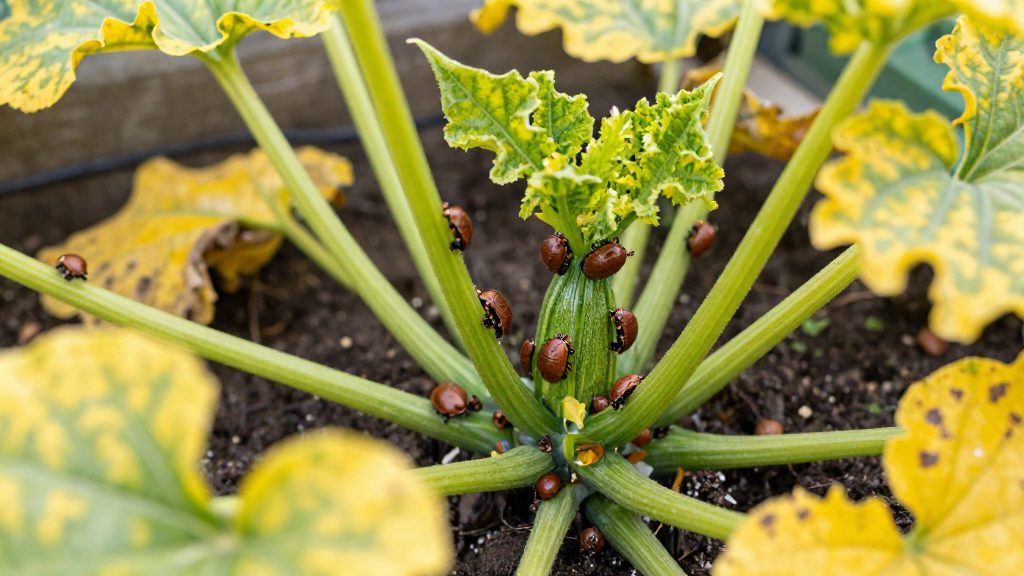
Squash bugs are confirmed by inspecting the leaf undersides, stems and plant bases, where their eggs and young stages are found. The official sources consulted do not specify adult body size, shape or detailed coloring, so the criteria below focus on where to look and on the features the sources describe.
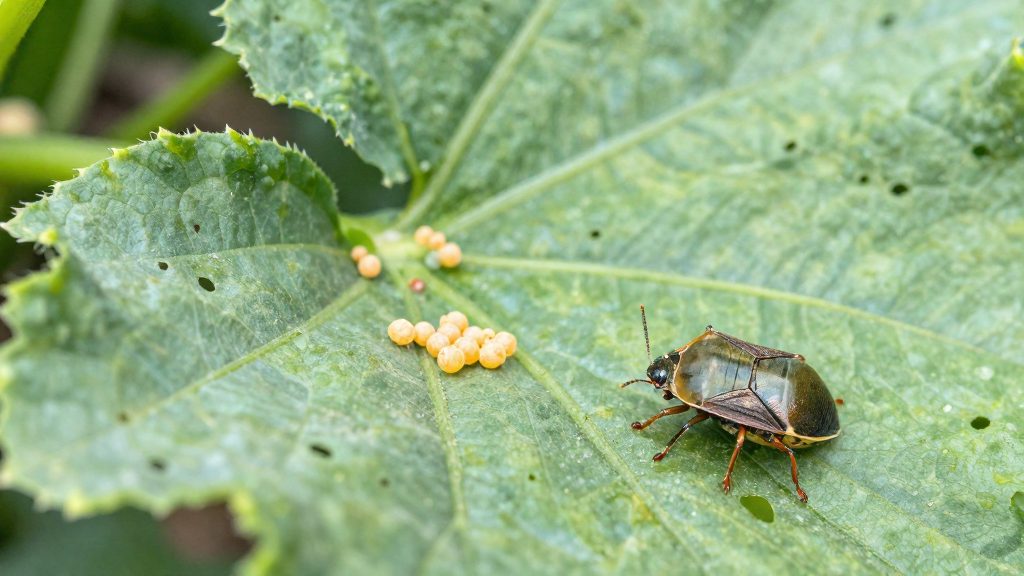
Egg masses are the most distinctive sign. Iowa State University Extension and Outreach (2026) describes the eggs as brick-red masses laid on leaf undersides. NC State Extension (Forsyth County) notes that females often lay copper-colored egg clusters where two leaf veins meet or on stems.
Nymphs are the young stages. Utah State University Extension (2026) places small nymphs on leaf undersides or near the plant base, so these areas should be inspected first when a plant shows signs of feeding damage. The sources consulted do not specify how to separate nymph stages by size or color.
Adults are harder to see during the day. Utah State University Extension (2026) reports that squash bugs hide under boards at night. NC State Extension (Forsyth County) reports that boards, newspaper or cardboard placed near the plants collect bugs overnight, which makes them useful for confirming that adults are present.
| Stage | Where to look | Source |
|---|---|---|
| Egg masses | Leaf undersides, where two veins meet, stems | Iowa State University Extension and Outreach (2026); NC State Extension (Forsyth County) |
| Nymphs | Leaf undersides, near the plant base | Utah State University Extension (2026) |
| Adults | Under boards or cardboard placed near plants | Utah State University Extension (2026); NC State Extension (Forsyth County) |
Boards and hand-picking: simple daily controls
Boards work as shelter traps for squash bugs. The insects hide under boards at night, so a board placed near the plants gives them a sheltered spot, and lifting it the next morning exposes them. According to Utah State University Extension (2026), this method works best in small gardens.
Setting up the traps
- Place boards near the zucchini plants in the evening. Keep them close to the plants, not in a separate part of the garden.
- Newspaper or cardboard can be used in place of boards. NC State Extension, Forsyth County, notes that these materials also collect bugs overnight.
Morning inspection and removal
The morning inspection is the core of the routine. Lift each trap, check its underside, and remove any bugs found there. The steps are:
| Routine step | Timing | Action |
|---|---|---|
| Place traps | Evening | Lay boards, newspaper or cardboard near the plants |
| Inspect | Every morning | Lift each trap and look for bugs sheltering beneath |
| Remove bugs | Every morning | Knock adults into a bucket of soapy water, or destroy them |
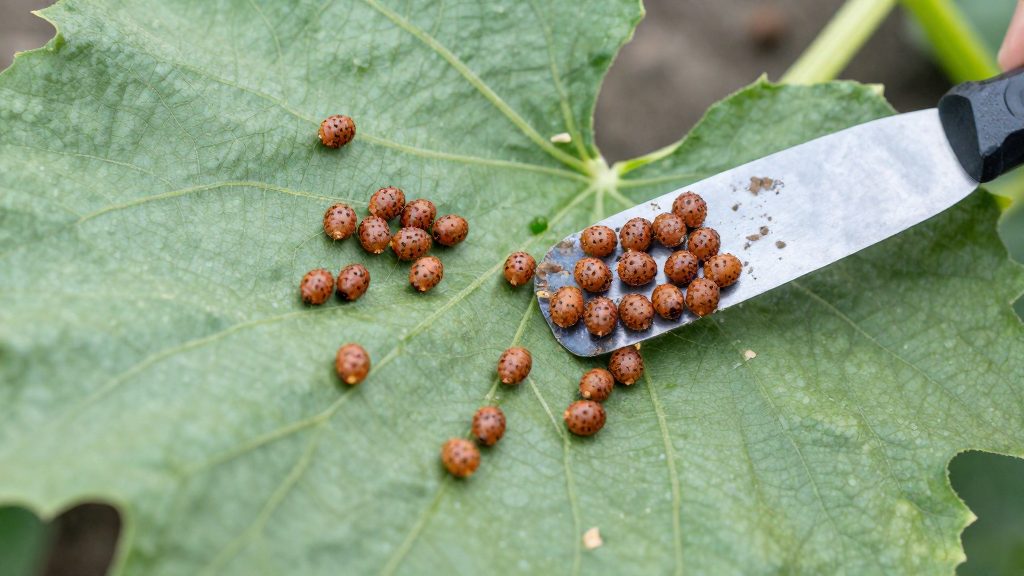
Knocking bugs into soapy water is hand-picking. NC State Extension, Forsyth County, notes that this works best for a few plants.
Where the method fits
The traps and hand-picking suit small plantings with few plants. The official sources consulted do not specify a number of traps per plant or a method for larger plantings.
How do you destroy squash bug eggs?
Squash bug eggs are destroyed by hand, and timing is the key factor: the egg masses should be crushed before the nymphs hatch. According to Iowa State University Extension and Outreach (2026), brick-red egg masses should be removed by hand, along with any adults present. NC State Extension, Forsyth County, describes the clusters as copper-colored and advises crushing them.
How to remove them
- Start with the lower leaves and check the egg locations listed in the identification table above.
- Crush each egg cluster with your thumb or a finger.
- Remove any adults you find alongside the eggs, as Iowa State University Extension and Outreach (2026) recommends.
- Repeat the check on the same plants, since new clusters can appear after an earlier inspection.
Timing before hatching
The official sources consulted do not specify the number of days between laying and hatching, so inspections should be regular rather than tied to a fixed schedule.
Garden cleanup and mulch management
Removing spent squash plants after harvest and clearing the places where adults overwinter are the cleanup steps that extension guidance links to lower squash bug numbers the following year. Adults spend winter in wood piles, sheds, and plant debris. Reducing these overwintering sites limits how many bugs survive to colonize new plants in spring. These steps reduce next season’s population. They do not control bugs that are already active in the current season.
Removing plants after harvest
Pull zucchini and other squash plants out once harvest is complete rather than leaving them standing. According to Utah State University Extension (2026), removing plants after harvest keeps bug numbers from building up for the next year. Clearing plant debris in the fall matters for the same reason, because NC State Extension, Forsyth County, notes that adults overwinter in that debris.
Clearing overwintering shelter
Wood piles and sheds near the garden give adults a sheltered place to pass the winter. Utah State University Extension (2026) advises reducing these hiding places, since doing so can lower the next year’s numbers. The sources name wood piles and sheds as overwintering shelter. Removing or relocating them away from the bed reduces the number of sheltered adults nearby.
Mulch as a possible hiding place
NC State Extension, Forsyth County, lists mulch among places where squash bugs hide, and advises removing it when populations are rising. The evidence on this point is limited. The sources consulted do not specify how much mulch contributes to bug numbers, or how much removing it changes outcomes. Lifting mulch to check for bugs when populations increase is a low-cost step, but it should not be treated as a proven control.
| Action | Target | Reported by |
|---|---|---|
| Remove squash plants after harvest | Bug build-up for the next year | Utah State University Extension (2026) |
| Clear plant debris in the fall | Adults overwintering in debris | NC State Extension, Forsyth County |
| Reduce wood piles and sheds | Adult overwintering sites | Utah State University Extension (2026) |
| Remove mulch when populations rise | Hiding places in mulch | NC State Extension, Forsyth County |
Do insecticides work against squash bugs?
Insecticides give limited control of squash bugs. Utah State University Extension (2026) describes these pests as hard to control, noting that insecticides are not very effective and work best on very young nymphs. Insecticides work best as one step within a broader control plan, not as a stand-alone fix. The official sources consulted do not specify product names, active ingredients or application rates, so none are recommended here.
Timing: target very young nymphs
Spray timing is the main factor in whether an insecticide has any effect:
- Insecticide treatment is aimed mainly at small nymphs, according to Iowa State University Extension and Outreach (2026).
- Utah State University Extension (2026) advises spraying only after small nymphs are confirmed, because older bugs are less affected.
- The official sources consulted do not specify results against adults or larger nymphs, so an insecticide should not be expected to clear an established population.
The sources describe insecticides as not very effective, so rely on hand removal and cleanup alongside any spraying.
Sprays are preferred over dusts
For application, sprays outperform dusts. Iowa State University Extension and Outreach (2026) states that sprays work better than dusts. When applying a spray:
- Cover the undersides of leaves, where the nymphs are concentrated.
- Treat the plant base as well, as the nymphs can gather there.
- Apply during a period when the target nymphs are present, not on a fixed calendar date.
When should you plant zucchini in Canada?
The official sources consulted for this article, including Utah State University Extension, Iowa State University Extension and Outreach, and NC State Extension, do not give Canadian planting dates, frost dates or hardiness zones. No calendar date for sowing or transplanting zucchini in Canada can be confirmed from these sources, so the timing has to be set from local conditions.
The practical reference point is your local last spring frost date. Zucchini is a warm-season crop, so the usual approach is to start planting after the risk of frost has passed in your area. Your regional weather service or a local extension office can provide this date for your town or city. Record it once and use it each year to plan sowing or transplanting.
To place your garden in a regional planting context, look up your hardiness zone. Canada’s hardiness zones describe average winter cold, and they help you compare your site with regional growing guidance. Because the consulted sources do not cover Canadian zones, use a Canadian reference for this lookup and not a zone map from another country.
Work through the timing in this order:
- Find your local last spring frost date from a Canadian weather source.
- Identify your hardiness zone for regional context.
- Count back from the frost-free date to decide when to sow indoors or to transplant outdoors.
- Check the forecast before transplanting, since a late cold snap can damage young plants.
Microclimates matter. A south-facing wall, a raised bed or a sheltered corner can warm up sooner than an open lawn in the same town, so the same frost date may apply differently across your property.