Why is clay soil a problem for vegetables?
Clay soil limits vegetables mainly through its physical structure. Its particles are very fine and pack tightly together, so water moves through slowly, air fills fewer spaces, and roots can sit in saturated soil after rain or irrigation. The problem is less about fertility than about how clay holds water and air. Clay can still grow vegetables, but the physical constraints shape which amendments and bed-building methods work.
Fine particles drain slowly. Clay particles are much smaller than sand or silt particles, so the spaces between them are small. Water passes through these spaces slowly, and after heavy rain the root zone can stay saturated for longer than vegetable roots tolerate. Waterlogged roots have less access to oxygen, so plants may wilt or grow poorly even when total rainfall or irrigation is not excessive.
Compaction reduces oxygen in saturated clay. When wet clay is walked on, worked, or tilled, its particles press closer together and the remaining pore space shrinks. According to Oregon State University Extension Service (US), over-tilling can create a dense layer that impedes roots and drainage. Compacted clay therefore compounds the drainage problem, because water and air both have fewer routes through the soil.
Clay holds nutrients and water well, with trade-offs. The same fine particles that slow drainage also retain water and nutrients that would otherwise leach away. The trade-off is that retention and drainage move in opposite directions: a bed that holds moisture well also drains more slowly. The official sources consulted do not specify exact nutrient-holding capacities for clay, so no figures are given here.
Test your soil first
Before you choose an amendment, confirm the bed is clay and measure how it drains. Soil texture determines how the bed should be worked and how much organic matter it can use. Drainage speed shows whether water stays around the roots. A soil test from a laboratory adds the chemical picture, covering pH and nutrient levels, which determines whether lime or fertilizer is needed at all.
Ribbon or jar test
The ribbon test is a hands-on check. Remove stones and roots from a handful of moist soil, then press it between thumb and forefinger to push out a ribbon. Clay soil forms a long, flexible ribbon that holds together. Sandier soil crumbles and does not form a ribbon. Test several spots across the bed, because texture can change over a short distance.
The jar test separates particles by size. Fill a clear jar about halfway with soil, add water until nearly full, shake vigorously, and let it settle undisturbed. Sand settles first, then silt, and clay stays suspended longest. A thick top layer of fine material indicates a clay-dominated soil. Record the layer proportions for each site so you can compare them later.
Percolation test
Dig a hole in the bed, fill it with water, and time how long the water takes to drain away. Repeat the test after the first fill has drained, because dry clay absorbs water differently from saturated clay. Slow drainage, where water still stands long after watering, points to dense or compacted soil that will keep roots waterlogged. Avoid testing right after heavy rain, since the result then reflects the weather rather than the bed.
Lab soil test for pH and nutrients
Field tests cannot measure pH or nutrient levels. Collect samples from several points in the bed, mix them together, and send them to an accredited soil testing laboratory in your province. The report gives the values needed to decide what to add. NC State Extension, Henderson County (US) recommends doing a soil test before liming or fertilizing. The official sources consulted do not specify a single sampling depth or frequency for every region, so follow the laboratory’s instructions.
How much compost should you add to clay?
For heavy clay vegetable beds, Oregon State University Extension Service (US) recommends spreading 1–3 inches (about 2.5–7.5 cm) of composted organic matter over the bed. NC State Extension, Henderson County (US) gives a wider range of 1–4 inches over the whole planting area. Thickness is the value you control. The bed’s surface area then determines how much compost you need in total.
Typical rate: one to three inches
Spread the compost evenly across the full bed surface. Each source gives its own range for clay (1–3 inches and 1–4 inches). The official sources consulted do not specify how to choose a value within the range for a particular bed, so the choice depends on how dense and compacted your soil is.
Add composted organic matter every year, not as a one-time treatment. Repeated additions are what gradually improve the structure of clay soil.
Any compost type is acceptable
NC State Extension, Henderson County (US) states that any compost works for this purpose. Homemade compost, bagged compost, and other finished organic material all fall within that guidance. The key requirement is that the material is composted, so it is stable and not raw organic matter.
Calculating the volume: bed area × thickness
Use this method to estimate how much compost to buy or prepare:
- Measure the bed’s length and width in feet.
- Multiply length × width to get the area in square feet.
- Convert the target thickness from inches to feet by dividing by 12.
- Multiply bed area × thickness to get the volume in cubic feet.
- Divide cubic feet by 27 to get cubic yards. Canadian suppliers often sell bulk compost by the cubic metre (1 cubic yard ≈ 0.76 m³), so check which unit your supplier uses.
For a 4 ft × 8 ft bed (32 square feet):
| Thickness | Thickness in feet | Volume needed |
|---|---|---|
| 1 inch | 0.083 ft | 2.67 cubic feet |
| 2 inches | 0.167 ft | 5.33 cubic feet |
| 3 inches | 0.25 ft | 8.00 cubic feet |
| 4 inches | 0.333 ft | 10.67 cubic feet |
At 3 inches, that bed needs about 8 cubic feet, or roughly 0.3 cubic yards, of compost. Because the volume scales directly with area, a bed twice as large needs twice the compost at the same thickness.
How deep should you work it in?
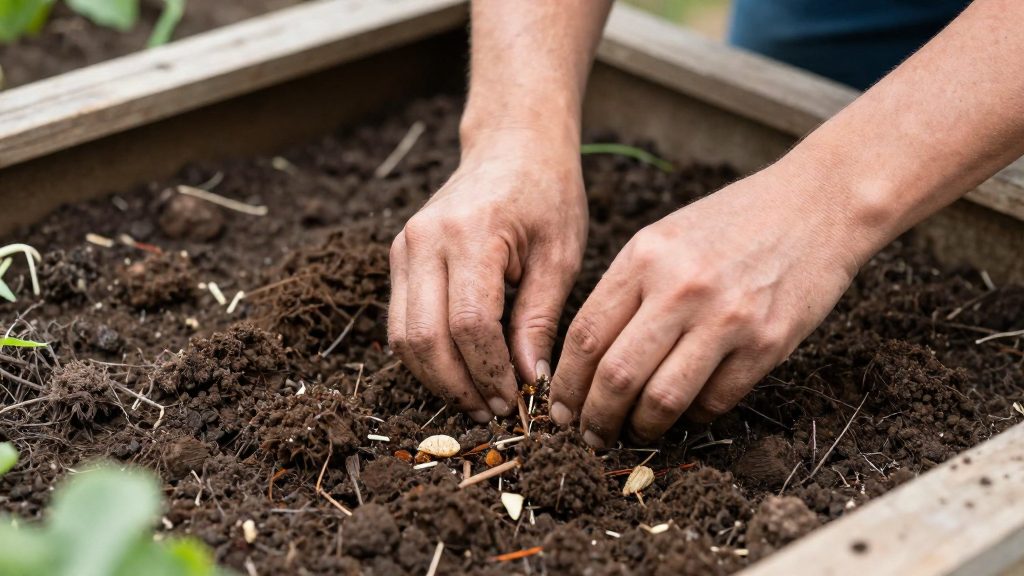
Work compost into the top 6 to 8 inches (about 15–20 cm) of clay soil. The Oregon State University Extension Service (US) recommends this depth. The Oregon State University Extension Service (US) recommends this depth, and NC State Extension, Henderson County (US) gives a slightly shallower target of the top six inches. Mixing the amendment into this zone, rather than leaving it on the surface, puts organic matter where roots and soil organisms are active.
Limit the number of passes
| Step | Action | Purpose |
|---|---|---|
| 1 | Spread the organic matter evenly over the bed surface | Uniform coverage before mixing |
| 2 | First pass: work it into the top 6 to 8 inches | Incorporate the amendment into the root zone |
| 3 | Second pass only if the mix is uneven | — |
Amend the whole bed
Treat the entire planting area, not only individual planting holes. NC State Extension, Henderson County (US) advises amending the wider area rather than just the planting hole. Amending only the holes leaves the surrounding clay unchanged, so roots would still meet dense, unamended soil once they leave the hole. Spread and work the amendment across the full bed so the root zone of every plant has the same soil structure.
Should you add sand or gypsum?
Sand alone is a poor fix for heavy clay. According to Oregon State University Extension Service (US), sand does not hold water or nutrients well, and it can increase compaction in silt or clay soils. Gypsum works differently. According to NC State Extension, Henderson County (US), it supplies calcium without changing pH and helps water infiltration, aeration and structure. For clay vegetable beds, rely on composted organic matter and treat gypsum as a targeted addition rather than using sand.
Why sand alone can increase clay compaction
Adding sand alone to clay does not give the bed a better structure. Oregon State University Extension Service (US) advises pairing any sand with an organic amendment, or skipping it. Without that organic component, the mix can pack down more tightly, which restricts roots and drainage. The official sources consulted do not specify a sand-to-clay ratio at which this effect begins, so no proportion is recommended here.
Gypsum supplies calcium without changing pH
Gypsum adds calcium while leaving pH unchanged, so it affects the soil’s structure and calcium content without shifting its acidity or alkalinity. This makes it a useful option when a pH change is not wanted. NC State Extension, Henderson County (US), describes it as a way to improve clay conditions without that side effect.
Gypsum effects on infiltration and aeration
Gypsum helps soil in three ways, as described by NC State Extension, Henderson County (US): it helps water infiltration, aeration and structure.
| Amendment | Documented effect on clay soil | Source |
|---|---|---|
| Sand alone | Does not hold water or nutrients well; can increase compaction | Oregon State University Extension Service (US) |
| Sand with organic matter | Pairing is recommended if sand is used | Oregon State University Extension Service (US) |
| Gypsum | Supplies calcium without changing pH | NC State Extension, Henderson County (US) |
| Gypsum | Helps water infiltration, aeration and structure | NC State Extension, Henderson County (US) |
Raised beds and mulch for heavy soil
Raised beds are an alternative approach to poorly draining clay, and mulch can be used with any bed. The sources consulted document only the mulch advice below. A raised bed puts the root zone in a loose growing medium above the native clay, which stays in place below. Mulch protects the surface of the bed once plants are in. The official sources consulted do not give a specific height for raised beds on clay, so the choices below are based on method rather than measurements.
Raised bed height
The sources consulted do not specify a recommended bed height for poorly draining clay. Choose a height that suits the gardener’s access and the depth of the planned soil mix. Avoid heavy digging of the clay beneath the bed.
Mulch after planting
According to Oregon State University Extension Service (US), mulching after planting helps hold moisture and keeps building the soil. The sources consulted do not specify a mulch depth or material for clay beds. Apply the mulch over the soil surface once planting is complete, and keep adding organic matter as part of routine bed care.
Imported soil mix
The sources consulted do not give a formula for the mix, so the proportions should be set by the gardener.
How often should you amend clay beds?
Clay beds need composted organic matter added every year, not only when the bed is first built. According to Oregon State University Extension Service (US), compost should be added each year, and mulch applied after planting helps hold moisture while the soil keeps improving. Treat the annual addition as routine maintenance. Each growing season the organic matter in the bed breaks down, so without regular additions the structure built in earlier years can weaken.
Annual maintenance cycle
| Task | Frequency | Detail |
|---|---|---|
| Add composted organic matter | Every year | — |
| Work it into the soil | Each time compost is added | — |
| Soil test | Before liming or fertilizing | Recommended by NC State Extension, Henderson County (US) |
Observing drainage between seasons
Improved drainage is the expected result of regular amendment. NC State Extension, Henderson County (US) lists water infiltration, aeration and structure among the benefits of amending the wider bed area. To track progress, compare the bed from one season to the next:
- Note how quickly water soaks in after a heavy rain or irrigation.
- Check whether puddles still form on the surface after the water has soaked in.
- Look for a crumbly texture when you dig, instead of a sticky or compacted one.
The official sources consulted do not specify how many seasons this change takes, so judge it by what you see in your own bed.
Adjusting rates over time
The official sources consulted do not specify a schedule for reducing application as soil organic matter rises. As the bed improves, base any decision to add less on its observed condition: drainage, texture and how easily roots penetrate the soil. Keep the annual addition in place unless the bed clearly stays well structured across several seasons.
Frequently asked questions
How deep should I work compost into clay soil for a vegetable bed?
According to Oregon State University Extension Service (US), spread 1 to 3 inches (about 2.5 to 7.5 cm) of composted organic matter over the bed and work it into the top 6 to 8 inches (about 15 to 20 cm). Limit yourself to a couple of passes with a fork or tiller, because over-tilling can form a dense layer that blocks roots and drainage.
Can I use sand to loosen clay soil instead of compost?
Not on its own. According to Oregon State University Extension Service (US), sand alone does not hold water or nutrients well and can increase compaction in silt or clay soils. If you add sand, pair it with organic matter such as compost, or skip it entirely.
How do I know whether my clay bed needs gypsum or lime?
According to NC State Extension, Henderson County (US), run a soil test before liming or fertilizing. Gypsum supplies calcium without changing pH and can improve water infiltration, aeration and structure, so spread it across the wider planting area rather than only in the planting hole.