In Canada, garlic is planted in fall, and the exact window depends on region. On the Prairies, the University of Saskatchewan (2026) advises planting between late August and early October, up to three weeks before the soil freezes. In Ontario, the Government of Ontario (OMAFRA, 2026) recommends fall planting, although spring planting is possible, but it gives no specific calendar dates in the sources consulted. Planting too early exposes emerged shoots to winter damage, while planting too late can prevent adequate root growth and reduce winter hardiness.
When to Plant Garlic in Fall in Canada?
The planting date for garlic is tied to when the soil freezes in your area, so the local window matters more than a single national date. The table below lists the recommendations from each source.
| Region | Source | Recommended timing |
|---|---|---|
| Prairies | University of Saskatchewan (2026) | Late August to early October, up to three weeks before the soil freezes |
| Ontario | Government of Ontario (OMAFRA, 2026) | Fall planting recommended; spring planting possible |
Why timing matters
Garlic needs enough time in the ground to establish roots before winter. The two sources describe the risks at each end of the window:
- Too early: Shoots that have already emerged are exposed to winter damage. On the Prairies, planting too early in warm weather can push shoots out of the soil.
- Too late: Roots do not establish sufficiently, which reduces winter hardiness.
Planting and mulching steps
- Depth (Prairies): Plant cloves 5 to 10 cm deep, with the pointed end facing up (University of Saskatchewan, 2026).
- Spacing on the Prairies: About 7 to 8 cm within the row and 30 cm between rows.
- Spacing in Ontario: 7 to 12 cm within the row, with rows at least 20 cm apart. Smaller-bulb types such as Artichoke take the 7 cm spacing, and larger-bulb types such as Porcelain take up to 12 cm.
- Winter mulch: The University of Saskatchewan recommends 15 to 20 cm of mulch for winter. OMAFRA describes the most common straw mulch as applied 10 to 15 cm deep directly over the rows, and it must be free of pests, diseases, and weed seeds.
- Spring: On the Prairies, remove part of the mulch in spring and leave enough around the shoots to protect them.
Planting dates by region
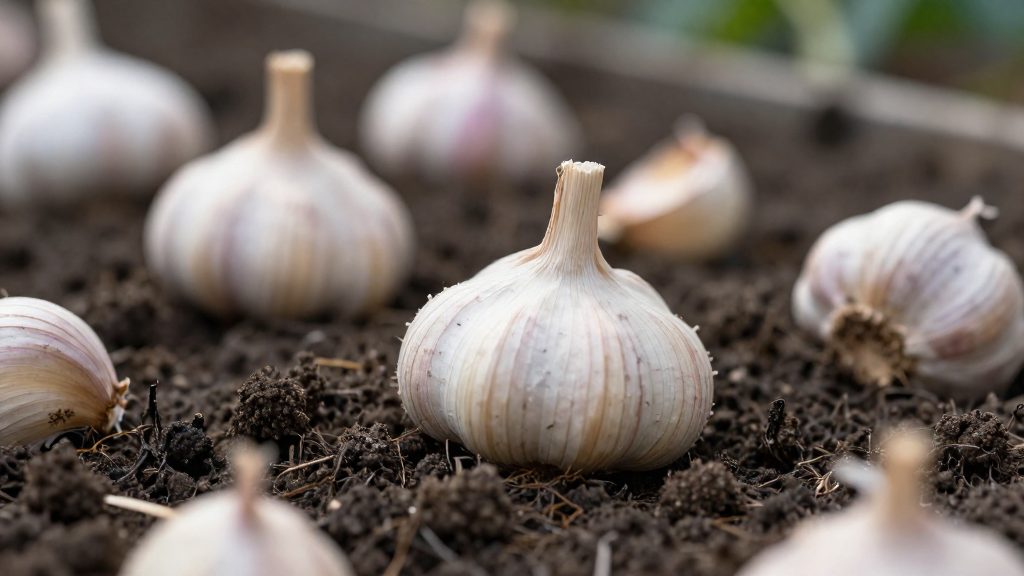
On the Prairies, garlic is planted between late August and early October, up to three weeks before the soil freezes. According to the University of Saskatchewan (2026), planting in this window lets the cloves establish roots before winter. In Ontario, garlic is grown as a winter annual: it is planted in autumn and harvested the following summer. The Government of Ontario (OMAFRA) (2026) recommends autumn planting, although spring planting is possible.
| Region | Planting window | Source |
|---|---|---|
| Prairies | Late August to early October, up to three weeks before the soil freezes | University of Saskatchewan (2026) |
| Ontario | Autumn is recommended; spring planting is possible | Government of Ontario (OMAFRA) (2026) |
Why timing matters
Planting timing affects both early growth and winter hardiness. The Government of Ontario (OMAFRA) (2026) gives the following guidance:
- Too early in autumn: shoots that have already emerged are exposed to winter damage.
- Too late in autumn: the cloves may not root sufficiently, which reduces winter hardiness.
Practical steps for autumn planting
- Check the local first-freeze date from regional weather forecasts or your local extension service.
- Count back about three weeks from the expected ground freeze on the Prairies. This is the latest point the University of Saskatchewan (2026) describes as suitable.
- In Ontario, plan the planting for autumn, since OMAFRA (2026) recommends it over spring.
- After planting, apply winter mulch. The University of Saskatchewan (2026) recommends 15 to 20 cm, and OMAFRA (2026) describes a common straw mulch of 10 to 15 cm applied directly over the rows.
The official sources consulted do not specify planting windows for other Canadian regions, including the Atlantic provinces, British Columbia, and Quebec. For those areas, local agricultural extension services are the most reliable reference.
Why Planting Too Early or Too Late Hurts Garlic
Garlic planting timing in Canada balances two failure modes: planting so early that shoots emerge before winter, and planting so late that roots never establish. In the Prairies, the University of Saskatchewan (2026) gives a planting window from late August to early October, with planting up to three weeks before the soil freezes. In Ontario, OMAFRA gives no calendar window, but it describes the same two risks. The Government of Ontario (OMAFRA) (2026) describes garlic there as a winter annual, planted in autumn and harvested the following summer, and recommends fall planting over spring.
Planting too early creates a specific risk. According to the University of Saskatchewan (2026), planting too early in hot weather can push shoots out of the soil. OMAFRA (2026) adds that shoots already emerged in autumn are exposed to winter damage.
Planting too late creates the opposite problem. OMAFRA (2026) notes that garlic planted too late may not develop enough root establishment before winter, which reduces its winter hardiness. A clove that has not rooted well before the ground freezes enters winter with less ability to survive it.
| Planting timing | Documented outcome | Source |
|---|---|---|
| Too early, hot weather | Shoots may emerge from the soil | University of Saskatchewan (2026) |
| Too early, generally | Emerged shoots are exposed to winter damage | OMAFRA (2026) |
| Prairies window | Late August to early October, up to three weeks before soil freeze | University of Saskatchewan (2026) |
| Too late | Insufficient rooting and reduced winter hardiness | OMAFRA (2026) |
To apply the timing:
- Count back about three weeks from the expected date of soil freeze in your area.
- Plant cloves 5 to 10 cm deep, pointed end up, spaced about 7 to 8 cm apart in the row with 30 cm between rows, as the University of Saskatchewan (2026) specifies for the Prairies.
- Mulch after planting. The University of Saskatchewan (2026) recommends 15 to 20 cm for winter in the Prairies, and OMAFRA (2026) advises 10 to 15 cm of straw in Ontario.
- Use only straw free of pests, diseases, and weed seeds, per OMAFRA (2026).
Planting Depth and Clove Spacing
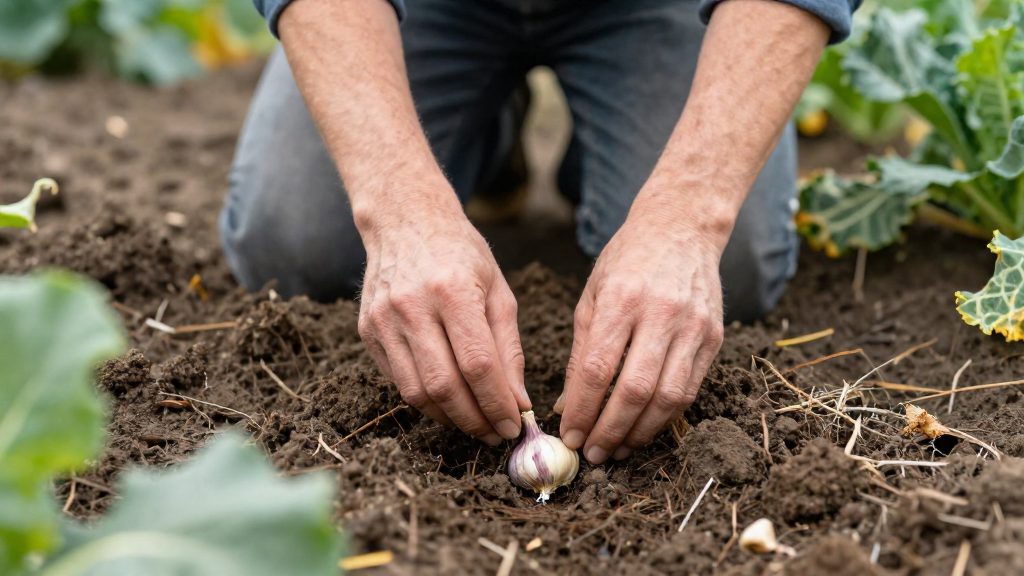
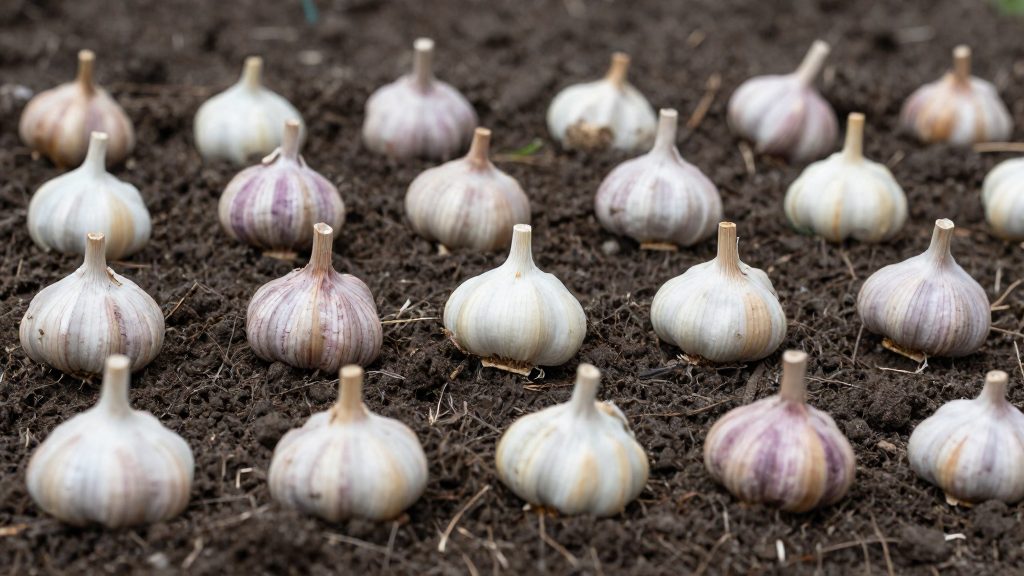
Plant garlic cloves pointed end up at a depth of 5 to 10 cm, according to the University of Saskatchewan (2026), which covers the Prairies. Within the row, cloves are spaced about 7 to 8 cm apart, with rows about 30 cm apart. Ontario guidance from the Government of Ontario (OMAFRA, 2026) gives a wider in-row range, and the correct spacing depends on the bulb type you grow.
Planting follows these steps:
- Separate the bulb into individual cloves just before planting, and keep each clove’s papery skin intact.
- Press each clove pointed end up into a furrow or hole at the target depth, then cover it fully with soil.
- Set the in-row spacing for the bulb type, then leave the full row gap before starting the next row.
Spacing varies by bulb type. OMAFRA (2026) recommends 7 cm for small-bulb types such as Artichoke and up to 12 cm for large-bulb types such as Porcelain. If you plant more than one type in the same bed, plant each type in its own rows and label them, because the spacing needs differ.
| Spacing | Prairies (University of Saskatchewan, 2026) | Ontario (OMAFRA, 2026) |
|---|---|---|
| In-row spacing | 7 to 8 cm | 7 to 12 cm, depending on bulb type |
| Row spacing | About 30 cm | At least 20 cm |
How to mulch garlic for winter
Mulching protects garlic planted in autumn through the cold months. The recommended depth depends on the region. The University of Saskatchewan (2026) advises 15 to 20 cm of mulch for winter on the Prairies, while the Government of Ontario (OMAFRA) (2026) describes straw applied at 10 to 15 cm directly over the rows. The official sources consulted do not specify an exact calendar date for applying mulch.
Choosing and applying the mulch
Straw is the most common mulch for garlic. According to OMAFRA (2026), it should be free of pests, diseases and weed seeds, so the bed does not start the season with weed competition or infected material. Spread it evenly over the planted rows so the cloves and shoots are fully covered.
| Region | Recommended mulch depth | Material | Placement | Source |
|---|---|---|---|---|
| Prairies | 15 to 20 cm | Mulch for winter (material not specified) | Not specified | University of Saskatchewan (2026) |
| Ontario | 10 to 15 cm | Straw, the most common type | Directly on the rows | OMAFRA (2026) |
Spring adjustment
In spring, do not remove all the mulch. The University of Saskatchewan (2026) recommends removing part of it and leaving enough material around the emerging shoots. This keeps a layer over the soil while allowing the shoots to grow through.
Timing and planting conditions
Mulch works best on garlic planted at the right time. OMAFRA (2026) warns that planting too early in autumn exposes emerged shoots to winter damage, while planting too late can prevent adequate root growth and reduce winter hardiness. On the Prairies, the University of Saskatchewan (2026) gives a planting window from late August to early October, and up to three weeks before the soil freezes.
When to Harvest Garlic Planted in Fall
Garlic planted in fall is harvested the following summer, not in the autumn it was planted. According to the Government of Ontario (OMAFRA, 2026), garlic is grown there as a winter annual: planted in fall and harvested the next summer. In the Prairies, the University of Saskatchewan (2026) gives a visual harvest signal instead of a calendar date: harvest when the lower third of the leaves has yellowed and dried. Because the timing depends on the plant’s condition, check the leaves rather than the calendar.
Harvest Signals by Region
| Region | Harvest timing or signal | Source |
|---|---|---|
| Prairies | Harvest when the lower third of the leaves has yellowed and dried | University of Saskatchewan (2026) |
| Ontario | Fall-planted garlic is harvested the following summer | OMAFRA (2026) |
Checking Readiness
- Inspect the lower leaves first, since they yellow before the upper leaves.
- Harvest when the lower third has yellowed and dried, not when the plants are still fully green.
- Do not wait too long once the tops have dried, because the bulbs can rot (University of Saskatchewan, 2026).
Harvesting Method
- Choose a dry day for lifting, so the bulbs are not wet when you handle them.
- Loosen the soil with a garden fork inserted well beyond the bulb, then lift the plant gently to avoid bruising or tearing the bulb.
- Brush off loose soil by hand. Do not wash the bulbs before drying.
- Dry the harvested bulbs in a shaded, airy place with good air movement.
Lifting carefully and drying promptly both protect the bulbs once they are out of the ground.
Choosing garlic varieties
Garlic varieties differ mainly in bulb size, and bulb size determines how much room each clove needs. According to the Government of Ontario (OMAFRA, 2026), the main distinction is between small-bulb types, such as Artichoke, and large-bulb types, such as Porcelain. Choose the variety first, then set the spacing to match its bulb size.
| Bulb type (OMAFRA, 2026) | Example variety | In-row spacing | Row spacing |
|---|---|---|---|
| Small bulbs | Artichoke | 7 cm | At least 20 cm |
| Large bulbs | Porcelain | Up to 12 cm | At least 20 cm |
Matching spacing to the variety
Large-bulb types need more space on the row, so the upper spacing limit of 12 cm applies to them. Small-bulb types can be planted at 7 cm. Keep rows at least 20 cm apart regardless of variety.
Growing region also changes the spacing. The University of Saskatchewan (2026) gives a spacing of about 7 to 8 cm on the row and 30 cm between rows for the Prairies. Use the regional guidance that matches your location.
Choosing a variety for your planting window
The planting window matters as much as the variety. Planting too early in fall exposes shoots that have already emerged to winter damage, and planting too late can prevent sufficient root growth and reduce winter hardiness (OMAFRA, 2026). In the Prairies, the University of Saskatchewan (2026) gives a window from late August to early October, ending about three weeks before the ground freezes.
Frequently asked questions
Can I plant garlic in fall if I live on the Prairies?
Yes. According to the University of Saskatchewan (2026), the planting window opens in late August and closes in early October, ending about three weeks before the soil freeze. Planting too early during a warm spell can push shoots out of the ground before winter.
Is fall still the right choice for garlic in Ontario?
The Government of Ontario (OMAFRA, 2026) recommends fall planting because garlic is grown there as a winter annual, planted in autumn and harvested the following summer. Spring planting is also possible, but the official sources consulted do not specify calendar dates for either season.
What should I do if I live in Quebec, British Columbia or the Atlantic provinces?
The official sources consulted do not specify planting dates for these regions, so the Prairie and Ontario windows cannot be applied directly. Check with your provincial agriculture ministry or a local extension service, and base your timing on when the ground freezes in your area.