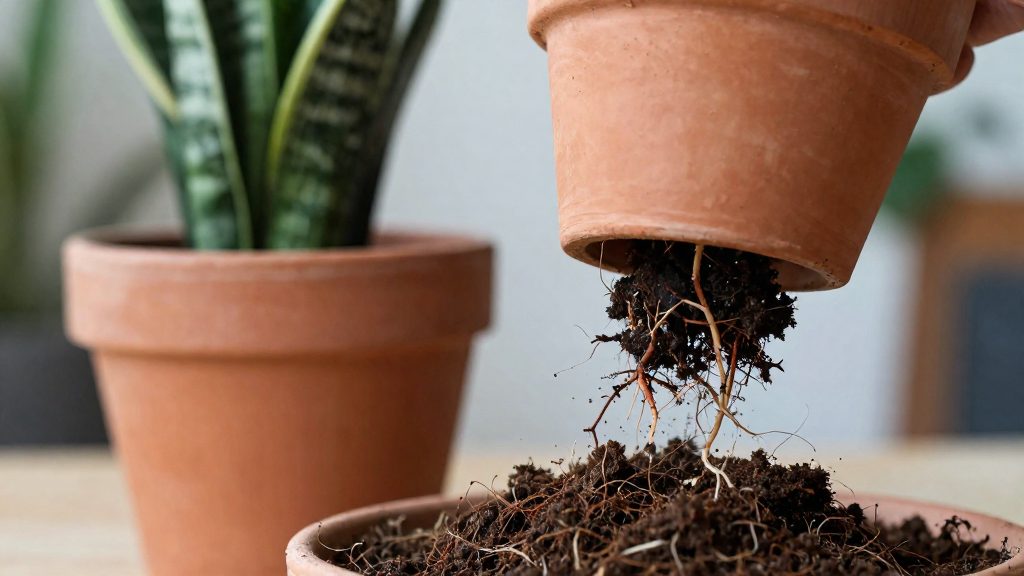
Repot a snake plant when its pot cracks or when roots grow out through the drainage holes. According to Green Matters (2026), citing the University of Arkansas Division of Agriculture, repotting is needed on average every three to five years. These physical signs should guide the decision more than the calendar alone.
When to Repot a Snake Plant
Check the plant before setting a schedule. The two clearest indicators are:
- Cracked pot: a split container can no longer hold the root ball and soil firmly.
- Roots at the drainage holes: roots pushing out of the base show that the plant has filled its container.
Green Matters (2026) gives an average interval of three to five years between repottings. Treat this range as a general guide, not a fixed rule. A snake plant that shows neither sign can usually stay in its current pot longer.
Signs Checklist
| Signal | What to look for | Action |
|---|---|---|
| Cracked pot | Visible splits or breaks in the container | Move to a larger pot |
| Roots at drainage holes | Roots exiting through the base | Repot and inspect the roots |
| Time since last repot | About three to five years, per Green Matters (2026) | Check the other signs first |
Removing the Plant
To extract the plant, hold the base with one hand and the bottom of the pot with the other. Pull gently while shaking the pot. If the plant resists, cut away a plastic pot or loosen the soil around the edges with a hand trowel. Then untangle the roots with your fingers to remove excess soil. Trim brown leaves and damaged roots before replanting. The plant can also be divided or propagated from leaf cuttings at this stage.
Replanting
Center the plant in a larger pot and fill the gaps with potting mix. Leave about 1 inch (about 2.5 cm) between the soil surface and the rim of the pot, and make sure the plant is firmly anchored. Gently press the soil so the root ball stays in place.
What Signs Show a Snake Plant Needs Repotting?
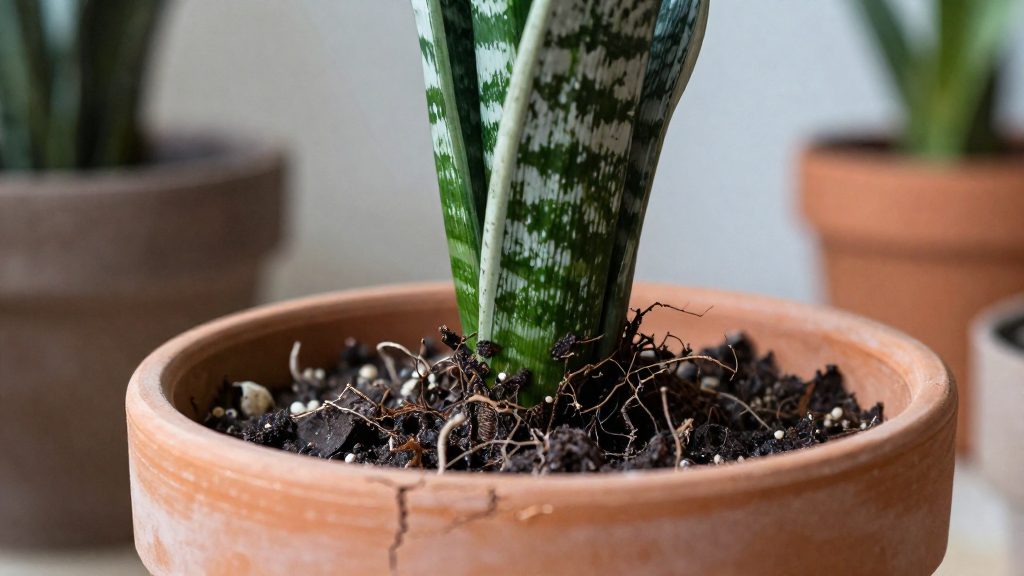
A snake plant needs repotting when its container becomes too small for the root system. According to Green Matters (2026), the two clearest signs are a cracked pot and roots growing out through the drainage holes. Both suggest that the roots have filled the available space and that the container has become too small for the root system.
Visible Warning Signs
| Sign | What it indicates |
|---|---|
| Cracked pot | Roots have expanded against the container walls until the material split |
| Roots through drainage holes | The root ball has filled the pot and is growing outward |
Check these signs before repotting on a set schedule. A pot that is intact and has no roots at the drainage holes does not need a larger container yet, even if the plant has been in it for some time.
Typical Repotting Interval
Green Matters (2026) states that snake plants are repotted on average every three to five years. The article attributes this figure to the University of Arkansas Division of Agriculture. Treat it as a general guide only: plants grow at different rates depending on the size of their pot and growing conditions, so the presence of the signs above is the more reliable indicator.
Materials and Potting Mix Needed
Repotting a snake plant (Dracaena trifasciata, formerly Sansevieria) requires few tools: a new pot, potting mix, and basic hand tools. According to Green Matters (2026), you should repot when the pot cracks or when roots grow out through the drainage holes. Otherwise, the plant is typically repotted every three to five years. Before starting, have everything within reach so the roots spend as little time out of the soil as possible.
The new pot should be larger than the current one and have drainage holes. Green Matters (2026) describes placing the plant in a bigger container and filling the gap with potting mix, so the new pot needs enough width to leave room around the root ball. The official sources consulted do not specify an exact size increase.
The potting mix is added around the root ball to fill the new pot. Use fresh mix rather than reusing old soil, since the old mix has likely compacted and may hold excess moisture.
The table below lists the tools and their use during the process:
| Item | Use |
|---|---|
| Fresh potting mix | Fills the space around the root ball in the new pot |
| Trowel | Loosens soil and helps free the plant if it resists |
| Knife or scissors | Cuts a plastic pot away from the root ball if the plant is stuck |
| Clean fingers | Untangle roots and remove excess soil |
| Pruning tool | Trims brown leaves and damaged roots |
Clean, sharp tools reduce the risk of damaging roots and spreading disease between plants. Keep a dry cloth nearby to wipe soil from your hands and the pot rim.
How to repot a snake plant step by step
Repot a snake plant when the pot cracks or when roots grow out through the drainage holes. Green Matters (2026) states that repotting is needed about every three to five years on average, a figure the article attributes to the University of Arkansas Division of Agriculture. The steps below follow the method described by Green Matters (2026).
Removing the plant from its pot
- Hold the base of the plant with one hand and the bottom of the pot with the other.
- Pull the plant out gently while shaking the pot.
- If the plant resists, cut away the plastic pot or loosen the soil with a hand trowel.
Preparing the roots
- Separate the root ball with your fingers to remove excess soil.
- Trim brown leaves and damaged roots.
- Divide the plant or take leaf cuttings if you want to propagate it.
Potting up and watering
- Center the plant in a larger pot.
- Fill around the root ball with potting mix.
- Leave about 1 inch between the soil surface and the rim of the pot, and make sure the plant sits firmly.
Watering timing after repotting depends on the moisture of the added mix:
| Condition of added potting mix | Watering action |
|---|---|
| Dry | Water thoroughly after repotting |
| Already moist | Wait a few days before watering |
How to divide the plant when repotting?
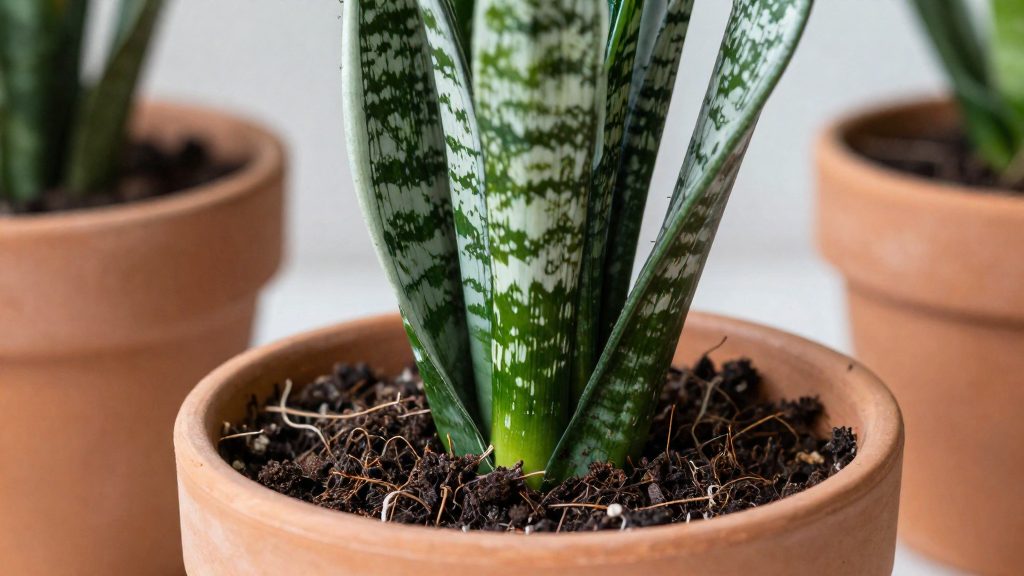
Division is done during repotting, once the root ball is out of its container. Repotting is needed when the pot cracks or roots grow out through the drainage holes. Green Matters (2026) gives an average interval of every three to five years and attributes that figure to the University of Arkansas Division of Agriculture. The same article lists division as one of the ways to propagate or refresh a snake plant, alongside leaf cuttings. The official sources consulted do not specify how many sections a plant should be divided into or how large each section must be.
- Remove the plant from its pot. Hold the base of the plant in one hand and the bottom of the pot in the other, then pull while shaking gently. If the plant resists, cut the plastic pot or loosen the soil with a trowel (Green Matters, 2026).
- Untangle the roots. Use your fingers to remove excess soil and separate the roots so the root mass can be seen clearly (Green Matters, 2026).
- Trim damaged parts. Cut off brown leaves and damaged roots before dividing (Green Matters, 2026).
- Divide the root mass. Separate the plant into sections along its natural clumps, making sure each section keeps its own roots. Gently pull the clumps apart by hand, and use a clean knife only where roots are too tightly bound to separate.
- Replant each section. Center each section in a container, fill around the roots with potting mix, and leave about 1 inch between the soil surface and the rim of the pot. The plant must be firmly held in place (Green Matters, 2026).
For the container size of each divided section, the official sources consulted do not give a specific recommendation. Green Matters (2026) only describes placing the plant in a larger pot, so the size should be chosen to fit the root mass of each section without leaving a large volume of unused soil.
Watering after division follows the same rule as standard repotting. If the potting mix added was dry, water thoroughly. If it was already moist, wait a few days before watering. Excess water stresses a snake plant, so avoiding waterlogged soil matters more than the watering schedule itself (Green Matters, 2026).
What care does a snake plant need after repotting?
Aftercare for a repotted snake plant depends mostly on the moisture of the potting mix added during repotting, according to Green Matters (2026). Check that mix before the first watering. Dry mix needs a thorough watering, while mix that was already moist should be left alone for a few days. Overwatering is the main error to avoid, because excess water stresses the plant while its roots are still recovering from disturbance.
Deciding when to water
Press a finger into the new potting mix to judge its moisture before deciding. The table below summarises the two cases described by Green Matters (2026).
| Moisture of the potting mix added | Action after repotting |
|---|---|
| Dry | Water thoroughly |
| Already moist | Wait a few days before watering |
How to water after repotting
When the mix is dry, water the whole root ball so the new soil is evenly moistened, then let the excess drain from the pot. Do not water a second time just because the surface looks dry, since the mix may still be wet underneath. Repeated light watering keeps the soil wet and is the pattern to avoid.
Mistakes to avoid
Excess water is the main risk after repotting. Follow the rule above: water thoroughly if the added mix was dry, wait a few days if it was already moist, and avoid excess water. The official sources consulted do not specify exact intervals between waterings, so judge by the moisture of the mix each time.
How often should you repot a snake plant?
A snake plant needs repotting when its container cracks or when roots grow out through the drainage holes. According to Green Matters (2026), repotting is needed on average every three to five years. Green Matters attributes this interval to the University of Arkansas Division of Agriculture. Because the trigger is physical rather than calendar-based, check the root system and container periodically instead of following a fixed schedule.
Signs that a snake plant needs repotting
- Cracked pot: the container splits or breaks, so it no longer holds the root ball securely.
- Roots through drainage holes: roots push out of the bottom openings, which shows the plant has filled its container.
Average interval
- Typical frequency: every three to five years on average, according to Green Matters (2026).
- Actual timing: driven by pot condition and root growth, so the average is a guide rather than a deadline.
Repotting steps at a glance
| Stage | Action |
|---|---|
| Removal | Hold the base of the plant with one hand and the bottom of the pot with the other, then pull while gently shaking. If the plant resists, cut a plastic pot or loosen the soil with a trowel. |
| Root preparation | Untangle the roots with your fingers to remove excess soil. Trim brown leaves and damaged roots. Division or leaf cuttings are also possible. |
| Potting | Center the plant in a larger pot and fill around it with potting mix. Leave about 1 inch between the soil surface and the rim, and make sure the plant is firmly anchored. |
| Watering | If the added potting mix was dry, water thoroughly. If it was already moist, wait a few days before watering. |