Drought-tolerant plantings on the Canadian prairies cut irrigation needs by matching plants to the conditions a yard actually provides, rather than watering the whole lot the same way. The gains come from three sources: grouping plants by water need, reducing turf, and watering deeply but less often. The prairie climate sets the limits, with dry summers, cold winters and variable rainfall. The official sources consulted do not give a percentage of water saved compared with a lawn, so the case below rests on the practices they describe.
Why choose drought tolerant plants on the prairies?
Xeriscape principles: group by water need
Xeriscaping, the practice of designing a yard around low water use, starts with grouping plants by similar water needs. According to CAA Manitoba Magazine (2022), this is the first principle of xeriscape practice. Plants that need more moisture sit together in one zone, and plants that tolerate dry soil sit together in another. Irrigation can then be applied to each zone according to its requirements, instead of to the entire lot.
The same source lists these additional practices:
- Limit turf to the areas where it serves a purpose.
- Add organic matter to the soil.
- Apply organic mulch around plantings.
- Water deeply but less often, using drip irrigation, a soaker hose or hand watering.
Water and maintenance compared with lawns
Reducing turf is one of the practices CAA Manitoba Magazine (2022) lists for lowering irrigation demand. The consulted sources do not compare the maintenance needs of turf and planted beds. The official sources consulted do not quantify either the water savings or the reduction in maintenance time, so these benefits should be judged on the specific lot.
Deep, infrequent watering matters because it encourages roots to grow downward, where soil holds moisture longer. Frequent light sprinkling keeps the surface wet and the roots shallow.
Prairie climate constraints
Three conditions shape any drought-tolerant plan on the prairies:
- Dry summers, when the soil needs the most attention and irrigation is most often required.
- Cold winters, which affect how plants survive in dormancy and how soil moisture is retained.
- Variable rainfall, which means a fixed watering schedule may over- or under-water from one year to the next.
Because rainfall varies, checking soil moisture by hand before watering is a practical habit. Watering should respond to what the soil shows, not to the calendar alone.
Which perennials handle dry prairie summers?
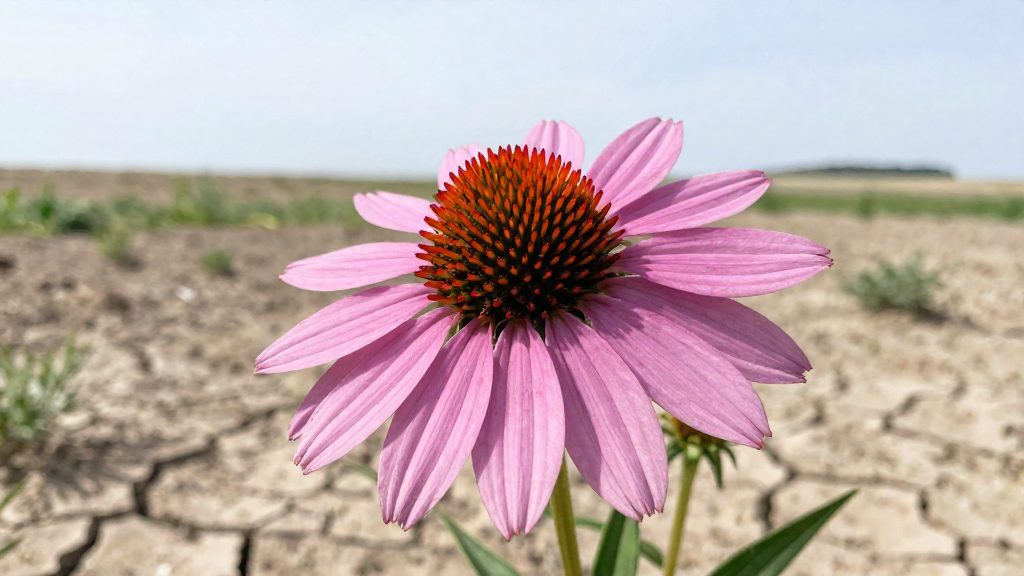
Several perennials are documented as drought tolerant for dry Canadian regions: blanket flower, false-sunflower, purple coneflower, yarrow, gas plant, sea lavender, Iceland poppy and yucca. The City of Calgary (2026) lists blanket flower, false-sunflower, gas plant, Iceland poppy, sea lavender and yucca, while Green Building Canada (2026) lists blanket flower, purple coneflower and yarrow for dry sites. Their light and soil needs differ, so the exposure and drainage of each bed should guide which species you place where.
| Plant | Documented condition | Source |
|---|---|---|
| Gas plant (Dictamnus albus) | Deep taproot; drought tolerant once established | City of Calgary (2026) |
| Sea lavender (Limonium latifolium) | Deep taproot | City of Calgary (2026) |
| Iceland poppy (Papaver nudicaule) | Grown in full sun | City of Calgary (2026) |
| Yucca (Yucca glauca) | Well-drained sandy loam | City of Calgary (2026) |
| Blanket flower (Gaillardia aristata) | Listed as drought tolerant | City of Calgary (2026); Green Building Canada (2026) |
| False-sunflower (Heliopsis helianthoides) | Listed as drought tolerant | City of Calgary (2026) |
| Purple coneflower | Listed as drought tolerant | Green Building Canada (2026) |
| Yarrow | Listed as drought tolerant | Green Building Canada (2026) |
Deep taproot species
Gas plant and sea lavender both develop a deep taproot, which is the structural trait noted for these two perennials. The City of Calgary (2026) describes gas plant as drought tolerant once it is established, so the first seasons after planting are the period when the plant still depends on regular watering.
Full-sun and well-drained sites
Iceland poppy is described for full sun, and yucca is described for well-drained soil, specifically sandy loam. Place these two in the sunniest, best-drained part of the bed. Avoid low spots where water collects, since these perennials are not described as tolerant of wet soil.
Drought-tolerant perennials without documented site needs
Blanket flower, false-sunflower, purple coneflower and yarrow are named as drought tolerant, but the official sources consulted do not specify their preferred light or soil conditions. Confirm exposure and soil type with a local nursery or extension service before planting these species in a new bed.
Native grasses for low-water yards
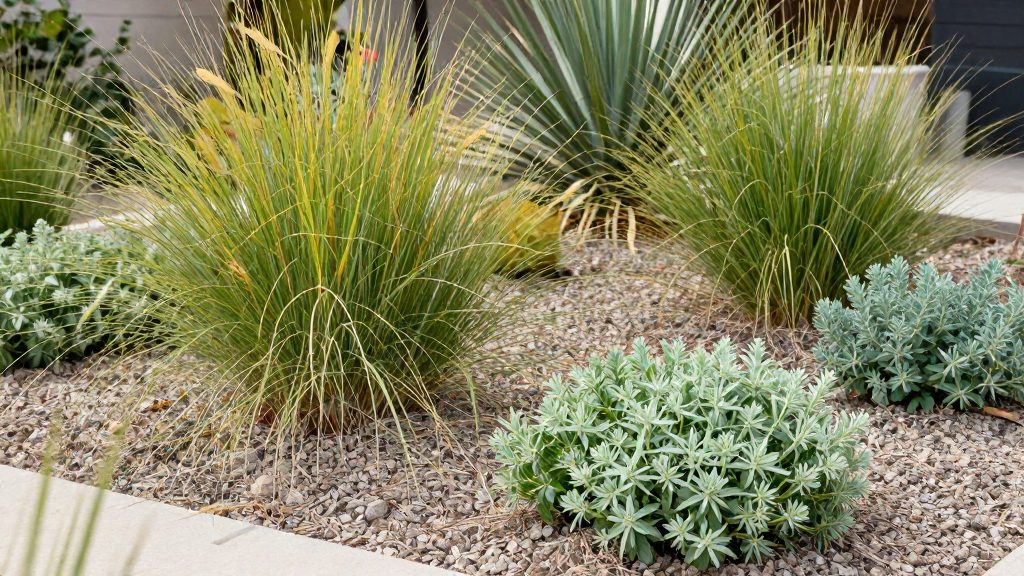
Little bluestem and blue grama are both listed as drought-tolerant grasses for dry Canadian regions (Green Building Canada, 2026). In a low-water yard, they work best as part of a planting group rather than as isolated specimens. The official sources consulted do not specify the growth habit, mature size, or spacing of either grass, so the placement advice below rests on general principles.
Little bluestem and blue grama
| Grass | Status in the consulted guidance | Source |
|---|---|---|
| Little bluestem | Drought-tolerant grass suggested for dry Canadian regions | Green Building Canada (2026) |
| Blue grama | Drought-tolerant grass suggested for dry Canadian regions | Green Building Canada (2026) |
The sources consulted do not state whether either species forms clumps or spreads, so check the plant tag or seed label for this before deciding where it goes in a bed.
Placing grasses in beds
- Group grasses with other plants that share their water needs, and keep thirstier perennials in separate beds.
Seed sourcing for prairie-style plantings
The official sources consulted do not specify seed suppliers, certification standards, or sowing rates for native grass seed. Before buying, read the seed packet and confirm the botanical name of each grass, so that little bluestem and blue grama are not mixed up with other species in a blend. Choose seed that lists the species names clearly, and compare them with the drought-tolerant grasses named above.
Shrubs and trees that tolerate drought
Woody plants give a xeriscape its structure, and the species below are the ones named for dry Canadian regions and for Manitoba xeriscaped yards. Start by choosing species from these regional lists. The sources consulted are a 2022 CAA Manitoba Magazine article and a 2026 Green Building Canada guide. They name the species but do not specify mature size, sun exposure or soil requirements, so check those details with a local nursery before planting.
Drought-tolerant shrubs
Saskatoon berry shrubs are described as tolerant of drought (CAA Manitoba Magazine, 2022). Buffaloberry is listed among shrubs for dry Canadian regions, alongside juniper and ninebark (Green Building Canada, 2026).
Drought-tolerant trees
Green Building Canada (2026) lists four trees for dry Canadian regions: bur oak, honey locust, hackberry and Kentucky coffeetree.
Species suggested for Manitoba xeriscaped yards
CAA Manitoba Magazine (2022) suggests five woody plants for xeriscaped yards in Manitoba: Siberian larch, Scots pine, flowering crabapple, subalpine fir and mountain ash.
Summary by species
| Species | Type | Listed for | Source |
|---|---|---|---|
| Saskatoon berry | Shrub | Drought tolerance | CAA Manitoba Magazine (2022) |
| Buffaloberry | Shrub | Dry Canadian regions | Green Building Canada (2026) |
| Bur oak | Tree | Dry Canadian regions | Green Building Canada (2026) |
| Honey locust | Tree | Dry Canadian regions | Green Building Canada (2026) |
| Hackberry | Tree | Dry Canadian regions | Green Building Canada (2026) |
| Kentucky coffeetree | Tree | Dry Canadian regions | Green Building Canada (2026) |
| Siberian larch | Tree | Manitoba xeriscaped yards | CAA Manitoba Magazine (2022) |
| Scots pine | Tree | Manitoba xeriscaped yards | CAA Manitoba Magazine (2022) |
| Flowering crabapple | Tree | Manitoba xeriscaped yards | CAA Manitoba Magazine (2022) |
| Subalpine fir | Tree | Manitoba xeriscaped yards | CAA Manitoba Magazine (2022) |
| Mountain ash | Tree | Manitoba xeriscaped yards | CAA Manitoba Magazine (2022) |
Choosing and grouping woody plants
Place shrubs and trees with comparable needs in the same bed or zone, so that one watering plan covers the group.
How do you prepare soil and mulch?
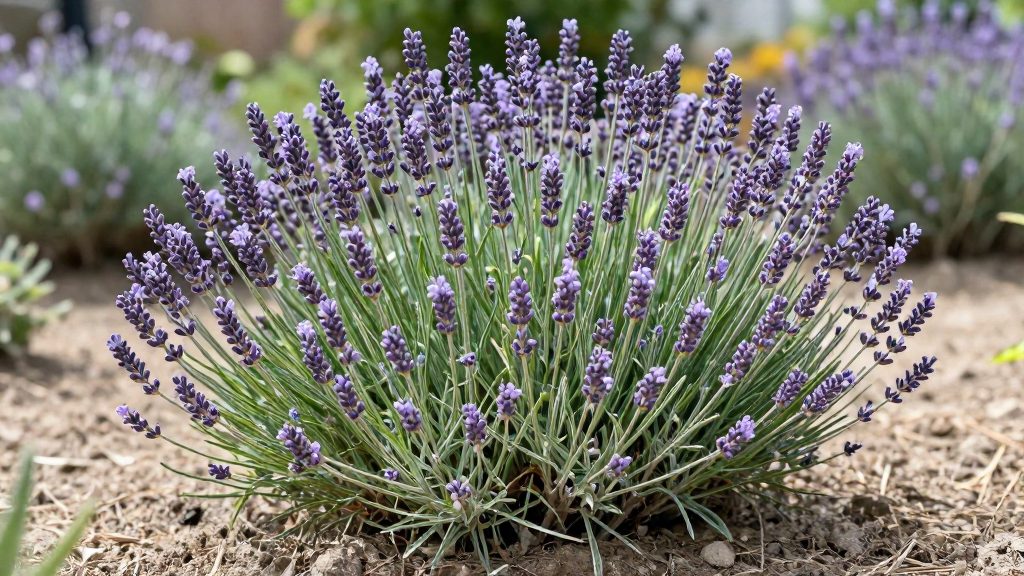
Soil and mulch preparation sets the moisture conditions that drought-tolerant perennials, shrubs and trees rely on in dry Canadian yards. Green Building Canada (2026) and CAA Manitoba Magazine (2022) both treat organic matter and organic mulch as core xeriscape practices.
Add organic matter to the soil
CAA Manitoba Magazine (2022) lists adding organic matter to the soil among its xeriscape practices. Work it into the bed before planting so the root zone of perennials and shrubs has more material to hold the water it receives. Green Building Canada (2026) advises adding compost every year, so organic matter is an annual task rather than a one-time step.
Spread organic mulch at the right depth
- Target depth: 5 to 10 cm of organic mulch around trees, shrubs and perennials (Green Building Canada, 2026).
- CAA Manitoba Magazine (2022) describes spreading about 4 inches (roughly 10 cm) of organic mulch.
- Spread the layer evenly across the bed rather than in concentrated heaps.
Avoid mulch volcanoes
Mulch should not be piled against trunks or stems, a practice Green Building Canada (2026) calls “mulch volcanoes.” Pull the mulch back from the base of each trunk and plant stem, leaving a clear gap at those points.
Summary of preparation rules
| Practice | Guidance | Source |
|---|---|---|
| Organic mulch depth | 5 to 10 cm around trees, shrubs and perennials | Green Building Canada (2026) |
| Mulch depth (xeriscape) | About 4 inches (roughly 10 cm) | CAA Manitoba Magazine (2022) |
| Mulch placement | Not piled against trunks or stems | Green Building Canada (2026) |
| Compost | Added every year | Green Building Canada (2026) |
| Organic matter | Added to the soil | CAA Manitoba Magazine (2022) |
How long should new plants be watered?
New plants in a prairie yard need supplemental water during an establishment period. During this time the roots have not yet spread through the soil, so the plant depends on the watering it receives. Drought tolerance comes later. Tolerance is therefore something a plant develops over time, not something it has on the day it goes into the ground.
The two-year establishment period
- Give new plants extra water for their first two years, as the City of Calgary (2026) describes for YardSmart plants.
- Water new plants on a schedule matched to their needs.
- Keep the schedule consistent through both years. Stopping early can leave young roots short of moisture.
Deep soaking to reach the roots
- Water until moisture reaches the root zone of the plant, not just the soil surface.
- After watering, check the moisture depth with a trowel or a probe. Dry soil below the surface means more water is needed.
- The official sources consulted do not give a specific soaking depth or volume, so adjust by checking the soil rather than following a fixed amount.
Gradual reduction after the second year
After the second year, reduce watering in steps rather than stopping at once.
| Stage | Watering approach |
|---|---|
| Years 1 to 2 | Extra water, applied deeply so moisture reaches the roots |
| After year 2 | Reduce watering gradually, in steps |
Watch the plants after each reduction. If leaves wilt and do not recover, return to the previous watering level for a while before reducing again.
Watering and lawn alternatives
Watering established drought-tolerant plants in Canadian prairie yards depends on two practices from the sources consulted: deep, infrequent watering and turf limitation. CAA Manitoba Magazine (2022) describes xeriscaping as a combination of grouping plants by water need, limiting turf, and watering deeply but less often by drip, soaker hose or hand. The official sources consulted do not specify watering frequency, volume per week or time of day, so the guidance below covers methods and plant choice rather than schedules.
Irrigation tools compared
| Method | Source | Stated detail |
|---|---|---|
| Drip irrigation | Green Building Canada (2026); CAA Manitoba Magazine (2022) | Recommended around trees, shrubs and perennials |
| Soaker hose | CAA Manitoba Magazine (2022) | Listed for deep, infrequent watering in xeriscaped yards |
| Hand watering | CAA Manitoba Magazine (2022) | Listed as an alternative method for the same watering pattern |
Drip irrigation is named by both sources. Soaker hoses and hand watering are presented as equivalent options, so the choice depends on the layout and size of the yard.
Turf area and low-water groundcover
Reducing the area of lawn is the main way to cut irrigation demand under the xeriscape approach described by CAA Manitoba Magazine (2022). Lawn can be kept where it is used and replaced elsewhere with perennial beds or groundcover. Green Building Canada (2026) lists the following drought-tolerant options for dry Canadian regions, and City of Calgary (2026) describes the conditions for several of the perennials:
| Plant | Source | Stated condition |
|---|---|---|
| Prairie smoke | Green Building Canada (2026) | Listed among drought-tolerant grasses and perennials |
| Sedum | Green Building Canada (2026) | Listed among drought-tolerant grasses and perennials |
| Yarrow | Green Building Canada (2026) | Listed among drought-tolerant grasses and perennials |
| Blanket flower (Gaillardia aristata) | City of Calgary (2026) | Described as drought tolerant |
| Gas plant (Dictamnus albus) | City of Calgary (2026) | Deep taproot; drought tolerant once established |
| Iceland poppy (Papaver nudicaule) | City of Calgary (2026) | Drought tolerant in full sun |
| Sea lavender (Limonium latifolium) | City of Calgary (2026) | Deep taproot |
| Yucca (Yucca glauca) | City of Calgary (2026) | Drought tolerant in well-drained sandy loam |
Irrigation timing for established plants and turf
The sources consulted do not give separate timing for turf, so lawn areas that remain should follow the pattern of fewer, deeper waterings.
Frequently asked questions
Which drought-tolerant perennials suit a prairie yard?
City of Calgary (2026) lists blanket flower, false-sunflower, gas plant, Iceland poppy, sea lavender and yucca, with yucca doing best in well-drained sandy loam. Green Building Canada (2026) suggests little bluestem, blue grama, prairie smoke, purple coneflower, yarrow and sedum. Blanket flower appears on both lists, so it is a reasonable starting point.
How should I water new drought-tolerant plants?
City of Calgary (2026) says YardSmart plants need extra water for their first two years, after which watering can be reduced gradually. CAA Manitoba Magazine (2022) recommends deep, infrequent watering by drip irrigation, soaker hose or hand, which encourages roots to grow downward where soil holds moisture longer.
How much mulch should go around drought-tolerant plants?
Green Building Canada (2026) recommends 5 to 10 cm of organic mulch around trees, shrubs and perennials. The same source warns against piling mulch against trunks, a practice known as “mulch volcanoes,” and advises adding compost every year.